

Private Pay Psychological Testing In 2026: Why Confidentiality Should Drive Your Decision
Written By: Michael Vale, Content Writer
Medically Reviewed By: Dr. Cathy Colet, Psy.D., Licensed Psychologist
Last Reviewed: April 14, 2026
If you’re weighing whether to use insurance or pay out of pocket for psychological testing, the answer comes down to one thing: who gets to see your results. Private pay psychological testing keeps your diagnosis, test scores, and clinical report out of insurance databases. You control the information. That single difference can affect your career, your insurance premiums, and even your ability to move abroad.
Most people don’t think past the co-pay. They see insurance coverage and assume it’s the smarter financial move. I’ve worked with enough adults pursuing autism, ADHD, and mental health evaluations to tell you the sticker price is rarely the full story. What you save on the front end with insurance can cost you in ways that don’t show up for years.
This article won’t cover forensic evaluations ordered by courts or attorneys. Those follow different rules around confidentiality and data ownership. We’re talking about adults who want answers for themselves and want to keep those answers private.

What Is Private Pay Psychological Testing?
Private pay psychological testing means you pay your psychologist directly, without routing anything through your health insurance. No claim gets filed. No diagnostic code enters your insurance record. No third-party reviewer decides what tests are “medically necessary.”
In a standard insurance-billed evaluation, your provider must submit diagnostic codes, test names, session notes, and sometimes the full report to justify payment. According to the APA’s Ethics Code, psychologists are bound by specific rules about what they can and can’t share. But once insurance is involved, that data moves into systems you don’t control.
With private pay, only you and your psychologist hold the results. You choose whether to share them with an employer, a school, a doctor, or nobody at all.

How a Diagnosis on File Can Follow You for Years
People think of a psychological evaluation as a one-time event. It is. But the record it creates isn’t. Once a diagnosis sits in an insurance database, it becomes part of your medical history. And that history gets pulled in situations most people never consider until they’re already in them.
Life Insurance and Underwriting Risk
Life insurance companies pull your medical records during underwriting. A documented diagnosis of depression, bipolar disorder, PTSD, or autism can change what you pay or whether you’re approved at all.
This isn’t speculation. Underwriters use diagnosis codes to model risk. A flagged mental health condition could mean higher premiums, reduced coverage caps, or outright denial, depending on the insurer’s guidelines. If that same diagnosis exists only between you and your psychologist (because you paid privately), it doesn’t appear in the records underwriters review.
I’m not saying you should hide conditions from your doctor. I’m saying there’s a difference between getting the answers you need and handing those answers to every company that requests your medical file.

Does a Mental Health Diagnosis Affect Security Clearances?
This is the one area where fear outpaces reality. The Defense Counterintelligence and Security Agency (DCSA) published a fact sheet stating that seeking mental health care does not, by itself, jeopardize your clearance eligibility. No cases were denied solely because someone got treatment.
But “doesn’t automatically disqualify you” and “won’t cause any friction” are two different statements. Section 21 of the SF-86 still asks about court-ordered care, involuntary hospitalizations, and certain diagnoses. Background investigators can request your medical records and a professional opinion on your reliability. For roles with the FBI, CIA, or Department of Defense, your psychological history gets reviewed.
Private pay doesn’t make you invisible to a background check. But it does keep diagnostic details out of insurance claim databases that standard employment screenings typically access. For careers in law enforcement, aviation, healthcare, or finance, that distinction matters.
Immigration and Visa Applications
Countries like Canada, Australia, and New Zealand review medical histories during visa processing. A documented autism or mental health diagnosis can trigger extra documentation requests, processing delays, or (in rare cases) denial based on projected healthcare costs.
Australia’s points-based system, for example, factors in whether an applicant might require social services that exceed a cost threshold. If your psychological testing results sit in an insurance database tied to your medical record, immigration officials may access them. Private pay keeps that evaluation out of the standard paper trail.
Why Are Wait Times So Much Shorter with Private Pay?
Here’s a practical reason that has nothing to do with privacy. Psychologists who accept insurance are buried. The BLS reports roughly 204,300 psychologists employed in the U.S. as of May 2024, with projected growth of only 6% over the next decade. Demand is outpacing supply.
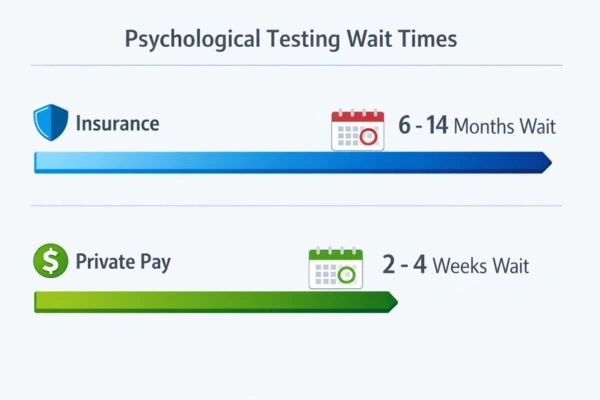
Insurance-based practices deal with prior authorizations, claim submissions, appeals, and lengthy evaluation backlogs. Wait times of six months to over a year are common for adults seeking ADHD or autism evaluations through insurance. I’ve seen people wait 14 months for a first appointment.
Private pay psychologists don’t have those administrative bottlenecks. Most can schedule you within two to four weeks. If you need answers for a workplace accommodation, a school plan, or your own clarity, that speed gap is the difference between moving forward and sitting in limbo.

The Hidden Cost Problem with Insurance-Covered Evaluations
Insurance looks cheaper until it isn’t. Providers can authorize psychological testing up front and then deny coverage after the evaluation is complete. You get a bill for the full amount, sometimes $2,000 to $3,500, with no warning.
Some insurers refuse to cover adult ADHD evaluations or autism assessments altogether, classifying them as outside the scope of medical necessity. Others cover only a portion of the battery, leaving you responsible for the rest.
With private pay, your psychologist gives you the total cost before testing starts. No claim reviews. No surprise denials three months later. You know the number, you agree to it, and that’s the end of the financial conversation. For adults paying out of pocket, comprehensive psychological evaluations typically run $1,500 to $3,500, depending on the testing battery.

Is Private Pay Psychological Testing Worth It?
For most adults pursuing an evaluation for ADHD, autism, or a mental health diagnosis, private pay is the better path. You get faster scheduling, transparent pricing, and full control over your records.
The privacy piece alone justifies it for anyone who might apply for life insurance, pursue a government career, or relocate internationally within the next decade. Those aren’t edge cases. Those are normal life decisions that a diagnosis in the wrong database can complicate.
If cost is a barrier, ask about payment plans. Many private pay psychologists, including practices that specialize in psychological evaluations, offer structured payment options that spread the expense across several months. The upfront number might look higher than a co-pay, but the long-term math favors keeping your results in your own hands.
Psychological testing should give you answers. It shouldn’t create problems you didn’t have before you walked in. Paying privately is the simplest way to make sure it doesn’t. If you’re unsure where to start, working with a team that understands your options can point you in the right direction.
Frequently Asked Questions
How much does private psychological testing cost in 2026?
Most private pay psychological evaluations for adults run between $1,500 and $3,500, depending on the type and number of tests in the battery. Neuropsychological evaluations or complex multi-day assessments can run higher. Your psychologist should give you the full cost before testing begins.
Will my psychological testing results show up on a background check?
Standard employment background checks don’t pull medical records. HIPAA protects that information, and employers can’t legally access it without your consent. The exception is roles requiring security clearances, where investigators may ask about specific mental health history disclosed on the SF-86.
Can insurance deny coverage for psychological testing after it’s already been completed?
Yes. Insurance companies can retroactively deny claims for psychological testing if they determine the evaluation wasn’t medically necessary. This leaves you responsible for the full cost, sometimes months after the testing is done. Private pay eliminates this risk entirely.
Does a mental health diagnosis affect your ability to get life insurance?
It can. Life insurance underwriters review medical records during the application process, and a documented diagnosis of depression, PTSD, bipolar disorder, or other conditions may result in higher premiums, reduced coverage, or denial. Private pay keeps the diagnosis out of insurance-accessible medical records.
Is psychological testing covered by health insurance?
Some plans cover psychological testing, but coverage varies widely. Many insurers limit the types of evaluations they’ll pay for, and adult ADHD or autism assessments are frequently excluded or only partially covered. Even with authorization, out-of-pocket costs after insurance can still be $800 to $2,000 or more.
What’s the difference between private pay and insurance-based psychological evaluations?
The main differences are privacy, speed, and cost predictability. Private pay keeps your records between you and your psychologist, typically schedules within weeks instead of months, and gives you a clear price up front. Insurance-based evaluations are cheaper initially but involve third-party access to your records and longer wait times.
Does seeking mental health care affect security clearance eligibility?
No. The Defense Counterintelligence and Security Agency states there are no automatically disqualifying mental health conditions or treatments. Seeking care is viewed as a positive step. Clearance concerns arise from untreated conditions, non-compliance with treatment, or dishonesty on the SF-86, not from getting help.

Dr. Cathy Colet, Psy.D., is a Licensed Clinical and Forensic Psychologist and founder of FC PsychExperts in Jupiter, Florida. She provides expert witness testimony across criminal, family, and immigration law, with advanced training in competency evaluations, criminal responsibility, child custody assessments, and VAWA hardship waivers.