

Why A Psychoeducational Assessment Matters For Diagnosing ADHD In Children In 2026
Written By: Michael Vale, Content Writer
Medically Reviewed By: Dr. Cathy Colet, Psy.D., Licensed Psychologist
Last Reviewed: April 18, 2026
A psychoeducational assessment is the most reliable way to diagnose ADHD in children because it measures how your child thinks, learns, and processes information across multiple settings. It goes well beyond a symptom checklist. If your child is struggling with focus, behavior, or schoolwork, a quick screening from a pediatrician might confirm a suspicion. But it won’t tell you why your child is struggling, whether something else is going on alongside ADHD, or what specific support your child actually needs to do better in the classroom.
A psychoeducational assessment is a structured battery of tests that evaluates a child’s cognitive ability (IQ), academic achievement, attention, executive function, and processing speed to identify the root causes behind learning and behavioral difficulties. It produces a detailed report used for ADHD diagnosis, school accommodations like IEPs and 504 plans, and (in some cases) legal proceedings.
I’ve reviewed hundreds of evaluation reports over the years, and the difference between a child who got a full psychoeducational assessment and one who got a 20-minute rating-scale review is night and day. The first kid has a roadmap. The second has a label. This article covers what the assessment includes, what it costs, why it matters more than most parents realize, and where the process breaks down if you skip it. We won’t cover adult ADHD testing or medication management here. Those are different conversations.

Why Can’t You Just Watch for Symptoms at Home and School?
You can. And that’s usually where it starts. A teacher notices your child can’t sit still. You notice homework takes three hours. The pediatrician hands you a Vanderbilt or Conners rating scale, and both you and the teacher fill it out. If the scores are high enough, your child gets an ADHD diagnosis. Done in one visit.
The problem? CDC data shows roughly 7 million U.S. children (about 11.4%) have received an ADHD diagnosis. That’s a huge number, and not all of those diagnoses rest on solid ground. A 2026 study reported that approximately 50% of psychologists assessing for ADHD don’t fully follow multi-context diagnostic guidelines. That’s the professionals. Pediatrician-only diagnoses relying on rating scales miss comorbidities in an estimated 30–50% of cases.
Watching for symptoms tells you that something is off. A psychoeducational assessment tells you what is off, how much it’s affecting your child, and what else might be riding along with it. Those are different questions, and they need different tools to answer.
How Does a Psychoeducational Assessment Look at the Whole Child?
This is where the testing earns its price tag. A psychoeducational assessment doesn’t just check a box for ADHD. It builds a full profile of your child.
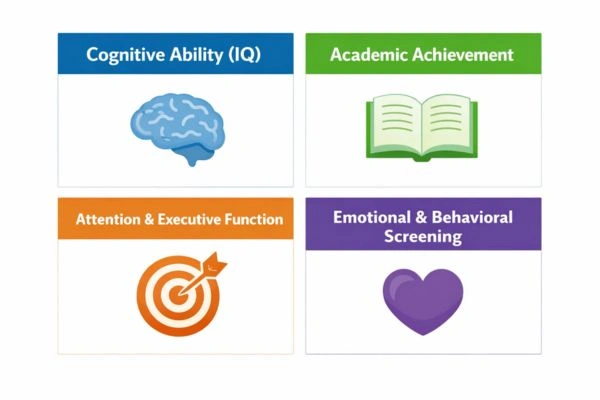
The typical battery includes four to six hours of direct testing (sometimes split across two sessions) plus parent and teacher questionnaires, a clinical interview, and a review of school records. Here’s what gets measured:
- Cognitive ability (IQ testing). This shows your child’s verbal reasoning, nonverbal problem-solving, working memory, and processing speed relative to same-age peers.
- Academic achievement. Standardized reading, writing, and math tests identify where your child performs compared to their cognitive potential. A gap between ability and achievement often signals a learning disability.
- Attention and executive function. Computerized performance tests (like the Conners CPT-3) and behavior rating scales from multiple sources measure sustained attention, impulse control, planning, and organization.
- Emotional and behavioral screening. Anxiety, depression, and trauma can all look like ADHD. Good testing screens for these.
The result is a 15–30 page report that explains your child’s cognitive and learning profile in plain language, with specific recommendations for home, school, and treatment. Without this level of detail, you’re guessing.

What Other Conditions Look Like ADHD in Kids?
This is the part most parents don’t hear about until it’s too late. A lot of conditions share symptoms with ADHD, and if your child has one of them (or has one alongside ADHD), a surface-level diagnosis will send you down the wrong path.
Anxiety is the biggest culprit. An anxious child can look inattentive because their brain is busy worrying, not because they can’t focus. Depression kills motivation and concentration. Learning disabilities like dyslexia create frustration that mimics hyperactivity and avoidance. Autism spectrum disorder overlaps with ADHD in roughly 30–80% of cases, depending on the study. And simple sleep deprivation? It produces symptoms nearly identical to ADHD in young children.
The American Psychological Association and the AAP both stress that any ADHD evaluation should screen for coexisting conditions. A psychoeducational assessment does this by design. A rating-scale-only approach does not.
Here’s a real scenario I’ve seen play out: a 9-year-old gets diagnosed with ADHD by a pediatrician, starts stimulant medication, and gets worse. Turns out the child had generalized anxiety disorder. The stimulant amplified the anxiety. A full assessment would have caught that before medication started, not after.

What Happens After Your Child Gets a Diagnosis?
A diagnosis without a plan is just a word on paper. The real value of a psychoeducational assessment is the recommendations section of the report.
Those recommendations aren’t generic. They’re tied directly to your child’s test results. If your child’s processing speed is in the 12th percentile but their verbal reasoning is in the 85th, the report will recommend extended time on tests, reduced written output expectations, and possibly assistive technology. If your child has ADHD combined type with a co-occurring reading disability, the recommendations will address both.
These reports are the documents that support IEP and 504 plan requests at school. They carry weight in due-process hearings if the school disagrees with your request. And in custody or juvenile court cases, a psychoeducational assessment gives testimony real teeth because the data behind it is standardized and replicable. CHADD’s evaluation guidance recommends that parents ask for testing that includes intelligence, achievement, and executive function measures, not just symptom checklists.
A word on cost: comprehensive psychoeducational assessments run $1,000–$5,000 nationally. Insurance coverage is inconsistent, and many plans only partially reimburse testing CPT codes. That’s real money. But I’ve watched families spend more than that redoing evaluations, switching medications that never should have been prescribed, or fighting school districts without adequate documentation. The upfront investment usually saves money and time in the long run.

How Do Parents and Teachers Use Assessment Results?
A good assessment doesn’t just hand you a diagnosis and send you home. It changes how every adult in your child’s life responds to them.
Parents stop interpreting ADHD behaviors as defiance or laziness. They start seeing a child whose working memory is in the 15th percentile, trying to follow multi-step directions in a world that assumes everyone can hold three instructions in their head at once. That shift alone changes the emotional temperature at home.
Teachers get specific, usable strategies instead of a vague “this child has ADHD” note. They know to seat your child near the front, break assignments into smaller chunks, allow movement breaks, and check for understanding after instructions. The difference between a teacher who has read a detailed assessment report and one working from a one-paragraph diagnosis letter is dramatic.
Here’s the contrarian take most clinicians won’t say out loud: school-district evaluations are free, and they’re legally required under IDEA if you request one. But they’re narrower in scope. A school evaluation looks at educational impact. A private psychoeducational assessment looks at your child as a whole person. If you only need a 504 plan for classroom accommodations, the school evaluation might be enough. If you need a full picture of how ADHD affects your child’s cognition, or if there’s any chance you’ll need the report for legal or private-school purposes, the private route is the stronger investment. Many families don’t realize this until they’ve already used up six months on the school process and still don’t have the data they need.
The bottom line: if your child is struggling and you’re wondering whether ADHD is the cause, a psychoeducational assessment gives you answers that a quick screening can’t. It costs more, takes more time, and produces something that actually drives results. Every parent I’ve worked with who invested in a full evaluation says the same thing. They wish they’d done it sooner.
If you’re considering an evaluation for your child, working with a team that understands both clinical and educational needs makes the process smoother from start to finish. The right assessment doesn’t just label your child. It gives your child a real path forward.
Frequently Asked Questions
Is a psychoeducational assessment really necessary for an ADHD diagnosis, or can a pediatrician handle it?
For basic medication management, a pediatrician’s diagnosis using rating scales may be enough per current AAP guidelines. But for school accommodations, ruling out other conditions, or any legal use, a psychoeducational assessment provides the depth you need. A 2026 study found that about half of psychologists skip full diagnostic guidelines when assessing ADHD, so the quality gap between a thorough assessment and a quick screening is wider than most parents assume.
How much does a psychoeducational assessment cost in 2026?
Nationally, a comprehensive psychoeducational assessment runs $1,000–$5,000. More complex neuropsychological batteries can reach $9,000–$14,000 at specialty centers. Insurance coverage varies widely. Many plans partially reimburse testing CPT codes, but full out-of-pocket payment is common. Always ask your provider for specific CPT codes before scheduling so you can verify coverage.
Can a school evaluation replace a private psychoeducational assessment for ADHD?
School evaluations are free under IDEA and legally required if you request one. They’re useful for establishing IEP or 504 eligibility. But they’re narrower, focusing only on educational impact. A private psychoeducational assessment provides a full cognitive, academic, and behavioral profile that’s stronger for private-school placement, custody cases, or due-process hearings.
What’s the difference between a psychoeducational assessment and a neuropsychological evaluation?
A psychoeducational assessment focuses on cognitive ability, academic achievement, and attention to identify learning disabilities and ADHD. A neuropsychological evaluation is broader, measuring memory, language, motor skills, and brain-behavior relationships. If the concern is primarily school performance and ADHD, psychoeducational testing is usually the right fit. If there’s a suspected brain injury, neurological condition, or autism, a neuropsychological evaluation goes deeper.
How long does a psychoeducational assessment take?
Most assessments involve four to six hours of direct testing with the child (often split across two sessions), plus parent and teacher questionnaires, a clinical interview, and a records review. The full process from intake to final report typically takes two to eight weeks.
How long are psychoeducational assessment results valid?
Results are generally considered current for two to five years, or until a major school transition. Schools often request updated evaluations every three years. For forensic or legal purposes, more recent testing usually carries more weight.
What conditions can a psychoeducational assessment identify besides ADHD?
A comprehensive assessment can identify specific learning disabilities (dyslexia, dyscalculia, dysgraphia), anxiety disorders, depression, intellectual giftedness, processing speed deficits, and executive function weaknesses. It can also flag indicators of autism spectrum disorder, though a separate evaluation is typically needed for a formal ASD diagnosis.

Dr. Cathy Colet, Psy.D., is a Licensed Clinical and Forensic Psychologist and founder of FC PsychExperts in Jupiter, Florida. She provides expert witness testimony across criminal, family, and immigration law, with advanced training in competency evaluations, criminal responsibility, child custody assessments, and VAWA hardship waivers.