
Psychological consultation is warranted in personal injury matters involving:
- Vehicular collision incidents
- Physical assault and battery cases
- Wrongful death claims
- Medical negligence and malpractice
- Premises liability accidents (slip, trip, and fall)
- Animal attack injuries
- Occupational and workplace injuries
- Traumatic brain injury (TBI)
- Spinal cord damage
- Pedestrian-involved accidents

A forensic psychological assessment in a personal injury case does one thing above all others. It establishes what the person was like before the event, measures what they are like now, and separates the two.
That separation is the whole job. Without a baseline, nobody can say which symptoms the collision caused and which were already there. The defense will ask that question in deposition, and a report that skipped it has already lost the point.
Emotional harm follows physical injury often, and it follows life-threatening events even when the body escapes. Disfiguring injuries and injuries that take away the ability to manage daily life independently carry the highest risk of lasting psychological consequence. Serious distress also develops with no physical injury at all, either from watching a traumatic event happen to someone else or from narrowly surviving one.
The expected diagnosis is post-traumatic stress disorder. It is not the only one. Major depression, specific phobias, generalized anxiety disorder, and dissociative presentations all follow traumatic injury, and the diagnosis that fits is the one the data supports rather than the one the referral anticipated.
Where a head injury is involved, neuropsychological testing measures what psychological testing cannot: specific memory deficits, executive dysfunction, reduced learning capacity, impaired visual-spatial processing and amnestic presentations.
Screening for symptom exaggeration runs throughout every one of our psychological assessments in personal injury litigation. Not as a section at the end. Throughout.
Understanding Personal / Emotional Injury Evaluations
A personal or emotional injury evaluation measures the psychological consequences of an event and projects how long they will last.
It answers two questions for the court. What did this event do to this person’s mental health, and what will that mean for their ability to work, maintain relationships and manage their own life going forward.
Those forensic assessments are used in civil and criminal proceedings alike, because the legal system needs a way to measure psychological harm that does not depend on how well the injured person describes it.
What the Evaluation Covers in a Tampa Case
Four questions, in order, because the third one is where reports fail.
Baseline. Pre-incident medical, mental health, school, military and employment records. Prior claims and prior diagnoses. This is most of the work, and it happens before anyone is examined.
Current condition. Structured clinical interview, standardized psychological testing, behavioral observation, and collateral interviews where the referral question needs them. Diagnosis against DSM-5-TR criteria where the criteria are met, and a plain statement where they are not.
Causation and apportionment. Which impairments trace to the event, which pre-dated it, and which have another cause entirely. Pre-existing conditions get addressed head-on. The defense examiner will find them either way, and a report that walked around them loses more than the point it avoided.
Prognosis and future needs. Expected course, recommended treatment, and what future care the condition indicates, written so that a treating clinician and an economist can both work from it.
The Hillsborough Deadlines That Govern Your Evaluation
In Hillsborough County the clerk generates your case management order automatically when you file, and it carries your expert deadlines already filled in.
Administrative Order S-2024-085, the Circuit Civil Differentiated Case Management Plan, took effect 1 January 2025. It provides that “a uniform Differentiated Case Management Order (‘DCM Order’) will be automatically generated by the clerk based on the initial designation made by plaintiff when filing.” The track comes from the case type on the civil cover sheet.
Every tort case type in the Thirteenth Circuit is assigned to the General track. Auto negligence. Other negligence. Premises liability, commercial and residential. Negligent security. Nursing home negligence. Product liability. Professional malpractice, medical.
Here is what the Amended Differentiated Case Management Order sets as the default calendar, counted in days from the filing of the complaint:
- Case management conference: 210 days
- Completion of fact discovery: 240 days on the streamlined track, 270 days on the general track
- Plaintiff’s expert disclosure: 300 days
- Defendant’s expert disclosure: 330 days
- Rebuttal expert disclosure: 344 days
- Completion of compulsory medical examination, if requested: 390 days
- Completion of expert discovery: 420 days
- Projected trial term: 540 days
Read the plaintiff’s expert disclosure line again. Three hundred days from filing, which is roughly 10 months, and the order exists from day one.
Three consequences for anyone commissioning a psychological evaluation in Tampa.
The clock starts at filing, not at retention. If a case has been in suit for seven months when the file lands on our desk, the plaintiff’s expert disclosure deadline is 90 days away and records collection has not started. Records are the long pole in a damages evaluation, and pre-incident records are the longest part of that pole.
The defense examination has its own published deadline. The order sets completion of the compulsory examination at 390 days, “if applicable and requested,” and marks it “subject to Rule 1.360(1)(A), Fla. R. Civ. P.” That is 60 days after the defendant’s own expert disclosure deadline and 150 days before the projected trial term.
These are defaults on a uniform order, not immovable dates. They can be modified. The point is that in Hillsborough you know the numbers before you decide whether to plead emotional distress damages at all, which is not true everywhere in Florida.
Send us the DCM order on the first call. Not the trial date. The order, with the expert disclosure deadline on it. We will tell you whether the window is reachable before you commit to anything.

What the Standard Tampa Examination Order Actually Allows
The Thirteenth Circuit publishes a standard Order Compelling Rule 1.360 Examination, and it answers the four questions attorneys usually have to argue about.
Most of what gets fought over in a compulsory examination is attendance, recording, scope and report timing. Florida’s rule leaves all four open. Hillsborough has pre-answered them on a form.
Who may attend. The order permits the plaintiff to have “his/her attorney (and spouse, or parent, or other representative) present for the examination, provided that only one of these listed non-attorney persons may attend.”
Recording. Plaintiff’s counsel may send “a court reporter or a videographer to the examination, provided that claimant’s counsel notifies defense counsel at least 10 days in advance.” A recording made by plaintiff’s counsel “is considered work-product, and neither the defense nor the examiner is entitled to a copy, unless and until same is designated as (or reasonably expected to become) trial evidence.”
Who may not attend. “Neither Defendant’s attorney nor any of Defendant’s representatives may attend, or observe, record or video the exam.”
Scope. The examination is “limited to the specific medical or psychological conditions in controversy,” and questions about fault, about hiring an attorney, about referrals and about attorney communications are marked as not permitted.
One examination per condition. The order provides that “such examination will be the only exam for the specific condition(s) or issues in controversy (without limiting the possibility of multiple specialties).”
Report timing. “The report of the examiner shall be sent to Plaintiff’s counsel… within 30 days of the examination, but in no event less than 21 days before the beginning of trial, unless otherwise agreed.”
Two of those terms change how a psychological examination gets prepared for. The 10-day notice requirement means the decision to bring a court reporter has to be made well before the appointment. And the scope limitation is enforceable, which means an order that says “psychological examination” and nothing more is an order worth objecting to before it is entered.
What Changed in Rule 1.360 on April 1, 2026
Rule 1.360(a)(1)(A) was amended effective 1 April 2026, and the new text requires the request or the response to say who is coming and how the examination will be recorded.
“The party to whom the request is directed shall serve a response within 30 days after service of the request, except that a defendant need not serve a response until 45 days after service of the process and initial pleading on that defendant. The court may allow a shorter or longer time. The response shall state that the examination will be permitted as requested unless the request is objected to, in which event the reasons for the objection shall be stated. If the examination is to be recorded or observed by others, the request or response shall also include the number of people attending, their role, and the method or methods of recording.”
Three things worth knowing about how that interacts with a psychological evaluation.
The request path in (a)(1)(A) is for physical conditions. Where the condition in controversy is not physical, subdivision (a)(1)(B) applies: a party must move for the examination, and the order “shall be made only after notice to the person to be examined and to all parties, and shall specify the time, place, manner, conditions, and scope of the examination and the person or persons by whom it is to be made.”
A mental examination cannot be obtained by request in Florida. It takes a motion, notice to everyone, and a court order that specifies scope. Rule 1.360(a)(2) puts the burden of showing good cause on the party seeking it.
Putting a mental condition in controversy is a decision. Pleading emotional distress as a category of damages is what opens the door to a psychological examination of your client. Decide it deliberately rather than as a by-product of the complaint.
A minor required to submit to examination under the rule “shall have the right to be accompanied by a parent or guardian at all times during the examination, except upon a showing that the presence of a parent or guardian is likely to have a material, negative impact on the minor’s examination.”
The Advantages of Psychological / Emotional Trauma Assessments
A psychological injury evaluation converts a subjective experience into evidence a court can weigh. That is what it is for.
Independent Documentation
The evaluation produces an independent measure of mental health status, arrived at through methods that can be described, replicated and cross-examined. Under Florida’s evidence code, expert testimony is admissible only where it rests on sufficient facts or data, is the product of reliable principles and methods, and applies those methods reliably to the facts of the case. Florida has applied that standard since the Supreme Court adopted the amendments to sections 90.702 and 90.704 of the evidence code on 23 May 2019.
A Measure of Functional Limitation
Psychological injury shows up in what a person can no longer do. The evaluation quantifies limitation across executive functioning, memory, emotional regulation and the capacity to complete ordinary daily activities, which is what turns “she has not been the same since” into something a jury can size.
A Route Into Treatment
Injury evaluations frequently identify treatment needs that nobody had named yet. Identifying PTSD, major depression or an anxiety disorder after a traumatic event is what makes targeted therapeutic interventions possible, for immediate symptoms and for longer rehabilitation.
A Basis for Future Needs
Damages run forward as well as backward. The evaluation projects expected course and future care requirements, which is what a life care planner or an economist needs in order to put a number on anything.

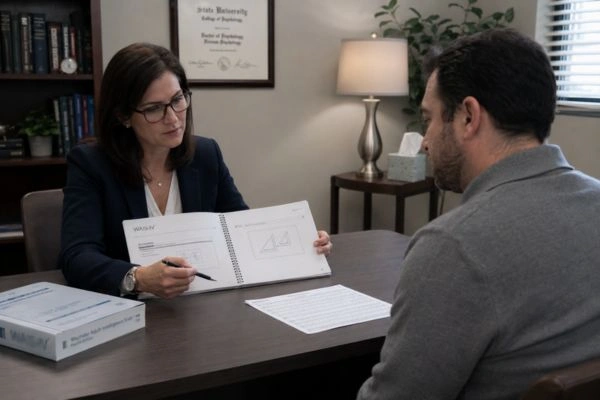
Key Elements of Personal Injury Evaluations
A forensic psychologist examines four elements in a personal or emotional injury evaluation.
- Pre-existing conditions and baseline functioning. Mental health and functioning before the event decide what can be attributed to it. Establishing the baseline is what lets the evaluator separate new impairment from old.
- Impact of the injury. Severity, frequency and duration of symptoms such as PTSD, depression, anxiety and phobic reactions, measured against how the person actually functions.
- Symptom validity. Whether the presentation is credible. Performance validity measures ask whether task performance is credible. Symptom validity measures ask whether self-report is credible. They answer different questions and neither substitutes for the other, which is why a defensible battery in a damages case carries both. A report that rests an invalidity opinion on a single failed measure is a report to cross-examine.
- Treatment recommendations. What would help, stated specifically: cognitive-behavioral therapy, trauma-focused therapy, medication management referral, or other services matched to the findings.
How Psychological / Emotional Trauma Assessments Support Legal Proceedings
The evaluation gives counsel documented psychological consequences that can support claims for damages and for future treatment.
In a collision case the psychological consequence is often specific and durable. Heightened anxiety about driving or riding in a vehicle changes where someone can work and how they run their household, and it frequently requires treatment that continues well past settlement.
In medical negligence litigation the damage is to trust. A person who was harmed inside the healthcare system may struggle with anxiety or depressive symptoms every time they engage with it afterwards, including for the care the injury itself made necessary.
One Florida threshold decides whether the question comes up at all. Where there has been no physical impact, the impact rule generally bars recovery for emotional distress in a negligence action, with a short list of narrowly defined exceptions. Where there has been an impact, the rule has no application, and mental anguish sits alongside pain and suffering as an ordinary element of damages. That single question, impact or no impact, comes before any evaluation is worth commissioning.
Examining the Operational Consequences of Trauma
Psychological injury is measured in function, and function is measured in three places: cognition, relationships and work.
- Executive function. Traumatic brain injury and psychological trauma both produce difficulty with memory, reasoning and sustained concentration. Clinicians document those changes to establish how intellectual capacity has actually shifted rather than asserting that it has.
- Psychological and interpersonal function. Traumatic events produce difficulty forming and keeping relationships, social withdrawal and distrust. This weighs heavily in assault and workplace harassment matters, where the trauma reshapes how the person relates to other people.
- Occupational function. The capacity to hold regular employment and perform in a professional setting is frequently the largest economic component of a psychological damages claim.
For the injured person, the evaluation does something beyond the case file. It puts a name and a measurement on an experience that until then has only been theirs to describe.
Where We Are, and Where We Are Not
FC PsychExperts has no Tampa office. Our offices are in Jupiter and Fort Lauderdale.
Saying so plainly is better than implying otherwise, and it matters less than it sounds. Records review, which is the largest part of a damages evaluation, is done remotely. Examinations are scheduled where the case requires.
Dr. Cathy Colet has served Florida courts since 2008 and has been court-qualified in Florida’s 1st, 15th, 17th, 19th and 20th Judicial Circuits. Hillsborough County is the 13th. We make no claim to prior qualification there, and any competent opposing counsel will check.
Her personal injury background includes firsthand work at a Level 1 Trauma Center covering traumatic brain injury, motor vehicle accidents, medical negligence, and rollover and catastrophic injury, including assessment of malingering and deception, for both plaintiff and defense counsel. That both-sides history is discoverable in Florida whether or not a practice publishes it, and it is the item that decides credibility fights more often than any other.
Verify any Florida psychologist’s license with the Department of Health before retaining them, including us. Florida issues no separate forensic psychology license. Everyone doing this work holds the standard psychologist license, which means the word “forensic” on a website is a marketing claim rather than a credential.
We decline cases for four reasons, and we say so on the first call rather than after the retainer clears:
- The referral question asks for a predetermined answer
- The records cannot support a defensible causation opinion
- The case needs a different discipline, such as psychiatry for medication questions
- A conflict exists from a prior evaluation of a party or family member
Why Tampa Attorneys Trust FC PsychExperts for Personal Injury Evaluations
Court-ready psychological evidence means a report that survives the deposition, and that is the standard the work is built to.
Our licensed psychologists produce documentation that holds up under cross-examination while giving the court the detail it needs. Validated testing instruments, structured clinical interviews, and methods that satisfy the reliability requirements of Florida’s evidence code.
We work for plaintiffs and for defendants. An evaluation is not a purchased conclusion, and if the data points somewhere unhelpful you will hear it on a call before anything is written down. At that point you still have options that close the moment something is filed.
Bring the DCM order and the expert disclosure deadline on it. Twenty-minute scoping call, no charge. We will tell you which evaluation answers your referral question and whether the window is reachable.
Get Expert Support Today
Frequently Asked Questions
When does a psychological evaluation have to be completed in a Hillsborough County civil case?
By the expert disclosure deadline on the Differentiated Case Management Order, which the clerk generates automatically at filing. On the Thirteenth Circuit’s Amended Differentiated Case Management Order the default deadlines run from the filing of the complaint: completion of fact discovery at 240 days on the streamlined track and 270 on the general track, plaintiff’s expert disclosure at 300 days, defendant’s expert disclosure at 330 days, rebuttal expert disclosure at 344 days, completion of expert discovery at 420 days, and a projected trial term at 540 days.
Which case management track does a Tampa personal injury case go on?
The general track. Under Administrative Order S-2024-085, effective 1 January 2025, every tort case type in Hillsborough County is assigned to the general track, including auto negligence, other negligence, premises liability commercial and residential, negligent security, nursing home negligence, product liability and professional malpractice medical. The track is set by the case type on the civil cover sheet at filing.
When does a defense psychological examination have to happen in Hillsborough County?
The Amended Differentiated Case Management Order sets completion of the compulsory medical examination, if applicable and requested, at a default of 390 days after the filing of the complaint, and marks it subject to Rule 1.360 of the Florida Rules of Civil Procedure. That is 60 days after the defendant’s own expert disclosure deadline.
Who is allowed to attend a Rule 1.360 examination in Tampa?
The Thirteenth Circuit’s standard Order Compelling Rule 1.360 Examination permits the plaintiff to have their attorney present, plus one non-attorney from among a spouse, parent or other representative. Plaintiff’s counsel may also send a court reporter or videographer if defense counsel is notified at least 10 days in advance. Neither the defendant’s attorney nor any of the defendant’s representatives may attend, observe, record or video the examination.
Can the examination be recorded?
Yes, by plaintiff’s counsel, with 10 days advance notice to defense counsel. Under the Thirteenth Circuit’s standard order a recording made by plaintiff’s counsel is work product, and neither the defense nor the examiner is entitled to a copy unless and until it is designated as, or reasonably expected to become, trial evidence.
What can the examiner ask about?
The Thirteenth Circuit’s standard order limits the examination to the specific medical or psychological conditions in controversy. Questions about fault, about the hiring of an attorney, about referrals, and about communications with counsel are not permitted. The order also provides that the examination will be the only exam for the specific conditions or issues in controversy, without limiting the possibility of multiple specialties.
When is the examiner’s report due?
Under the Thirteenth Circuit’s standard order the examiner’s report is sent to plaintiff’s counsel within 30 days of the examination, and in no event less than 21 days before the beginning of trial, unless otherwise agreed.