

Neuropsychological Evaluation For Parkinson’s Disease: What To Expect
Written By: Michael Vale, Content Writer
Medically Reviewed By: Dr. Cathy Colet, Psy.D., Licensed Psychologist
Last Reviewed: August 17, 2026
When memory or focus slips in Parkinson’s, three different problems can look identical: a medication side effect, depression, or the disease reaching the brain networks that run thinking. A neuropsychological evaluation for Parkinson’s is how you tell them apart. It’s a set of standardized tests, scored against people of your age and education, that maps which thinking skills have changed and which are intact. That map matters because the fixes differ. Adjusting a dopamine agonist, treating depression, and planning for cognitive change are three separate paths. Mild cognitive impairment shows up in 20% to 50% of people with Parkinson’s, and it often starts years before it disrupts daily life. Testing catches it early and hands your care team a baseline to measure against.

What Is a Neuropsychological Evaluation for Parkinson’s?
A neuropsychological evaluation for Parkinson’s is a series of pencil-and-paper and computer-based tests that measure memory, attention, processing speed, language, visual-spatial skill, and executive function. A neuropsychologist compares your scores to age-matched norms, then writes a report explaining which cognitive areas are affected and how that fits your Parkinson’s, your medications, and your mood.
It’s more involved than the quick questionnaire a neurologist runs in the office. A full evaluation looks at each thinking skill separately, so the result is a profile, not a single pass-or-fail number. Most people are referred by their neurologist, though you can also arrange a neuropsychological evaluation yourself.

Why Parkinson’s Changes Thinking and Memory
The same brain changes that cause tremor and stiffness also reach the circuits that handle attention and planning. Parkinson’s is a movement disorder on the surface, but the Parkinson’s Foundation lists six cognitive areas it commonly touches: attention, speed of mental processing, executive function, memory, language, and visuospatial skill.
Executive function and attention tend to go first. That looks like trouble juggling steps in a task, losing the thread in a group conversation, or feeling stuck when a decision has too many parts. A dopamine drop drives some of it, but researchers point to two other brain chemicals, acetylcholine and norepinephrine, as bigger players in memory and executive changes.
Mood makes it worse, and it’s common. Up to 50% of people with PD deal with depression and up to 40% with anxiety, and both drag down attention and memory on their own. That overlap is exactly why a trained examiner matters. A tired, anxious, or under-medicated brain tests worse than it actually is.
Is a MoCA the same as a Neuropsychological Evaluation?
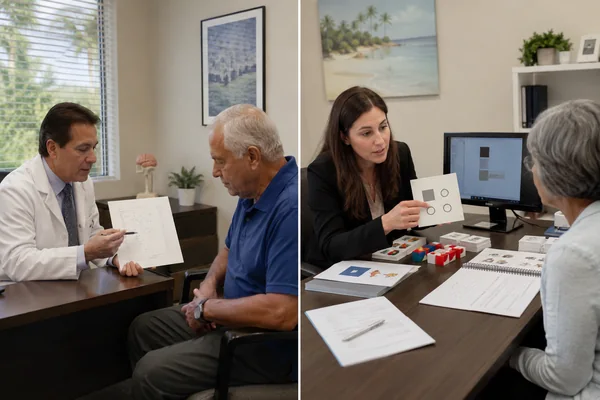
No. A MoCA is a 10-minute screen. A neuropsychological evaluation is several hours of testing that a screen can’t stand in for. This trips up a lot of families, so it’s worth being blunt: a normal score on a quick office screen does not mean your thinking is fine.
The Movement Disorder Society recommends the Montreal Cognitive Assessment (MoCA) as a screen for Parkinson’s, and it flags more early change than the older MMSE. But a screen is a flag, not a diagnosis. The Parkinson’s Foundation lists the MoCA and MMSE as screening tools and points to a clinical neuropsychologist for the detailed assessment that maps which domains are actually affected. If a screen looks borderline, or if it looks normal but you know something has shifted, that’s the moment a full evaluation earns its keep.

What a Parkinson’s Evaluation Actually Changes
The report changes real decisions, not just a chart note. It tells your team which symptom to treat first, whether you’re a candidate for deep brain stimulation, whether driving is still safe, and how to plan legal and financial matters while you can take part in the decisions.
Start with the baseline. The Parkinson’s Foundation makes the case plainly: an evaluation early in a cognitive problem lets your doctor tell whether a later change came from medication, from the Parkinson’s itself, or from something like depression. Without that first data point, everyone is guessing. There’s a useful rule that comes out of the same source: Parkinson’s does not cause sudden mental changes. If thinking drops off fast, the cause is usually a medication or another illness, and that’s worth flagging the same week.
Testing also feeds bigger calls. Neuropsychological assessment is a standard step in selecting patients for deep brain stimulation, because surgeons need to know the cognitive starting point before they operate. The same profile helps a neurologist separate Parkinson’s-related changes from Alzheimer’s disease or stroke, which the Parkinson’s Foundation names as a core reason to test. And when capacity or driving fitness is in question, a documented profile is far stronger than an opinion. That’s where a practice with a forensic background is different from a general clinic, since capacity questions are part of the daily work.

What to Expect During a Parkinson’s Evaluation
Expect several hours of one-on-one testing, usually in a morning session, plus an interview about your history and how daily life is going. A care partner is often asked to describe what they’ve noticed, because the people who live with you spot patterns you can’t.
There’s no needle and no scanner. You’ll answer questions, remember word lists, copy designs, sort cards, and work through timed puzzles. Some tasks feel easy and some feel hard on purpose, which is how the examiner finds the edges of each skill.
One piece of prep changes your results more than anything else: test during your “on” time. Take your Parkinson’s medication as usual and aim for a morning slot when you’re rested, since fatigue and poor sleep both push scores down. At FC PsychExperts, your neuropsychologist sets the exact tests and number of sessions around the questions your neurologist needs answered, and walks you through the plan before testing starts.

When Should Someone With Parkinson’s Get Tested?
Sooner than most people expect. The highest-value time is early, to set a baseline, and again any time thinking changes in a way you or your family notice.
Three moments are worth acting on. First, around diagnosis or soon after, so there’s a starting point on record. Second, before a major decision like deep brain stimulation, a move, or a change to who manages finances. Third, any sudden drop, which usually points to medication rather than the disease and should be checked quickly. Waiting until problems are obvious means losing the baseline that makes every later test readable.
How We Evaluate Parkinson’s Cognition in Palm Beach County
At FC PsychExperts, Parkinson’s evaluations are handled by Dr. Lauren Miller, a clinical and forensic neuropsychologist with nearly 20 years of experience, out of our Jupiter and Fort Lauderdale offices. Reports are reviewed by our founder, Dr. Cathy Colet, Psy.D.
Our forensic side is the part most clinics don’t have. The practice has served Florida courts since 2008, so when a Parkinson’s evaluation touches capacity, driving fitness, or a family’s legal planning, the report is written to hold up under scrutiny, not just to sit in a file. If your question is purely clinical, a straightforward clinical evaluation may be the better fit, and we’ll tell you which one you need.
You’ll find us at 210 Jupiter Lakes Blvd, Unit 4-201 in Jupiter, and 1451 W. Cypress Creek Road, Suite 300 in Fort Lauderdale. To start, call (561) 870-0411 or request an appointment.
If you or a parent has Parkinson’s, don’t wait for memory problems to get obvious. A neuropsychological evaluation for Parkinson’s gives your neurologist a baseline now, so the next change actually means something instead of leaving everyone to guess. That first appointment is the cheapest insurance you’ll buy all year.
Frequently Asked Questions
How long does a neuropsychological evaluation for Parkinson’s take?
Plan for several hours of one-on-one testing, usually in a single morning, plus a separate interview and the examiner’s scoring and report time afterward. The exact length depends on how many cognitive areas need testing, and your examiner will give you an estimate up front.
Is a MoCA the same as a neuropsychological evaluation?
No. The MoCA is a 10-minute screen that flags possible change. A neuropsychological evaluation is a multi-hour battery that measures each thinking skill separately and produces a full profile. A normal MoCA can miss real, early deficits.
Can a neuropsychological evaluation tell Parkinson’s dementia from Alzheimer’s?
It helps. The Parkinson’s Foundation names neuropsychological assessment as an important tool for telling PD apart from Alzheimer’s disease, stroke, and other causes of memory loss, because the pattern of affected skills differs between them.
Does everyone with Parkinson’s develop dementia?
No. Mild cognitive impairment affects 20% to 50% of people with PD, and not all of it leads to dementia. The Parkinson’s Foundation notes that about 30% of people with Parkinson’s do not develop dementia as the disease progresses.
Should I take my Parkinson’s medication before the test?
Yes, unless your doctor says otherwise. Test during your “on” time, when medication is working, and aim for a rested morning. Fatigue, poor sleep, and being “off” all push scores lower than your true ability.
When should someone with Parkinson’s get a neuropsychological evaluation?
Early, to set a baseline, and again any time thinking changes noticeably. Testing before deep brain stimulation or a major legal or financial decision is also worthwhile. A sudden drop should be checked quickly, since that usually points to medication rather than the disease.
Is the evaluation covered by insurance?
Often, when it’s medically necessary and ordered for a diagnostic reason, though coverage and out-of-pocket cost vary by plan. Check your benefits before scheduling, and contact our office to confirm fees and the plans we accept.

Dr. Cathy Colet, Psy.D., is a Licensed Clinical and Forensic Psychologist and founder of FC PsychExperts in Jupiter, Florida. She provides expert witness testimony across criminal, family, and immigration law, with advanced training in competency evaluations, criminal responsibility, child custody assessments, and VAWA hardship waivers.