
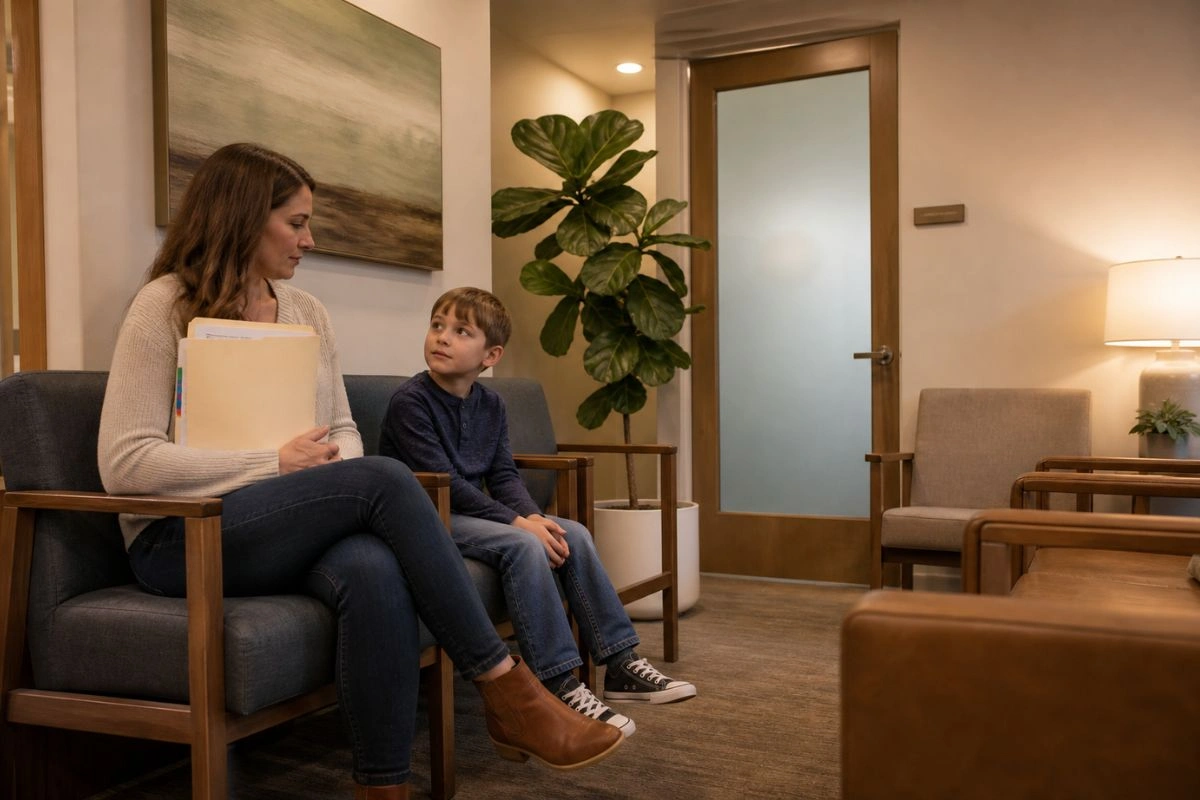
How To Prepare For A Psychoeducational Assessment
Written By: Michael Vale, Content Writer
Medically Reviewed By: Dr. Cathy Colet, Psy.D., Licensed Psychologist
Last Reviewed: May 16, 2026
Most parents don’t realize that what you do before a psychoeducational assessment matters almost as much as the testing itself. A psychoeducational assessment is a one-on-one evaluation conducted by a licensed psychologist that measures how your child thinks, processes information, and performs academically. It typically runs 4 to 8 hours across one or two sessions and produces a detailed report with a diagnosis (when one applies) plus specific recommendations for school accommodations like IEPs and 504 plans.
I’ve sat in on hundreds of feedback sessions where parents heard results that could’ve been sharper if the preparation had been better. Incomplete records, a child who barely slept, vague descriptions of the problem. These aren’t small things. They change what the evaluator sees and what they recommend.
What Documents Should You Gather Before Testing?
Bring everything. Not “whatever you can find.” Everything.
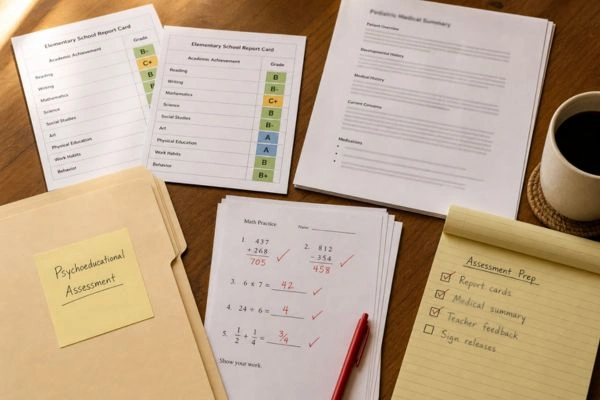
The evaluator needs your child’s report cards going back at least two years, any teacher evaluations or progress reports, and prior testing results if they exist. A 2024 survey by the National Association of School Psychologists found that roughly 63% of evaluators said incomplete background records were the single biggest barrier to accurate diagnosis.
Medical records matter too. If your child has a history of ear infections, concussions, or medication changes, the psychologist needs to know. These things affect cognitive performance in ways that look like learning disabilities but aren’t.
Here’s what to put in a folder before your appointment:
- Report cards and teacher comments (last 2–3 years)
- Any previous psychological, speech, or occupational therapy evaluations
- Medical records covering diagnoses, medications, and developmental milestones
- IEP or 504 plan documents, if your child already has one
- Work samples showing the specific struggles you’ve noticed
One thing parents overlook: bring examples of the problem, not just the grades. A math worksheet where your child got every computation right but couldn’t finish a word problem tells the evaluator something a report card can’t.

Tell the Evaluator What You’ve Actually Noticed
This is where most parents either underexplain or overexplain. The evaluator doesn’t need a full biography. They need you to describe specific patterns you’ve observed, when they started, and what you’ve already tried.
Bad example: “He’s struggling in school.”
Better: “He reads at grade level when it’s quiet, but can’t retain anything he reads in a classroom. His teacher started a reading intervention in September, and after four months his comprehension scores haven’t moved.”
That second version gives the evaluator something to test against. The APA’s assessment guidelines stress that parent observations are one of the strongest predictors of assessment accuracy, because parents see patterns that show up across settings, not just during a two-hour test.
If you’re pursuing psychoeducational testing because a teacher suggested it, ask that teacher to write down their concerns before your appointment. A written observation from a teacher carries diagnostic weight.
Also, tell the evaluator what you want to know. Are you trying to qualify for a 504 plan? Do you suspect ADHD? Being direct about your goals shapes which tests get administered.

Rest, Nutrition, and Medication on Test Day
This sounds obvious, but it falls apart more than you’d think.
Your child needs a full night of sleep the night before testing. The WISC-V (one of the most common IQ tests in psychoeducational assessments) includes timed subtests that measure processing speed. Sleep deprivation impairs working memory and processing speed by roughly 20-30%, according to research published in the Journal of Sleep Research. Six hours of sleep versus eight isn’t a small difference on a timed test.
Feed your child a real breakfast. Protein and complex carbs. Skip the sugary cereal that causes a crash 90 minutes later, right in the middle of a reading comprehension subtest.
If your child takes medication for ADHD or anxiety, give it as prescribed unless the evaluator tells you otherwise. Some evaluators want to see your child on and off medication. Ask this question before test day, not the morning of.

What Happens During a Psychoeducational Assessment?
The evaluator typically starts with a parent interview. This takes 30 to 60 minutes and covers developmental history, school history, and your specific concerns. Your child isn’t usually in the room for this part.
Then comes the actual testing, which runs 3 to 6 hours depending on complexity. Your child works one-on-one with the psychologist through a battery of standardized tests. Common tools include the Wechsler Intelligence Scale for Children (WISC-V) for cognitive ability, the Woodcock-Johnson IV for academic achievement, and the BASC-3 for behavioral and emotional functioning.
The tests aren’t pass/fail. They measure how your child thinks relative to same-age peers across verbal reasoning, working memory, processing speed, reading, math, and written expression.
After testing, the psychologist scores everything and writes a report. This usually takes 2 to 4 weeks. You’ll get a feedback session where the evaluator walks you through results, diagnosis (if applicable), and recommendations.
One thing that surprises parents: the evaluator is also watching how your child approaches problems. Do they give up quickly? Rush through timed sections? That behavioral data matters as much as the scores.

Preparing Your Child Without Creating More Anxiety
Here’s the contrarian take: most advice about “preparing your child emotionally” actually backfires. Telling a 7-year-old “there’s nothing to worry about” three times before the appointment teaches them there’s something to worry about.
Keep it simple and honest. Tell your child they’re going to do some activities with a psychologist so you can all figure out the best way to help them at school. Use the word “activities,” not “tests.” For younger kids, you can say it’s like puzzles and games (because it partially is). For older kids, be straight. “A psychologist is going to figure out how your brain works best.”
Don’t try to prep them on content. The evaluator needs your child’s actual, uncoached performance. Practicing math facts the night before distorts the results.
If your child has anxiety about new situations, the only preparation that actually helps is familiarity with the logistics. Tell them where you’re going, how long it’ll take, that they’ll get breaks, and that you’ll be in the waiting room. The National Center for Learning Disabilities recommends framing the assessment as a way to understand strengths, not just problems.

Why Honesty Changes the Outcome
I’ve seen parents minimize problems during the intake interview because they don’t want a label on their child. And I’ve seen parents exaggerate problems because they want to guarantee a diagnosis.
Both approaches hurt your child. The evaluator compares your description against objective test data. If you say “he’s fine at home” but the WISC-V shows a significant processing speed deficit, that mismatch adds uncertainty and can weaken the report.
Be specific and truthful. If your child melts down over homework every night, say that. If they’re doing fine socially but falling apart academically, say that too. A complete picture leads to a complete diagnosis, and that’s what gets your child the right support.

What Should You Do After Getting the Results?
The report is only useful if you do something with it. And this is where most families drop the ball.
Schedule the feedback session within two weeks of receiving the report. Come with questions. If the evaluator recommends classroom accommodations, ask specifically: “What do I need to say to the school to make this happen?”
If your child qualifies for an IEP or 504 plan, the psychoeducational report is your strongest tool. Schools are required under IDEA and Section 504 to consider outside evaluations. Bring the report to a meeting with your child’s school psychologist and special education coordinator. Don’t just email it.
If the results show something unexpected (an additional referral for neuropsychological testing, for example), ask why and what it would add.
The families I’ve worked with who get the best outcomes from psychoeducational assessments are the ones who treat the report as a starting point, not an endpoint. The testing tells you what’s happening. What you do with that information is what changes your child’s trajectory in the classroom.
Frequently Asked Questions
How long does a psychoeducational assessment take?
Most psychoeducational assessments take 4 to 8 hours of testing, spread across one or two sessions. After testing, the psychologist needs 2 to 4 weeks for scoring and report writing. The feedback session typically adds another hour. From first appointment to final report, plan for roughly 4 to 6 weeks total.
What’s the difference between a psychoeducational assessment and a neuropsychological evaluation?
A psychoeducational assessment focuses on learning and academic performance. It measures IQ, academic achievement, and information processing to identify learning disabilities and guide school accommodations. A neuropsychological evaluation is broader and examines brain function across areas like memory, attention, executive function, and motor skills. Most families start with psychoeducational testing unless the referral question involves brain injury, neurological conditions, or cognitive decline.
Can a psychoeducational assessment diagnose ADHD?
Yes. A psychoeducational assessment can identify ADHD when the evaluation includes attention and executive functioning measures alongside cognitive and academic testing. Tools like the Conners Rating Scales and the BASC-3 are commonly used. About 9.8% of U.S. children aged 3 to 17 have received an ADHD diagnosis, according to CDC data from 2024.
What tests are used in a psychoeducational assessment?
The most common tools include the WISC-V (Wechsler Intelligence Scale for Children) for cognitive ability, the Woodcock-Johnson IV or KTEA for academic achievement, and the BASC-3 for behavioral and emotional functioning. The specific battery varies depending on your child’s age and the referral question. A licensed psychologist selects the appropriate combination.
Will a psychoeducational assessment help my child get an IEP or 504 plan?
It’s the most direct path. Schools are required under IDEA and Section 504 of the Rehabilitation Act to consider independent psychoeducational evaluations when determining eligibility for accommodations. The written report provides the documentation schools need to justify services. Roughly 7.3 million U.S. students (ages 3–21) received special education services under IDEA during the 2022–2023 school year, according to the National Center for Education Statistics.
At what age should my child get a psychoeducational assessment?
Children can be evaluated as early as age 3, though most psychoeducational assessments are conducted between ages 6 and 16 when academic demands make learning differences more visible. If your child has struggled academically for six months or more despite receiving help, that’s generally the right time to pursue testing regardless of age.
How do I use the psychoeducational assessment report with my child’s school?
Bring the full report to a meeting with the school psychologist and special education coordinator. Request an eligibility meeting for an IEP or 504 plan. The school must review the outside evaluation and respond in writing. If you disagree with their decision, you have the right to request an Independent Educational Evaluation at the district’s expense under IDEA regulations.

Dr. Cathy Colet, Psy.D., is a Licensed Clinical and Forensic Psychologist and founder of FC PsychExperts in Jupiter, Florida. She provides expert witness testimony across criminal, family, and immigration law, with advanced training in competency evaluations, criminal responsibility, child custody assessments, and VAWA hardship waivers.