

What Is Neuropsychological Evaluations For Epilepsy?
Written By: Michael Vale, Health Content Writer
Medically Reviewed By: Dr. Cathy Colet, Psy.D., Licensed Psychologist
Last Updated: August 18, 2026
In 247 adults with newly diagnosed epilepsy, tested before any of them had taken a single antiseizure drug, 47.8 percent had measurable memory deficits. Only 25.1 percent said they had a memory problem.
Witt and Helmstaedter published those figures in the Journal of Neurology in 2012, and they are the reason a neuropsychological evaluation for epilepsy exists. Asking someone how their memory is doing finds roughly half of what testing finds. The missing half is the half that later decides whether a person keeps a driver’s license, keeps a job, or qualifies for benefits.
Your neurologist orders this evaluation to plan treatment. That is a real use and it matters. What almost nobody explains is who reads the report after that.

What A Neuropsychological Evaluation For Epilepsy Measures
A neuropsychological evaluation for epilepsy is a set of standardized tests that measure memory, attention, language, processing speed, and executive function, paired with an assessment of mood and personality. A neuropsychologist scores each result against age-matched norms, then writes a report describing where seizures, medication, or mood have changed how a person’s brain performs.
The appointment starts with an interview. Sometimes a family member sits in, because people are unreliable narrators of their own attention. Then the testing itself: paper-and-pencil tasks, timed puzzles, word lists, and computer-administered measures. Questionnaires about mood and daily functioning go home with the patient and, often, with a spouse or parent. Our walkthrough of the stages of a neuropsychological assessment covers the sequence in more detail, and the tests involved in a neuropsychological evaluation names the batteries by cognitive domain.
Published session lengths vary widely by center. Cleveland Clinic’s patient handout gives three to five hours of testing. Northwestern Medicine says three to six. UCSF Benioff Children’s says one to six for children. Texas Children’s breaks it down by age, from one to three hours for toddlers up to four to six hours for older adolescents.
Epilepsy sits alongside the other conditions neuropsychologists evaluate, and the battery is not fixed. It changes with the referral question, which is the first thing worth asking about.

Why Testing Finds What Asking Misses
Self-report and formal testing disagree, and they disagree in a direction that costs patients.
Go back to those 247 untreated patients. Witt and Helmstaedter found impairments in attention and executive function in 49.4 percent and memory deficits in 47.8 percent. Only 27.9 percent were unimpaired in both. Meanwhile 28.7 percent reported attention problems and 25.1 percent reported memory problems. Their own conclusion was blunt: “Patients appear to underreport cognitive deficits.”
The same pattern shows up in mood. Scott and colleagues pooled 27 studies covering 3,221 people with epilepsy in Epilepsia in 2017 and tested how the assessment method changed the answer. Unstructured clinician assessment found anxiety disorders in 8.1 percent, 95% CI 5.7 to 11.4. Structured clinical interview found them in 27.3 percent, 95% CI 22.1 to 33.3. The moderation statistic was Q1 = 36.29, p<0.0001. That is not a comment on anyone’s competence. It is a comment on instruments. Informal questioning misses more than two thirds of the anxiety that structured assessment detects.
At population level, CDC data from the 2021 to 2022 National Health Interview Survey covering 57,088 adults found 55.8 percent of adults with active epilepsy reported difficulty remembering or concentrating, against 19.1 percent of adults without epilepsy. Nearly a three-fold gap, self-reported. The measured gap is wider.

Who Reads The Report After Your Neurologist?
Four other readers, usually, and each one wants something different from the same document.
A disability adjudicator wants scores mapped to functional limitations, not diagnoses. A state licensing authority reviewing a driving privilege wants evidence about attention, reaction time, and awareness. An employer processing an accommodation request wants to know which specific work demands are affected. A school district wants standardized scores that map onto eligibility categories. An opposing expert in a lawsuit wants to know whether the effort measures were run and what they showed.
A report written only for the referring neurologist tends to say “mild verbal memory weakness, recommend compensatory strategies.” That sentence is clinically fine and evidentially useless. It does not tell an adjudicator whether the person can sustain concentration across an eight-hour shift.
| Treatment-purpose evaluation | Evaluation written to be scrutinized | |
|---|---|---|
| Who asks for it | Neurologist, epileptologist, patient | Attorney, insurer, court, agency, or a patient anticipating a claim |
| Question answered | What is going on and what helps | What is the person’s functional capacity, and what caused it |
| Records reviewed | Usually the treating chart | Full history, including pre-illness school, work, and medical records |
| Validity measures | Sometimes | Always, and reported |
| Causation addressed | Rarely | Directly |
| Who else sees it | The care team | Opposing counsel, an adjudicator, and a rebuttal expert |
| Written to survive | Clinical review | Cross-examination |
Neither column is better. They answer different questions, and a report built for one does not convert into the other after the fact. Our guide to neuropsychological assessments in medico-legal cases covers where the two paths separate.

What Social Security Actually Requires
This is the part no page on either search results page explains, and it is the reason cognitive testing decides epilepsy claims.
The Social Security Administration’s neurological listing 11.02 has four pathways. Two of them turn on seizure frequency alone. The other two do not.
| Pathway | Seizure requirement, despite adherence to prescribed treatment | Additional requirement |
|---|---|---|
| A | Generalized tonic-clonic, at least once a month for at least 3 consecutive months | None |
| B | Dyscognitive, at least once a week for at least 3 consecutive months | None |
| C | Generalized tonic-clonic, at least once every 2 months for at least 4 consecutive months | Marked limitation in one of five areas |
| D | Dyscognitive, at least once every 2 weeks for at least 3 consecutive months | Marked limitation in one of five areas |
The five areas are physical functioning; understanding, remembering, or applying information; interacting with others; concentrating, persisting, or maintaining pace; and adapting or managing oneself. Four of the five are mental, not physical. SSA defines “marked” as the fourth point on a five-point scale, meaning seriously limited in the ability to function independently on a sustained basis.
So a person whose seizures are frequent but not frequent enough for pathway A or B can still meet the listing through C or D, and the deciding evidence is a documented marked limitation in a cognitive or behavioral domain. That is a neuropsychological finding. A seizure diary cannot produce it. Neither can an EEG, which listing 11.00 does not require and Social Security will not purchase.
Worth knowing about the paperwork: the listing requires at least one detailed description of the seizures from someone who has observed a typical episode. Multiple seizures in 24 hours count as one. Status epilepticus counts as one. Our post on a neuropsychological evaluation in a disability claim covers how the report gets built for that use.

Most People With Epilepsy Will Never Have Surgery, And Still Need The Testing
Here is where the standard framing breaks.
Nearly every page ranking for this topic presents neuropsychological evaluation as a step in the surgical workup. University of Florida buries its page five levels deep inside the epilepsy surgery program. Texas Children’s opens with “All patients considering surgery.” That framing tells the majority of readers the article is not about them.
The commonly quoted figure is that one third of people with epilepsy are drug resistant. It comes from tertiary referral centers, where the hardest cases concentrate. Chen and colleagues reported 36.3 percent not seizure free across 1,795 newly treated patients at a single Glasgow center over 30 years, in JAMA Neurology in 2018. Pool 39 cohorts including community and pediatric samples, n = 21,139, and the drug-resistant rate is 17 percent, 95% CI 13 to 21 (Janmohamed and colleagues, CNS Drugs, 2023).
Both figures are accurate about the populations they describe. The practical consequence is that roughly five in six people with epilepsy will achieve seizure control on medication and will never sit in a pre-surgical conference. Their cognitive problems are no less real, and their reasons for testing are the ones this field ignores: work, school, driving, benefits, and tracking change over time.
One number that has not moved: Kwan and Brodie found 63 percent of 525 patients seizure free in 2000. Chen’s 30-year update found 63.7 percent. Eighteen years and a dozen new drugs later, the same fraction.

Separating The Seizures From The Medication
Patients ask whether the fog is the epilepsy or the pills. The honest answer is usually both, in a proportion that testing can estimate and conversation cannot.
Start with the fact that deficits arrive before the drugs do. That is what the Witt and Helmstaedter cohort of untreated patients establishes, and it rules out the tidy explanation that medication is the whole story.
Medication still contributes, and not equally across drugs. Salinsky and colleagues gave healthy volunteers topiramate at 300 mg per day in a double-blind placebo-controlled trial published in Neurology in 2005, and reported that those subjects “performed significantly worse on half of the neuropsychological variables.” Healthy volunteers, so seizures cannot be blamed for the result. Compared directly against lamotrigine across 41 variables, lamotrigine performed better on 33 of them and topiramate on none. Carbamazepine, in the same line of research, was worse than the non-drug condition on 65 percent of measures against 12 percent for levetiracetam.
Now the gap that matters. Mula’s review in Therapeutic Advances in Drug Safety in 2012 found that up to 10 percent of patients on add-on topiramate complain of cognitive side effects, falling to 3 to 4 percent on monotherapy. Measured decline in the volunteer studies ran near half the variables tested. Complaints ran near one in ten. Testing catches what patients do not raise, and dose matters: at 251 mg per day topiramate impaired performance on only one of 17 variables, while at 400 mg it showed up on word finding and processing speed.
Nothing here is a reason to stop or change a medication. That decision belongs to your neurologist, and stopping an antiseizure drug without medical supervision is dangerous. It is a reason to arrive at that conversation with data instead of an impression.

The Comorbidity That Changes Outcomes More Than Seizure Count
Depression and anxiety are more common in epilepsy than in the general population, and the real numbers are lower than the internet claims.
Two independent meta-analyses converge. Fiest and colleagues, in Neurology in 2013, pooled population-based studies covering 29,891 people with epilepsy and found active depression in 23.1 percent, with an odds ratio against people without epilepsy of 2.77, 95% CI 2.09 to 3.67, drawn from more than 1.2 million participants. Scott’s 2017 analysis, built on a different set of samples, found depressive disorders in 22.9 percent and anxiety disorders in 20.2 percent. The figures of 50 percent and higher that circulate widely come from small symptom-scale surveys at tertiary clinics, not from diagnostic assessment.
Suicide risk runs higher too, and the pooled evidence behind that is now large. Wang and colleagues, in Frontiers in Psychiatry in 2023, covered 88 articles, 1,178,401 people with epilepsy and 6,900,657 controls, and reported an odds ratio of 2.60 for total suicidality, 95% CI 2.13 to 3.18. Within epilepsy populations, pooled suicidal ideation ran at 19.73 percent.
Here is the finding that contradicts what most clinicians assume. Scott’s team tested drug resistance as a moderator of psychiatric comorbidity and it was not significant for depressive disorders. Their own words: these findings “challenge widely held assumptions that psychiatric comorbidity is more common in people with drug-resistant epilepsy.” Well-controlled epilepsy does not mean psychiatrically low-risk, which is precisely why mood screening belongs in the evaluation rather than in the referral criteria. Our clinical psychological evaluation service covers that side of the assessment.
If any of this is describing your own situation and you are having thoughts of harming yourself, this is worth raising with your doctor now rather than at the next appointment. In the United States you can call or text 988 at any hour.
When The Seizures Are Not Epilepsy
Some people referred for epilepsy testing do not have epilepsy. They have functional seizures, also called psychogenic nonepileptic seizures, and the misdiagnosis has a cost measured in years.
The American Academy of Neurology published its practice guideline on the management of functional seizures in Neurology in December 2025. It states that diagnosis has historically been “delayed for an average of 7-8 years after symptom onset.” A 2024 Montreal cohort published in Frontiers in Neurology reported a median delay of 3 years in patients diagnosed in an epilepsy monitoring unit, which is real progress and still a long time to treat the wrong condition.
The guideline also dismantles the either-or framing. Functional seizures may co-occur in up to 12 percent of people with epilepsy, and epilepsy may co-occur in up to 20 percent of adults with functional seizures, 30 to 40 percent of children, and up to 50 percent of individuals with intellectual disabilities and functional seizures.
What that misdiagnosis costs: the AAN gives a Level B recommendation that clinicians should not prescribe antiseizure medications to patients with functional seizures who have no co-occurring epilepsy or other indication, and should taper the ones already prescribed. Which means a person can spend years on drugs with documented cognitive effects, for a condition those drugs do not treat.
Now the limit, stated plainly, because overclaiming here would be dishonest. Neuropsychological testing does not diagnose functional seizures. Video EEG of a typical episode remains the confirmatory test. The AAN places psychological assessment in the comorbidity and treatment pathway, with a Level B recommendation that clinicians evaluate patients for co-occurring affective, trauma-related, personality, and substance use disorders, and that neurologists and mental health clinicians collaborate. Testing contributes; it does not decide.
One more consequence most people never hear: Social Security evaluates psychogenic seizures under the mental disorders listings rather than under 11.02. The diagnosis changes which rulebook applies to the claim.
Can Testing Hurt A Disability Claim?
Yes, sometimes, and any evaluator who tells you otherwise is selling something.
A disability attorney’s own published guidance tells claimants to weigh the pros and cons with a lawyer before agreeing to neuropsychological testing. That warning is fair. Three things can go wrong. Scores can land in the normal range and be read as proof that nothing is wrong. An inconsistent effort profile can be read as exaggeration. And a poorly built report can invite a rebuttal expert to argue that no baseline was ever established, so no decline can be shown.
Every modern battery includes performance validity measures, which test effort directly rather than inferring it from a low score. This is not an accusation aimed at any individual. It is what makes the rest of the data interpretable, and its absence is the first thing an opposing expert looks for. We cover this in whether you can fail a neuropsychological evaluation and in more depth in detecting malingering in forensic evaluations.
There are cases where I would tell someone to gather records before testing rather than after. If nobody can document what a person’s memory, reading speed, or work performance looked like before the seizures started, a single set of scores has nothing to be compared against. School transcripts, standardized test results, performance reviews, and military entrance scores all reconstruct a baseline. Bring them. They change what the report can conclude.
What To Bring, And What To Ask Before You Book
Bring the glasses. Bring the hearing aids. Take medication exactly as prescribed on the day, unless the ordering physician says otherwise, because testing an unmedicated brain answers a different question than the one being asked. Say in advance if an interpreter is needed. Sleep, and if a seizure happens the night before, call, because a postictal patient produces scores that describe the postictal state and nothing else.
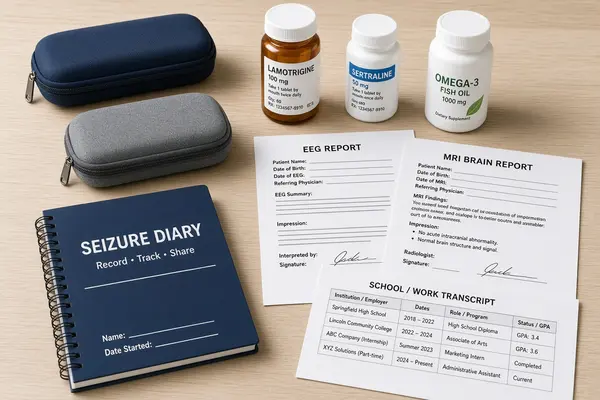
Bring the records: seizure diary, medication history including drugs that were tried and stopped, EEG and MRI reports, and anything documenting function before the epilepsy began.
Then ask three questions of whoever is doing the evaluation. Is a neuropsychologist administering and interpreting this, and what is their training in epilepsy specifically? Does the battery include performance validity measures? And what is the turnaround from testing day to written report? Every published page in this field tells you how many hours the testing takes. Almost none tells you how long you wait for the document, which is the part that actually gates a claim, an accommodation, or a surgical decision. Our post on what type of doctor does neuropsychological evaluations explains what to look for, and for children, how to prepare your child for a neuropsychological evaluation covers the day itself.
Where To Start
If the evaluation is purely about treatment planning, your epilepsy center’s own neuropsychologist is usually the right call and the shortest path. Ask for the referral.
If the report is going to be read by anyone outside the care team, an adjudicator, an insurer, a school district, a licensing authority, or opposing counsel, the report needs to be built for that reader from the first appointment. It cannot be retrofitted.
That is the work we do. Our neuropsychological evaluation service already names epilepsy and seizure disorders among the conditions it covers, and Dr. Lauren Miller brings nearly 20 years as a clinical and forensic neuropsychologist, including reviewing psychological and neuropsychological disability claims and analyzing opposing experts’ reports. She has taught graduate assessment courses at the University of Miami and Nova Southeastern. A neuropsychological evaluation for epilepsy from our offices in Jupiter and Fort Lauderdale is scoped against the question the report has to answer, not against a standard battery. Call 561-870-0411 and tell us who is going to read it.
Medical disclaimer: this article is general information, not medical or legal advice, and it is not a substitute for care from your treating physician. Never change or stop an antiseizure medication without your doctor.
Frequently Asked Questions
How long does a neuropsychological evaluation for epilepsy take?
Published session lengths from major epilepsy centers run from about three to six hours of testing for adults, with Cleveland Clinic listing three to five hours and Northwestern Medicine three to six. Pediatric evaluations are usually longer and are often split across days.
Does epilepsy cause memory loss?
Memory problems are the most commonly reported cognitive complaint in epilepsy, and they show up early. In 247 adults with newly diagnosed epilepsy tested before any medication, 47.8 percent had measurable memory deficits, while only 25.1 percent reported having a memory problem. Seizure activity, antiseizure medication, and mood all contribute, and formal testing is what separates them.
Will I lose memory after epilepsy surgery?
Some patients do, and the risk depends heavily on which side is operated on. Pooled across 23 studies and 2,012 patients, verbal memory declined in 44 percent after dominant-side temporal resection and 20 percent after non-dominant. Seven percent and 14 percent respectively improved, so the outcome is not uniformly a loss, and knowing the number before consenting is the point of pre-surgical testing.
Can a neuropsychological evaluation for epilepsy be used for a disability claim?
Yes, and for two of the four Social Security pathways it is close to decisive. Listing 11.02 pathways C and D require, in addition to a seizure frequency threshold, a documented marked limitation in one of five functional areas, four of which are mental rather than physical. A seizure diary cannot establish that. Standardized cognitive testing can.
Has the Wada test been replaced by fMRI?
No. The American Academy of Neurology’s 2017 guideline says fMRI may be used instead of the intracarotid amobarbital procedure for language and memory lateralization, but rates that recommendation Level C, its weak evidence tier, and states that fMRI is not established as an alternative for predicting global amnesia after surgery. The guideline’s one moderate-strength recommendation is for fMRI as a predictor of verbal memory outcome, working alongside neuropsychological testing rather than replacing the Wada test.
Can neuropsychological testing tell epileptic seizures from functional seizures?
It contributes but it does not decide. Video EEG of a typical episode remains the confirmatory test, and the 2025 AAN guideline places psychological assessment in the comorbidity and treatment pathway rather than the diagnostic one. Testing still matters, because functional seizures may co-occur in up to 12 percent of people with epilepsy and epilepsy in up to 20 percent of adults with functional seizures.
Does insurance cover a neuropsychological evaluation?
Coverage depends on the payer, the referral question, and whether the evaluation is treatment-purpose or requested for a legal or benefits matter. Evaluations ordered for litigation, an insurer, or a court are generally billed to the requesting party rather than to health insurance.

Dr. Cathy Colet, Psy.D., is a Licensed Clinical and Forensic Psychologist and founder of FC PsychExperts in Jupiter, Florida. She provides expert witness testimony across criminal, family, and immigration law, with advanced training in competency evaluations, criminal responsibility, child custody assessments, and VAWA hardship waivers.