

Family Therapy For Addiction In 2026: 3 Methods That Work
Written By: Michael Vale, Content Writer
Medically Reviewed By: Dr. Cathy Colet, Psy.D., Licensed Psychologist
Last Reviewed: November 8, 2026
Family therapy for addiction works, and the research is specific about how. When relatives learn a method called CRAFT, about 2 in 3 loved ones who refused help go on to enter treatment. In a pooled analysis of 12 clinical trials, couples therapy built around recovery beat individual treatment. For teens, a 2018 review gave its highest rating to family therapy that works with parents, school and peers together.
Dr. Cathy Colet, a licensed clinical and forensic psychologist, founded FC PsychExperts in Jupiter. Her predoctoral internship, in 2012 and 2013, was at an addiction treatment program in West Palm Beach. She gave individual and family therapy there to adults and to teens 13 to 17. Today she’s also a court-appointed expert witness in 5 Florida judicial circuits.

What Is Family Therapy For Addiction?
Family therapy for addiction is counseling that brings a person’s family into substance use treatment. A licensed clinician works with relatives to help a loved one start treatment. Sessions also change the habits at home that keep drinking or drug use going and support each family member’s own recovery.
That definition tracks SAMHSA’s Treatment Improvement Protocol 39, the federal guide to family therapy in substance use care, last updated in 2020. It names the same 3 goals: start and sustain recovery, repair communication at home, and help relatives care for themselves.
Sessions can include a spouse, parents, adult children or siblings. They can also include only the relatives. Our Palm Beach County family therapy page sets it apart from individual therapy in 1 row. In family therapy, the client is the family system. In individual therapy, the client is the individual.
That page also lists “A diagnosis, an addiction, a loss” among the 6 situations that bring families to our Jupiter office most often. In its words, “When 1 member is in treatment or grieving, the whole system shifts.”
Family Therapy For Addiction: What The 2026 Evidence Shows
As of 2026, 3 methods lead the evidence: CRAFT for relatives, behavioral couples therapy for partners and family-based treatment for teens. The need is large. SAMHSA’s 2025 National Survey on Drug Use and Health came out in July 2026. It counted 44.6 million people aged 12 or older, or 15.3%, with a substance use disorder in the past year. Only about 1 in 6 people who needed treatment got it.
Children carry part of that load. A SAMHSA report on 2009 to 2014 data estimated that 8.7 million children lived with at least 1 parent who had a substance use disorder. That’s about 1 in 8 children.
| Approach | Built for | Typical length | What the research found |
|---|---|---|---|
| CRAFT (Community Reinforcement and Family Training) | Relatives of someone who refuses treatment | Usually 4 to 6 sessions | About 2 in 3 loved ones entered treatment across 4 trials |
| Behavioral couples therapy | Married or live-in partners, together 1 year or more | 12 to 20 weekly sessions | Beat individual treatment in a pooled analysis of 12 trials |
| Behavioral family counseling | An adult in recovery plus a parent | 12 sessions | Better retention and abstinence than individual treatment |
| Multidimensional family therapy | Teens and their parents | 16 to 25 sessions over 4 to 6 months | Cut teen drug use in randomized trials |
| Brief strategic family therapy | Teens and their families | Varies by program | More than 30 years of research; first built for Cuban youth in Miami |
Couples And Adult Children
For couples, the strongest data comes from a 2008 analysis in Clinical Psychology Review. Powers and colleagues pooled 12 randomized trials with 754 people. Adding behavioral couples therapy beat individual treatment. The pooled effect size was 0.54, which researchers call medium.
Right after treatment, the gain showed up mostly in relationship satisfaction. At follow-up, couples therapy came out ahead on all 3 outcomes: how often people used, problems caused by use, and relationship satisfaction. SAMHSA’s protocol reports the same edge for women and men.
If you’re the partner who wants help and your spouse won’t come yet, our couples therapy lets 1 partner start alone. For an adult child who lives with a parent, TIP 39 describes a 12-session version built around a daily trust discussion. The parent backs the plan to stay sober, and both work on fewer fights and better conversations.
Teens
For teens, family involvement sits at the top of the evidence, tied with 2 forms of cognitive behavioral therapy. It rated ecological family-based treatment “well-established.” That is its highest category, shared with individual and group CBT.
Ecological models such as multidimensional family therapy work with the teen, the parents, the school and peers at the same time. The federal protocol also cites a pooled study where family counseling for teens beat some individual and group methods and usual care.
There’s a Florida thread here, too. Brief strategic family therapy was first developed in Miami for Cuban youth.
What If Your Loved One Refuses Help?
Start without them. CRAFT trains relatives, and in head-to-head trials it beat the other common family approaches at getting a resistant loved one into care.
In 2010, Roozen and colleagues pooled 4 randomized trials with 264 family members. CRAFT got about 2 in 3 treatment-resistant loved ones into treatment, and the program typically ran 4 to 6 sessions. Relatives learn to notice and reward sober time, stop arguing about the use, and pick the moment to bring up treatment.
The relatives gained too. Family members felt better emotionally and physically in every group. That included those sent to Al-Anon, Nar-Anon or a Johnson-style intervention.
You don’t need your loved one’s agreement to begin here, either. Our post on who has to attend family therapy covers this. A course can run parents-only for weeks before a child joins, and the work still holds.
Skip The Surprise Intervention
If you’re planning a TV-style intervention, where the family surprises someone and reads letters, the research points to a calmer route. In the same 2010 review, CRAFT’s treatment entry rate was about 3 times that of Al-Anon or Nar-Anon. It was twice the rate of the Johnson Institute intervention, the classic confrontation model.
SAMHSA’s guide adds a warning. People pushed into treatment through confrontation are more likely to return to use. People who start through positive reinforcement do better.
So the evidence points to CRAFT first. Learn it, or find a therapist trained in it, and keep Al-Anon or Nar-Anon for your own support. The protocol also links Al-Anon with real gains for family members. As a way to get someone else into treatment, it’s the weaker bet.
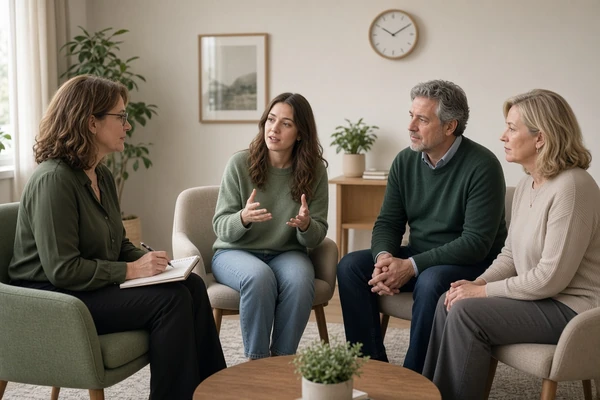
What Happens In A Family Therapy Session For Addiction?
A first session maps the family’s pattern, who reacts to whom, and ends with 1 small thing to try at home.
The First 80 Minutes In Our Jupiter Office
Most families arrive braced for a blame session. It isn’t one. A first family appointment at FC PsychExperts runs like this:
| Time | What happens |
|---|---|
| Minutes 0 to 15 | Everyone gets the same question: “What would need to be different for you to say this helped?” Each person answers, and nobody is interrupted. |
| Minutes 15 to 45 | The pattern, not the person. We map the loop: who reacts to whom, what happens next and where it ends. |
| Minutes 45 to 65 | Short one-on-one time if needed. A teen or a co-parent may get 10 minutes alone, and what gets shared back is agreed in advance. |
| Minutes 65 to 80 | 1 small, specific thing to try before next time, plus a plan for who attends the next session and how often you meet. |
From there, our family work moves through 5 stages: joining, assessment, restructuring, consolidation and closure. Our post on what the first family therapy session should look like covers how to prepare.

What Changes When Addiction Is In The Room
With addiction, the sessions get more specific. TIP 39 says the focus shifts from how the family talks to what it talks about. That means the use itself, its effects on the household and what to do after a return to use.
It also describes a family behavior loop map, a step-by-step chain of who does what before someone uses and before they don’t. The point is that no single person is the cause or the victim. We start mapping that loop at minute 15.
Families relapse too. A relative who spots a sign of use can slide back into blaming, shaming or taking over the household. So the protocol has family members write their own relapse plan, with their triggers, self-care steps, people they can call and crisis numbers.
Goals don’t have to start at total abstinence, either. SAMHSA lists harm reduction goals among the core principles of family-based care.
How Long Does Family Therapy For Addiction Take?
It depends on the method. CRAFT usually takes 4 to 6 sessions. Couples therapy runs 12 to 20 weekly sessions. Teen programs like multidimensional family therapy run 16 to 25 sessions over 4 to 6 months.
At FC PsychExperts, sessions run 50 to 80 minutes. Our family therapy page says focused goals, such as a specific conflict or a transition, often improve in 8 to 12 sessions.
NIDA’s research-based treatment guide adds a wider frame. Most people need at least 3 months in treatment to cut their drug use sharply or stop.
When Is Family Therapy The Wrong First Step?
When someone in the home isn’t safe, or when the addiction is active and untreated. In both cases, other care comes first.
Safety is the first screen. TIP 39 lists “no indication of risk of severe intimate partner violence” as a basic condition for behavioral couples therapy. It also tells counselors to talk through safety before inviting relatives into treatment. Our guide on when family therapy isn’t appropriate puts it in 1 line: “Safety must always come first for every family member.”
The same guide draws a second line: “Family therapy often fails when addiction is still active and untreated.” It adds, “Substance abuse needs specialized care before therapy can help.” The methods in the table above were built for addiction, not for general family problems. CRAFT, for example, works with relatives while their loved one is still using.
TIP 39’s couples criteria also screen out cases where a mental health condition would get in the way of taking part. The protocol reports that couples therapy seems to work as well when both partners have a substance use disorder and both are working on recovery.
On the free 15-minute call, we figure out who should come to the first session.

Court-Ordered Family Therapy Can Still Work
A court order doesn’t cancel out treatment. Pressure to start can still lead to progress.
NIDA’s Principles of Drug Addiction Treatment puts it directly: “Treatment does not need to be voluntary to be effective.” The same principle says pressure from family, an employer or the criminal justice system can raise treatment entry, retention and success.
From 2008 to 2011, Dr. Colet worked as a mitigation specialist with the Public Defender in Miami’s 11th Judicial Circuit. Part of the job was explaining a client’s mental health and substance use to the court.
When a court refers a family to us, the order sets what gets reported. Families get dated attendance records, a progress summary written for a legal reader and a completion letter once the requirement is met. Attendance is logged after every session, and you can request a copy any time.
Some orders call for a state-certified program, such as a DUI program. Our office tells you on the first call whether we can meet that or refers you to a certified provider. Our court-ordered therapy covers family, co-parenting and reunification cases. Dr. Colet oversees court-referred cases and their documentation.

Working With FC PsychExperts In Jupiter
Jessica T. Aloise, LCSW, is a family therapist here with more than 20 years of experience. Her family work centers on communication, regulation and repair. Her CV lists therapist and group therapy roles in Palm Beach County since 2013, and “Substance Use & Co-Occurring Disorders” among her clinical expertise. Dr. Colet supervises all clinical work at FC PsychExperts.
Sessions run 50 to 80 minutes at 210 Jupiter Lakes Blvd, Unit 4-201, or by secure video anywhere in Florida. First sessions are usually available the same week, and Saturday hours run 9 AM to 4 PM.
If anyone in your home is in danger or thinking about suicide, call 911, or call or text 988.
Call (561) 834-5849 for a free 15-minute call. We’ll figure out who should come to the first session and answer fees and insurance questions. If family therapy for addiction feels right for your family, we’ll book it on the same call.
FAQs
Does family therapy for addiction work?
Yes, and the evidence is strongest in 3 areas. A 2010 review of 4 trials found CRAFT helped relatives get about 2 in 3 treatment-resistant loved ones into treatment. A 2008 analysis of 12 trials found behavioral couples therapy beat individual treatment, and a 2018 review gave ecological family therapy for teens its highest evidence rating.
What is CRAFT in addiction treatment?
CRAFT, short for Community Reinforcement and Family Training, coaches the relatives of someone who refuses treatment. SAMHSA’s TIP 39 says it usually runs 4 to 6 sessions. Relatives learn to reward sober time, stop arguing about the use and choose the right moment to suggest treatment.
Can family therapy for addiction help if my loved one won’t come?
Yes. CRAFT is designed for relatives who attend without the person using, and in CRAFT trials, family members also felt better emotionally and physically. At FC PsychExperts, family therapy can run parents-only for weeks before a child joins, and 1 partner can start couples therapy alone.
How long does family therapy for addiction take?
It depends on the method. CRAFT usually takes 4 to 6 sessions, behavioral couples therapy 12 to 20 weekly sessions, and multidimensional family therapy for teens 16 to 25 sessions over 4 to 6 months. At FC PsychExperts, sessions run 50 to 80 minutes, and focused goals such as a specific conflict often improve in 8 to 12 sessions.
Does court-ordered therapy work for addiction?
It can. NIDA’s Principles of Drug Addiction Treatment states that “treatment does not need to be voluntary to be effective,” and pressure from family, an employer or the criminal justice system can raise treatment entry and retention. At FC PsychExperts, attendance is logged after every session, and documents go to you, your attorney, probation or the court as your order and signed release specify.
Does insurance cover family therapy for addiction?
Sometimes. FC PsychExperts answers fees and insurance questions on a free 15-minute call. For court-ordered therapy, insurance may pay if the treatment is medically necessary and your plan covers it.
FAQPage Schema
Dr. Cathy Colet, Psy.D., is a Licensed Clinical and Forensic Psychologist and founder of FC PsychExperts in Jupiter, Florida. She provides expert witness testimony across criminal, family, and immigration law, with advanced training in competency evaluations, criminal responsibility, child custody assessments, and VAWA hardship waivers.