

Family Therapy For Adult Siblings: How It Works
Written By: Michael Vale, Content Writer
Medically Reviewed By: Dr. Cathy Colet, Psy.D., Licensed Psychologist
Last Reviewed: November 4, 2026
Family therapy for adult siblings is counseling where grown brothers and sisters meet with a licensed clinician to change how they deal with each other now. You don’t need a tidy account of whose fault it is. At FC PsychExperts, the first family session runs 80 minutes, and a focused goal often takes 8 to 12 sessions.
You’re far from the only family stuck here. A Cornell University national survey of more than 1,300 adults found that 8% were estranged from a sibling. In all, 27% had cut off contact with at least 1 family member.
What Is Family Therapy for Adult Siblings?
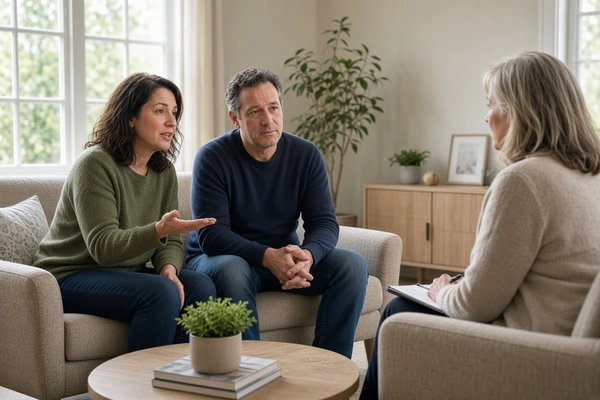
Family therapy for adult siblings is a short course of sessions where 2 or more grown brothers and sisters meet with a licensed clinician to change the patterns between them. It targets old family roles and how siblings split decisions. The family system is the client, so no 1 sibling is treated as the problem.
In couples therapy, the client is the relationship. In family therapy, it’s the family system, and that’s how our family therapy team sets up sibling work. Siblings didn’t choose each other the way partners did, and their shared history starts in childhood.

Why Adult Sibling Relationships Break Down
Sibling rifts often trace back to childhood, and they tend to resurface when adult life forces a joint decision. Cornell’s research says family estrangement is often linked to early harsh parenting, parental favoritism, and parental divorce. Fights over money and inheritances are other common triggers.
Favoritism can still matter in your 60s. A study of 608 adults in the Journal of Family Psychology looked at people with an average age of 64.6. Those who reported more sibling conflict, or felt a parent favored 1 child, had more symptoms of depression, anxiety, and hostility. The study measured associations at 1 point in time, so it can’t show that conflict or favoritism caused the symptoms.
Old family roles often come back under pressure. It can happen in a hospital corridor or at a holiday table, years after everyone moved out.
Inside the First 80-Minute Session
Our first family session runs 80 minutes in 4 blocks. Most families arrive braced for a blame session. Here is what happens instead.
| Minutes | What happens |
|---|---|
| 0 to 15 | Everyone answers the same question: what would need to be different for you to say this helped? Nobody is interrupted. |
| 15 to 45 | The clinician maps the loop: who reacts to whom, what happens next, and where it ends. |
| 45 to 65 | Short 1-on-1 time if needed. What gets shared back is agreed in advance, so nobody is ambushed. |
| 65 to 80 | 1 small, specific thing to try before next time, plus a plan for who attends next and how often you meet. |
Families are usually surprised that the fight has a shape. The shape is the target.

How Many Sessions Does Sibling Therapy Take in 2026?
Plan on 8 to 12 sessions for a focused goal at our practice. That’s close to the averages published by the American Association for Marriage and Family Therapy. AAMFT says family therapy averages 9 sessions. Across all the cases marriage and family therapists see, 65.6% finish within 20 sessions.
| Type of therapy | Typical number of sessions | Session length | Source |
|---|---|---|---|
| Family therapy at FC PsychExperts, focused goal | 8 to 12 | 50 to 80 minutes | FC PsychExperts |
| Family therapy average (AAMFT) | 9 | Not reported | AAMFT |
| All marriage and family therapy cases | 12 on average; 65.6% done within 20 | Not reported | AAMFT |
| Individual therapy at FC PsychExperts, focused goal | 6 to 12 | 50 minutes | FC PsychExperts |
If 1 sibling needs their own sessions alongside the family work, individual therapy at our practice runs 50 minutes. Family work moves through 5 stages: joining, assessment, restructuring, consolidation, and closure. We’ve found that knowing them ahead of time keeps families from quitting in stage 2, the assessment, where most of the work happens. Sessions space out in stage 4, as new patterns get practiced at home.

When the Fight Is About a Parent’s Care
Therapy fits when siblings are fighting about the work: who visits, who drives to appointments, who gets left out, and who feels used. A parent’s decline often forces those decisions on siblings for the first time as adults.
A 2025 AARP and National Alliance for Caregiving report counted 63 million Americans caring for an adult or child with a complex medical condition or disability. That’s nearly 1 in 4 adults.
Adult children and aging parents are 1 of the 6 situations that bring families to our office most often. The method is the same as any family work, with no children in the room.
Our post on therapy for aging parents covers the fights family sessions can help with, from uneven care loads to a parent who refuses help.
After a parent dies, the fight can move to belongings, headstones, anniversaries, and who showed up at the hospital. Family grief sessions work on how close the family stays, how members talk, and how they handle conflict.

Can a Sibling in Another State Join by Video?
Sometimes, but a video link doesn’t settle it. The answer depends on where each sibling is during the session and how the clinician is licensed.
Video looks like the easy fix for siblings spread across states. Licensing law makes it harder than that.
Florida’s telehealth law, section 456.47, generally requires a clinician licensed in another state to register before treating a patient located in Florida. The exceptions are narrow, such as emergencies. Other states set their own rules for patients located there. Our video sessions cover clients anywhere in Florida, so a sibling who joins from another state can bring that state’s rules into the session.
Florida joined PSYPACT, the interstate compact for psychologists, in 2023. It covers psychologists only. Our family therapy lead is a licensed clinical social worker, and Florida isn’t in the social work compact. Bills to join it passed the Florida House in 2025 and 2026 and died in the Senate both years.
So raise each sibling’s location on the free 15-minute call, before anyone books. When everyone can be in Florida for the session, in person in Jupiter or by video, that question goes away.

When 1 Sibling Won’t Come
Start anyway. Sessions can begin with the siblings who are willing. Bringing in the missing sibling is usually one of the early goals, not a condition for starting.
In our experience, most families never get every member into the same session, and that’s normal. Our guide to who has to attend family therapy explains how the room gets planned. It also covers why, in Florida, each family member in therapy has to agree in writing before the privilege is waived, with narrow exceptions.
There’s a hard limit, too. If a sibling has already decided to stop contact, family sessions can’t reverse that and shouldn’t be used to try. Individual therapy is the right referral then.
Safety comes first. If someone is being hurt, a weekly appointment is not a safety plan. Call 911 in an emergency. If the risk is to someone’s own life, call or text 988.

Starting Sibling Therapy in Jupiter or by Video
Book a free 15-minute call and say up front that the family is adult siblings, and where each of you lives. On that call, the office works out who should come to the first session and answers fee and insurance questions.
Jessica T. Aloise, LCSW, leads family therapy at FC PsychExperts. She has more than 20 years of experience with individuals, couples, and families. Her family work centers on communication, regulation, and repair.
Getting 4 working adults into 1 room is harder than getting a young family there. That’s why the Jupiter office keeps Saturday hours, 9 AM to 4 PM, the slot working parents and adult siblings ask for most. Evening sessions aren’t offered.
Sessions run 50 to 80 minutes at our Jupiter office, 210 Jupiter Lakes Blvd, Unit 4-201, or by secure video anywhere in Florida. First family sessions are usually available within the same week. Our page on family therapy in Jupiter has directions and hours.
Not every call ends in a booking. In 2025, the Jupiter office redirected roughly 1 in 6 family inquiries to a different service on the first call.
If family therapy for adult siblings sounds like the right fit, phone (561) 870-0411 and ask for the free 15-minute call.
Frequently Asked Questions
How long does family therapy for adult siblings take?
At FC PsychExperts, a focused goal often takes 8 to 12 sessions of 50 to 80 minutes each. The American Association for Marriage and Family Therapy says family therapy averages 9 sessions. Sessions space out as siblings practice new patterns at home.
Do all siblings have to agree to family therapy for adult siblings?
No. Therapy can start with the siblings who are willing. Bringing in the missing sibling is usually one of the early goals, not a condition for starting. Most families we see never have every member in the same session.
Can siblings who live in different states do therapy by video?
Sometimes. Florida’s telehealth law, section 456.47, generally makes clinicians licensed elsewhere register before treating patients located in Florida. Other states set their own rules for patients located there. FC PsychExperts offers video sessions anywhere in Florida, so raise each sibling’s location on the free 15-minute call.
How common is sibling estrangement?
A Cornell University national survey of more than 1,300 adults found that 8% were estranged from a sibling. The same survey found 27% of Americans 18 and older had cut off contact with a family member. Cornell’s research says family estrangement is often linked to early harsh parenting, parental favoritism, and parental divorce.
Is sibling therapy confidential in Florida?
Yes, with limits, and your clinician explains them before you begin. Under sections 490.0147 and 491.0147, when more than 1 family member is in therapy, each must agree in writing before the privilege is waived. Exceptions cover a specific threat to seriously hurt or kill an identified person, and a case a client brings against the clinician. Clinicians must also report suspected abuse, neglect, or exploitation of a vulnerable adult, such as a parent who can’t care for themselves because of aging.
What happens in the first sibling therapy session?
At FC PsychExperts, the first family session runs 80 minutes in 4 blocks. Everyone answers the same opening question, and the clinician maps the pattern between you. Short 1-on-1 time happens if needed, and the session ends with 1 thing to try before next time.

Dr. Cathy Colet, Psy.D., is a Licensed Clinical and Forensic Psychologist and founder of FC PsychExperts in Jupiter, Florida. She provides expert witness testimony across criminal, family, and immigration law, with advanced training in competency evaluations, criminal responsibility, child custody assessments, and VAWA hardship waivers.