

What A Spinal Cord Injury Psychological Evaluation Proves
Written By: Michael Vale, Content Writer
Medically Reviewed By: Dr. Cathy Colet, Psy.D., Licensed Psychologist
Last Reviewed: August 29, 2026
A spinal cord injury psychological evaluation answers the one question a medical chart can’t: how much of a claimant’s distress is a diagnosable condition, and how much is the ordinary grief of a changed life. That line decides cases. Roughly three in four people with a spinal cord injury never meet criteria for depression. The pooled figure from the only meta-analysis restricted to clinical-interview diagnosis is 22.2 percent, not the 11 to 37 percent range copied across most rehabilitation websites. Depression, anxiety, post-traumatic stress, and chronic fatigue are the four conditions an evaluator screens for. Proving any of them takes testing, records, collateral interviews, and a written opinion that holds up under cross-examination.

What Is A Spinal Cord Injury Psychological Evaluation?
It’s a forensic assessment, not treatment. The evaluator is retained to form an opinion for the court, not to help the person feel better, and that difference changes everything about how the examination is run.
A spinal cord injury psychological evaluation is a forensic assessment that documents whether a person developed a diagnosable psychiatric condition after a spinal cord injury, how severe it is, and whether the injury caused it. It combines a clinical interview, standardized testing, medical record review, and collateral interviews, then produces a written opinion for court.
Treatment records won’t do this work. A therapist’s chart shows what a patient reported and what the clinician tried. It doesn’t establish causation, it doesn’t rule out pre-existing conditions, and it wasn’t written to survive a deposition. Our breakdown of how psychological evaluations affect injury claims covers the mechanics that apply to any civil matter. What follows is what changes when the injury is to the spinal cord.
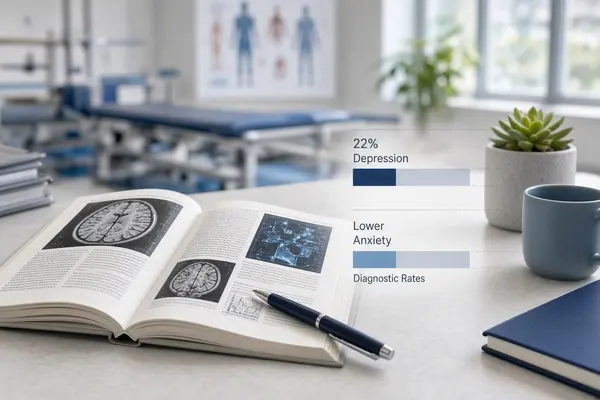
The Psychological Effects Of Spinal Cord Injury, By The Numbers
Four conditions account for most of what shows up after a spinal cord injury. The published rates for each vary wildly, and the reason is that different studies measure different things.
| Condition | Best available figure | What that number actually measures | Source |
|---|---|---|---|
| Depression | 22.2% (range 18.7 to 26.3) | Diagnosed by clinical interview, 19 studies, 35,676 people | Williams and Murray, Archives of Physical Medicine and Rehabilitation, 2015 |
| Anxiety | 27% screened positive, 5% met diagnostic criteria | Screening questionnaires vs actual disorder, 18 studies, 3,158 people | Le and Dorstyn, Spinal Cord, 2016 |
| PTSD | 8.4% | Diagnosed rate, 443 adults, Victoria, Australia | Migliorini, Tonge and Taleporos, Australian and New Zealand Journal of Psychiatry, 2008 |
| Any psychological condition | 59.1% with SCI vs 30.9% without | Five-year incidence in insurance claims, 9,081 vs 1,474,232 | Peterson and colleagues, Spinal Cord, 2022 |
That last row is the strongest study in the field by sample size, and its adjusted hazard ratio is 1.67. You’ll see “an 80 percent increased risk” quoted in a lot of places. It doesn’t match the paper.
Why Do Published Depression Rates For Spinal Cord Injury Disagree?
Because half the studies count people who scored high on a questionnaire, and half count people a clinician actually diagnosed. Those are not the same population, and the gap between them is enormous.
The clearest example sits in the anxiety literature. Le and Dorstyn’s 2016 meta-analysis found 27 percent of people with spinal cord injury screened positive for clinically significant anxiety symptoms. In the same analysis, 5 percent met criteria for generalized anxiety disorder or panic disorder. Most websites quote the first number and describe it as people who “develop anxiety.” That’s a fivefold overstatement, and opposing counsel will find it.
This distinction isn’t academic. A questionnaire score is a flag. A diagnosis is a finding. Only one of them is testimony.

Chronic Pain Drives The Psychological Injury More Than The Paralysis Does
This is the finding that should reshape how causation gets argued, and almost nobody uses it. In the largest study of its kind, chronic pain predicted psychiatric outcomes more strongly than living with the injury itself.
Peterson and colleagues tracked 9,081 adults with traumatic spinal cord injury against more than 1.4 million adults without one, using five years of insurance claims. Their conclusion, in their own words: “In most cases, chronic pain was an even greater influence on these conditions than exposure to living with the injury itself.” The same study put the hazard ratio for PTSD at 2.10.
So when a defense expert argues that a claimant’s depression stems from a difficult personality or a rough childhood rather than the crash, the pain record is where the answer lives. Untreated neuropathic pain is a documented psychiatric risk factor, and it’s usually sitting right there in the medical file.
Most People With A Spinal Cord Injury Never Develop A Psychiatric Disorder
We’ll say the thing that plaintiff marketing pages won’t. The majority of people who suffer a spinal cord injury adjust without ever meeting criteria for a psychiatric diagnosis.
The Migliorini study of 443 Australian adults found PTSD in 8.4 percent, not the majority that legal blog posts imply. Williams and Murray put diagnosed depression at 22.2 percent, which leaves roughly three in four people who don’t qualify. Both numbers come from peer-reviewed sources and both cut against the reflexive assumption that catastrophic injury automatically means catastrophic psychiatric harm.
Here’s why saying so helps a claimant whose injury is real. If everyone with a spinal cord injury were depressed, a depression diagnosis would carry no weight at all. It would be background noise. Because the base rate is roughly 22 percent, a documented diagnosis, properly tested and properly attributed, is evidence of something specific that happened to this person. Neutrality is the asset. An evaluator who never finds against the retaining party isn’t an expert, they’re a witness with a price.
Dr. Cathy Colet takes catastrophic injury referrals from plaintiff and defense attorneys alike. That’s deliberate.
How Does An Evaluator Separate Normal Adjustment From A Diagnosis?
By timeline, by function, and by criteria. Grief after paralysis is expected. A disorder is grief that meets a defined threshold, persists past a defined window, and measurably degrades functioning.
Post-traumatic stress disorder is the cleanest illustration. Under DSM-5, symptoms must last more than one month before the diagnosis applies. Below that threshold, the correct label is acute stress disorder. Getting that wrong in a report is the kind of error that ends an expert’s usefulness in a case.
Experience with the acute phase matters here more than most people realize. Dr. Colet’s firsthand work at a Level 1 Trauma Center means she has seen these patients in the days after the injury, not years after it. Most forensic examiners meet the claimant once litigation is underway, when memory has been rehearsed and symptoms have been described to a dozen people. Knowing what the first week actually looks like changes what you ask about, and it changes how you weigh a story that has been told too smoothly.
One more thing worth knowing. A 2020 survey of 111 clinicians who treat spinal cord injury found that 62.2 percent relied on their own clinical judgment rather than a validated screening tool. Treatment records reflect that. A forensic evaluation doesn’t have that option.
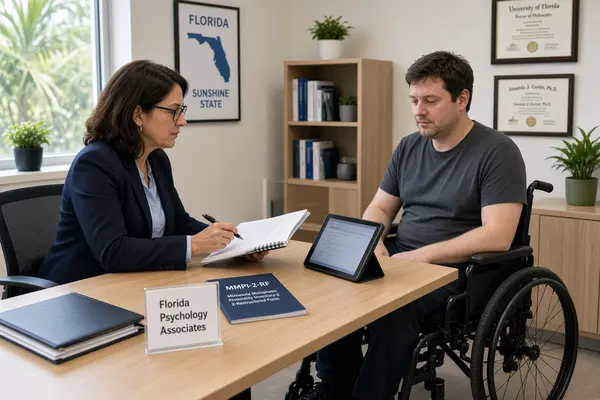
Can A Spinal Cord Injury Make Psychological Test Results Look Exaggerated?
Yes, and this is the trap that catches honest claimants. Standard personality inventories ask about fatigue, disrupted sleep, reduced activity, and preoccupation with the body. A person with genuine paralysis answers yes to those items truthfully.
The result is a somatic score above the normal range that, read without context, looks like symptom magnification. An opposing expert can hold up that score and argue the claimant is inflating their complaints, when the score is measuring a physical injury nobody disputes.
Handling this correctly takes two things. First, interpreting the score against the physical injury rather than against a healthy-population norm. Second, running separate validity measures that test effort and response consistency directly, instead of inferring exaggeration from a high somatic score. Our overview of what tests are involved in a neuropsychological evaluation walks through the categories, and detecting malingering in forensic evaluations covers how effort testing works.
An evaluator who doesn’t anticipate this hands the other side an argument for free.
What The Evaluation Documents
Five things, and each one exists because a specific challenge will be made to it.
Diagnosis
What condition the person has, by DSM-5 criteria, with the evidence for each criterion stated.
Causation
Whether the spinal cord injury caused the condition, contributed to it, or is unrelated. This includes pre-existing history, because ignoring it is how reports get excluded.
Severity and functional impact
What the person can no longer do. Work, parenting, relationships, independence. The employment picture gives this context: national registry data shows 18 percent of people with traumatic spinal cord injury are employed one year after injury, rising to 29 percent at twenty years.
Prognosis and treatment needs
What care is required, for how long, and what it costs. This feeds directly into a life care plan.
Validity
Whether the presentation is consistent, and what the effort measures showed.
The parallel with brain injury cases is close, and our guide on how to prove a traumatic brain injury covers the shared evidentiary ground. The conditions neuropsychologists evaluate overlap heavily, since spinal cord injuries and head injuries frequently arrive together in the same crash.
Injury Level Predicts Less Than Most People Assume
Paraplegia versus tetraplegia turns out to be a weaker predictor of psychiatric outcome than injury severity overall. That surprises attorneys who expect the highest-level injuries to produce the worst psychological harm.
A 2022 Canadian study compared motor complete against motor incomplete injuries and paraplegia against tetraplegia. It found no statistically significant difference in depression or anxiety scores between the groups. That study included only 49 people, so treat it as weak evidence rather than a settled answer. What’s better supported comes from a Taiwanese cohort of 3,556 matched pairs published in PLOS ONE in 2017, which found that overall injury severity, measured by Injury Severity Score, predicted anxiety and depression with a hazard ratio of 1.85 for the more severely injured group.
The practical read: don’t assume a paraplegic claimant has a weaker psychological case than a tetraplegic one. The evidence doesn’t support that, and building a damages theory on it is a mistake.

When Florida Attorneys Should Schedule The Evaluation
Earlier than most do. Once the acute medical picture has stabilized and before the deposition, so the opinion is on the record rather than assembled under deadline.
Two situations argue for moving fast. If a defense examination has been noticed, an independent evaluation already in hand changes the posture of that examination. And if the claimant is in active mental health treatment, a baseline assessment documents the condition while it’s current rather than reconstructing it later from notes.
Forensic and Clinical PsychExperts has served Florida courts since 2008, with practice split roughly 75 percent forensic and 25 percent clinical. Dr. Colet is court-qualified in Florida’s 1st, 15th, 17th, 19th, and 20th Judicial Circuits, with offices in Jupiter and Fort Lauderdale. Dr. Lauren Miller, a clinical and forensic neuropsychologist with nearly 20 years of experience, reviews psychological and neuropsychological disability claims, analyzes opposing experts’ work, and develops deposition questions for attorneys. Her background is listed in full on Dr. Miller’s profile.
For the broader civil framework, see how Florida attorneys use psychological evaluations to prove personal injury damages, or start with our personal and emotional injury evaluations service page. A spinal cord injury psychological evaluation is worth ordering when the psychological harm is real, because the file needs to show which of the four conditions applies, why the injury caused it, and what it will cost to treat.
Frequently Asked Questions
How long does a spinal cord injury psychological evaluation take?
The examination itself runs across one or two appointments and includes a clinical interview plus standardized testing. Records review and collateral interviews happen separately. The written report follows once all materials are in hand. Timeline depends on how quickly the medical file arrives.
Is depression after a spinal cord injury common enough to assume?
No. The pooled rate from the only meta-analysis restricted to clinical-interview diagnosis is 22.2 percent across 19 studies and 35,676 people. Roughly three out of four people with a spinal cord injury don’t meet criteria. That’s exactly why a documented diagnosis carries evidentiary weight.
Can a treating therapist’s letter replace a spinal cord injury psychological evaluation?
Rarely. Treatment records document what a patient reported and what was tried. They don’t establish causation, address pre-existing conditions, or include validity testing. A 2020 survey found 62.2 percent of clinicians treating spinal cord injury relied on clinical judgment rather than a validated screening instrument.
How long do PTSD symptoms have to last after a spinal cord injury?
More than one month, under DSM-5 Criterion F. Symptoms lasting less than a month fall under acute stress disorder instead. Getting that distinction wrong in a written opinion is a common and avoidable error.
Does the level of paralysis affect the psychological outcome?
Less than most people expect. A 2022 study comparing paraplegia against tetraplegia and complete against incomplete injuries found no statistically significant difference in depression or anxiety scores, though it included only 49 people. Overall injury severity is the better-supported predictor.
Why does chronic pain matter in a spinal cord injury claim?
Because it predicts psychiatric outcomes more strongly than the paralysis does. A 2022 study of 9,081 adults with traumatic spinal cord injury found chronic pain was a greater influence on psychological conditions than living with the injury itself. The pain record often carries the causation argument.
Who should perform the evaluation?
A licensed psychologist with forensic training and courtroom experience. Clinical skill alone isn’t enough, because the report has to withstand challenge on causation, validity, and methodology. Ask about the evaluator’s testimony history and whether they accept work from both plaintiff and defense.

Dr. Cathy Colet, Psy.D., is a Licensed Clinical and Forensic Psychologist and founder of FC PsychExperts in Jupiter, Florida. She provides expert witness testimony across criminal, family, and immigration law, with advanced training in competency evaluations, criminal responsibility, child custody assessments, and VAWA hardship waivers.