

Contractual Capacity Evaluation: How Capacity Gets Proven
Written By: Michael Vale, Content Writer
Medically Reviewed By: Dr. Cathy Colet, Psy.D., Licensed Psychologist
Last Reviewed: August 31, 2026
A contract signed by someone who lacked mental capacity is usually voidable, not void. The person who signed it can walk away. That’s the easy part, and it takes one sentence. The hard part is proving what was happening inside someone’s head on the day they signed, sometimes years after the fact, sometimes after they’ve died. That’s what a contractual capacity evaluation answers. The cases we see in Florida courts don’t turn on the legal standard. Attorneys already know the standard. They turn on records. If nobody documented the signer during the week they signed, no honest expert can give you a defensible opinion, and we’ll tell you that on the first call.

What Is a Contractual Capacity Evaluation?
A contractual capacity evaluation is a forensic psychological examination that determines whether a person could understand the nature and consequences of a specific agreement at the moment they signed it. A licensed psychologist reviews records, interviews the signer and collateral witnesses, administers standardized testing, and issues a written opinion for the court.

Is a Contract Signed by an Incapacitated Person Valid?
Usually yes, until the incapacitated person voids it. The Restatement (Second) of Contracts, section 15, sets out two paths. Under 15(1)(a), a person incurs only voidable duties if a mental illness or defect leaves them “unable to understand in a reasonable manner the nature and consequences of the transaction.” Under 15(1)(b), that same illness or defect makes the contract voidable if the person can’t act reasonably in relation to it and the other party has reason to know about the condition.
Then comes the limit that surprises people. Section 15(2) says that where the deal was made on fair terms and the other side didn’t know about the condition, the power to void narrows to the extent the contract has been performed or circumstances have changed enough that undoing it would be unjust. The Restatement still lets a court grant whatever relief justice requires. In plain terms: if the contractor already built the addition at a fair price, the signer usually can’t keep the addition and walk from the whole debt.
Florida phrases the test its own way. In John Knox Village of Tampa Bay v. Perry, the Second District asked whether the signer was capable of understanding both the nature of the transaction and its significance and effect. Florida presumes competence, so the party attacking the contract carries the burden of proving the signer wasn’t competent, a rule running back to Travis v. Travis in 1921.
There’s a shortcut worth checking before any of that. Under Florida Statutes section 744.3215(3)(a), the right “to contract” is one of the rights a court can strip from a person adjudicated incapacitated and hand to a guardian. A guardianship court deciding incapacity works from a higher bar than a contract dispute does, since section 744.331(5)(c) requires clear and convincing evidence. Once that order exists, the analysis changes. Some Florida commentary argues the contract becomes void rather than merely voidable, though no Florida appellate decision appears to settle it. Pull the guardianship docket before you spend money on an expert.
Why Capacity Fights Are Getting More Common
More people are signing documents while their thinking changes. The Alzheimer’s Association’s 2026 Facts and Figures report, published in the journal Alzheimer’s and Dementia, estimates 7.4 million Americans age 65 and older are living with clinical Alzheimer’s dementia. That’s the population most capacity disputes come out of, and it isn’t shrinking.
Financial pressure on that same group is measurable, at least in the slice somebody counts. The FBI’s Internet Crime Complaint Center logged 201,266 complaints from victims 60 and older in 2025, a 37 percent jump, with $7.748 billion in reported losses, up 59 percent from the year before.
Be careful with that number. It counts internet-enabled crime only. It misses the documents behind most of our capacity referrals: quitclaim deeds, reverse mortgages, annuity purchases, home improvement contracts, arbitration clauses buried in nursing home admission packets, and settlement releases. Nobody publishes a count of those. The referrals arrive anyway.

Does a Dementia Diagnosis Void a Contract?
No. And this is where most referrals go wrong. A diagnosis is not a finding of incapacity, and a clean cognitive screen is not a finding of capacity.
Capacity is decided one transaction at a time, at one moment in time, against the difficulty of the specific document. The ABA and APA’s 2008 capacity handbook for psychologists puts it directly: courts “generally assess the party’s ability to understand the nature and effect of the act and the business being transacted,” and “if the act or business being transacted is highly complicated, a higher level of understanding may be needed.”
Read that twice. The same person, on the same afternoon, can have capacity to sign a one-page phone contract and lack capacity to sign a 40-page cross-collateralized loan. Moderate dementia doesn’t answer the question. Neither does a 27 out of 30 on a bedside screen taken eight months after the signing. Dementia isn’t the only condition that raises these questions either, and our piece on what conditions neuropsychologists evaluate covers traumatic brain injury, stroke, and the psychiatric presentations that show up in capacity referrals.
The handbook separates diagnosis from function on purpose. Its model runs through nine parts, in the handbook’s own labels: “legal standard,” “functional elements,” “diagnosis,” “cognitive underpinnings,” “psychiatric or emotional factors,” “values,” “risk considerations,” “steps to enhance capacity,” and “clinical judgment of capacity.” Diagnosis is one of nine. Attorneys who lead with the diagnosis and nothing else lose.
Testamentary, Contractual, Financial: The Capacity Ladder
These are different thresholds, and mixing them up costs cases. Here’s how they stack.
| Capacity type | What the person must understand | Threshold | Common document |
|---|---|---|---|
| Testamentary | The nature of a will, the general extent of their property, and who the natural objects of their bounty are, which can include friends and charities, not only heirs | Generally the lowest | Will, codicil |
| Donative | The nature and purpose of the gift, the nature and extent of the property given, the natural objects of their bounty, and the effect of making the gift | Unsettled. Some states set it above testamentary capacity because a gift takes effect right away. | Gift, beneficiary change |
| Contractual | The nature of the bargain and its significance and effect, scaled to how complicated the document is | Moderate to high, and it rises with the document | Deed, loan, settlement, purchase |
| Financial management | Ongoing ability to handle money, bills, and assets, and to resist exploitation | A different axis: continuous rather than tied to one transaction | Guardianship of property |
A person can have testamentary capacity and lack contractual capacity on the same day. That isn’t a contradiction. It’s the law working as designed, and it’s why an opinion written for a will contest doesn’t transfer to a mortgage dispute. Florida hasn’t drawn every line on this ladder cleanly, so check the standard for your specific document rather than assuming the hierarchy holds.

How Do You Prove Capacity for a Contract Signed Two Years Ago?
You build it from records made during the signing window, then test what’s left of the person now. Other experts will proceed on family recollection alone. We won’t. An opinion resting on nobody’s contemporaneous notes is inference dressed as expertise, and it gets taken apart on cross.
Here’s what actually decides these cases, ranked by how much weight it carries.
| Evidence | Why it matters | Where to get it |
|---|---|---|
| Medical and pharmacy records from 30 days either side of signing | Shows cognitive status, delirium, infection, pain medication, and sedation at the relevant time | Treating providers, hospitals, pharmacies |
| Any cognitive testing done near the signing date | The closest thing to a direct measurement | Primary care, neurology, memory clinic |
| The signed document itself | Complexity sets the required threshold | Counsel |
| Notary log, witness list, video of signing | Establishes who was in the room and what was said | Title company, lender, facility |
| Bank and account activity in that period | Errors, duplicate payments, and unusual transfers are functional evidence | Subpoena |
| Collateral interviews with people who saw the signer that month | Fills the gaps records leave | Family, staff, neighbors, counsel |
| Current examination and testing | Establishes trajectory and rules out other explanations | The evaluation itself |
Missing the first two rows is usually fatal. That’s the honest answer, and it’s the reason we decline cases.
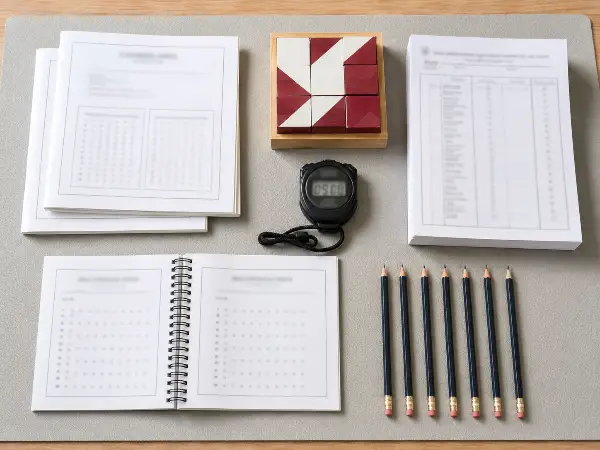
Which Tests Are Used, and What Each One Measures
No single validated test answers the contractual capacity question. That’s a real gap in the field, not a dodge. The ABA and APA’s 2008 handbook warns that across capacity assessment instruments generally, “most lack adequate reliability, validity, and normative properties for older adults,” and it names testamentary capacity as an area with almost no instrument development at all.
So a defensible evaluation stacks measures that each answer part of the question:
Brief cognitive screens establish a floor and nothing more. They flag impairment. They don’t decide capacity, and a report that stops here shouldn’t survive cross-examination.
Full neuropsychological testing maps which abilities are damaged and which are intact. Memory, attention, executive function, and language all matter differently depending on the document. A person with intact memory and damaged executive function may recite the contract terms back to you and still be unable to weigh the consequences of signing.
Structured capacity interviews ask the person to explain the deal in their own words, describe what they get and what they give up, and reason through an alternative. The MacArthur family of tools was built for treatment consent, research consent, and criminal adjudication rather than contracts, so this part is usually a structured clinical interview built around the legal elements of the specific document.
Validity and effort measures check whether the presentation is real. More on that next.
Which measures we run depends on the referral question and on what the records already show. Our overview of the common tools used by forensic psychologists walks through those categories in more detail.
Why the person claiming incapacity has a reason to look worse
Whoever alleges incapacity usually benefits from the finding. That’s not cynicism, it’s the structure of the litigation, and any evaluator who ignores it is handing opposing counsel a gift.
An examinee who wants a contract voided has an incentive to underperform. An examinee defending a transfer they orchestrated has an incentive to overperform. Both happen. Standalone validity tests and embedded validity indicators exist to catch it, and they belong in every capacity battery where money is in dispute.
This cuts the other way too. Poor effort doesn’t prove capacity. A person can have genuine dementia and also exaggerate. The report has to say which findings survive the validity data and which don’t, and it has to say so before opposing counsel does. What survives cross-examination is a separate question from what’s clinically true, and we write with both in mind, which is the same discipline behind what evidence shapes forensic psychology expert opinions.

What We Turn Down at Intake in 2026
Every capacity referral gets a scope call before we accept it. On that call we ask what the document was, when it was signed, what records exist from that window, and what question the court needs answered. Then we tell you whether we can give an objective opinion or not.
We say no when the records from the signing period don’t exist, when the referral asks for a predetermined conclusion, and when the question is outside what a psychological examination can answer. Attorneys sometimes find that irritating on the call and useful three months later. An expert who accepts everything produces opinions that get excluded, which is one of the risks of hiring an unqualified forensic psychologist.
Our four psychologists hold active Florida licenses, PY9058, PY8992, PY7803, and PY6432, first issued in 2014, 2013, 2008, and 2007. We’ve testified in the 1st, 2nd, 15th, 17th, 19th, and 20th judicial circuits, including Palm Beach, Broward, Martin, St. Lucie, Indian River, Okeechobee, Leon, Escambia, Charlotte, Collier, Glades, and Hendry counties. We take referrals from both sides, plaintiff and defense, prosecution and defense. That matters in a capacity fight more than in almost any other kind of case, because the first thing opposing counsel will ask is who you usually work for.
How long it takes and what you get
A full evaluation runs about 10 hours of professional time. That covers the clinical interview, mental status exam, collateral interviews, record review, psychological testing, scoring and interpretation, and writing the report. We’re typically booked about three weeks out, and rush scheduling depends on the calendar that month.
The report states the referral question, the records reviewed, the examination findings, the test results with validity data, the reasoning, and the opinion tied to the legal standard for that document. Fee structure and testimony billing are set in the retainer agreement before any work begins.
If you’re weighing whether the case needs an expert at all, our forensic evaluations page lists the civil and criminal referral questions we take. Attorneys in South Florida can start with our Fort Lauderdale forensic evaluation office, and everything the Florida forensic psychology practice handles statewide runs out of the same two offices in Jupiter and Fort Lauderdale.
Bring us the records from the signing week and a copy of the document. If those two things exist, a contractual capacity evaluation can answer the question. If they don’t, we’ll say so before you commit to anything. Call 561-870-0411 or get in touch to start the scope call.
FAQs
What is a contractual capacity evaluation?
It’s a forensic psychological examination that determines whether someone could understand the nature and consequences of a specific agreement when they signed it. The evaluator reviews records, interviews the signer and collateral witnesses, runs standardized testing, and writes an opinion tied to the legal standard. A full evaluation takes about 10 hours of professional time.
Is a contract signed by someone with dementia automatically void?
No. Under the Restatement (Second) of Contracts, section 15, such a contract is generally voidable at the signer’s election, not void. A diagnosis alone doesn’t decide it. Courts look at whether the person understood that particular transaction at that particular moment, and a more complicated document requires more understanding.
Who has to prove that someone lacked capacity?
In Florida the law presumes competence, so the party attacking the contract carries the burden of proving the signer wasn’t competent. A guardianship court deciding incapacity in the first place works from a different and higher standard, because Florida Statutes section 744.331(5)(c) requires clear and convincing evidence. If a court has already removed the right to contract under section 744.3215(3)(a), the analysis changes again.
How far back can a contractual capacity evaluation go?
As far back as the records support. The opinion is built from medical, pharmacy, and financial records created around the signing date, ideally within 30 days on either side, plus collateral interviews and a current examination. Without contemporaneous documentation from that window, a retrospective opinion rests on lay recollection and inference, and we won’t sign one on that basis.
Is testamentary capacity the same as contractual capacity?
No. Testamentary capacity generally sits at a lower threshold. A person needs to understand the nature of a will, the general extent of their property, and who the natural objects of their bounty are, which can include friends and charities, not only heirs. Contractual capacity scales with the complexity of the document, so the same person can validly sign a will and lack capacity for a cross-collateralized loan the same afternoon.
Which test measures contractual capacity?
There isn’t one. The ABA and APA’s 2008 capacity handbook for psychologists warns that across capacity assessment instruments generally, “most lack adequate reliability, validity, and normative properties for older adults.” A defensible evaluation stacks a cognitive screen, full neuropsychological testing, a structured interview built around the legal elements of the specific document, and validity or effort measures.
How soon can you schedule an evaluation?
We’re typically booked about three weeks out across our Jupiter and Fort Lauderdale offices, and rush availability depends on that month’s calendar. Bring the signed document and the records from the signing window to the scope call, and we’ll tell you on that call whether we can give an objective opinion.

Dr. Cathy Colet, Psy.D., is a Licensed Clinical and Forensic Psychologist and founder of FC PsychExperts in Jupiter, Florida. She provides expert witness testimony across criminal, family, and immigration law, with advanced training in competency evaluations, criminal responsibility, child custody assessments, and VAWA hardship waivers.