
Family Therapy For Adoptive Families: Test Or Treat First?
Written By: Michael Vale, Content Writer
Medically Reviewed By: Dr. Cathy Colet, Psy.D., Licensed Psychologist
Last Reviewed: November 2, 2026
Family therapy for adoptive families should start with an assessment, not a guess. The same behavior can come from grief, trauma, ADHD, a learning disorder or a true attachment problem. Each one needs a different plan.
A 2006 task force of the American Professional Society on the Abuse of Children (APSAC) gave the same advice. It said treatment for children in the child welfare and foster care systems should rest on a careful assessment by a qualified mental health professional. It also said assessment should first consider more common disorders and explanations for behavior.
I’m Dr. Cathy Colet, founder of FC PsychExperts, a forensic and clinical psychology practice with offices in Jupiter and Fort Lauderdale. I did pre-adoptive evaluations during my doctoral training, from 2008 to 2010.
From 2011 to 2012, I did pre- and post-adoptive evaluations for children, teens and adults referred through the dependency, delinquency and court systems or by private referral. I did them again as a postdoctoral resident in 2013 and 2014. Attachment and bonding assessments are part of my civil forensic work today.

What Is Family Therapy for Adoptive Families?
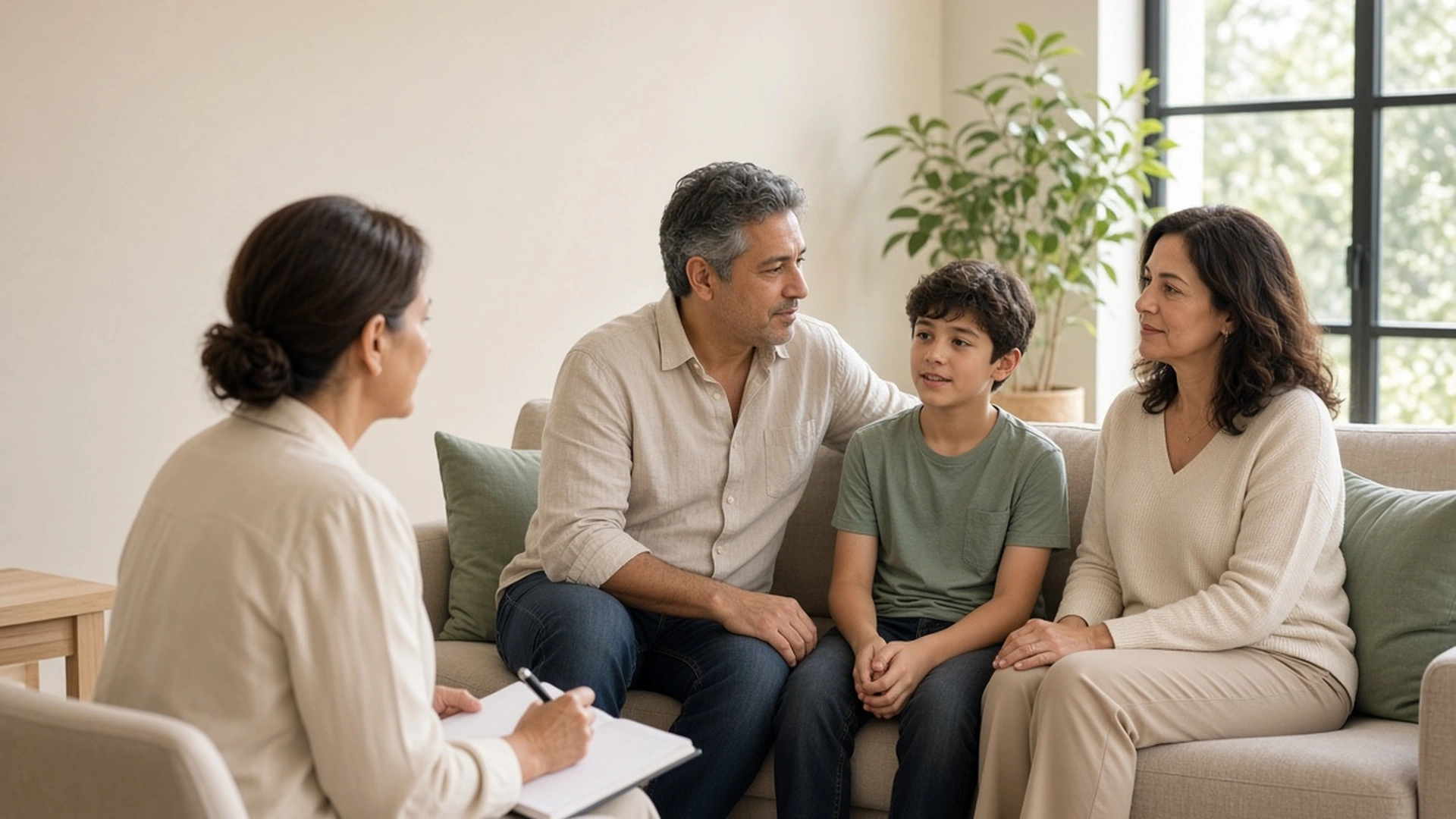
Family therapy for adoptive families is treatment in which adoptive parents, the adopted child and often siblings meet together with a licensed clinician. The work targets the patterns between them: trust, conflict, grief and how the family talks about adoption and birth relatives. The goal is a steadier parent-child relationship rather than treating the child as the problem.
Child Welfare Information Gateway, a federal resource, describes it the same way. It says these sessions build attachment relationships and improve communication between parents and children. Its factsheet on adoption-competent therapists adds that these therapists often make including parents a priority.
Parent involvement has research behind it. APSAC’s 2006 task force pointed to a review of more than 70 studies on early childhood attachment. The programs that most increased parents’ sensitivity also did the most to improve children’s attachment security.
What the Federal Data Says About Adopted Children
Most adopted children do well. As a group, though, they’re diagnosed with ADHD and behavior problems more often than other kids, and children adopted from foster care show the highest rates.
The numbers come from the 2007 National Survey of Adoptive Parents. It was the first nationally representative survey of adoptive families, run for the U.S. Department of Health and Human Services (HHS). The survey reached parents of 2,089 adopted children. Its results, published in an HHS chartbook, represent nearly 1.8 million adopted kids. Of those children, 37% were adopted from foster care, 38% through private U.S. adoptions and 25% from other countries.
Compared with all U.S. children, adopted children were about 2 times as likely to have special health care needs (39% vs. 19%). Among kids 6 and older, 26% had been diagnosed with ADD or ADHD, against 10% of all children. Behavior or conduct disorder diagnoses ran 15% vs. 4%.
Parent-reported diagnoses by adoption type, 2007
| Measure | Adopted from foster care | Private U.S. adoption | International adoption | All U.S. children |
|---|---|---|---|---|
| Special health care needs | 54% | 32% | 29% | 19% |
| Ever diagnosed with ADD or ADHD (ages 6+) | 38% | 19% | 17% | 10% |
| Ever diagnosed with behavior or conduct problems | 25% | 11% | 7% | 4% |
| Parent told the child had attachment disorder | 21% | 6% | 8% | Not available |
That survey has a hopeful side too. For 81% of adopted children, parents called the relationship “very warm and close.” For 87%, parents said they would “definitely” adopt that child again. The chartbook also found that most adopted children fare well on 6 measures of social and emotional well-being.
Unmet need shows up as well. For 21% of adopted children, parents said their child missed at least 1 needed service outside adoption itself, such as mental health care or family counseling. Parents of 3 in 10 said the same about an adoption-specific support, such as a support group or parent training.
These are parent reports from 2007, so read them as a snapshot of families nationwide. Still, ADHD and behavior problems were more common in adopted children. An evaluation can check for both.

Is It an Attachment Disorder, or Something Else?
Sometimes it is. But APSAC’s 2006 task force warned that attachment problems can be missed, overdiagnosed or both. It advised checking more common conditions first.
In the 2007 survey, parents of 12% of adopted children said a provider had told them their child had attachment disorder. Even so, 64% of those children had parents who called the relationship “very warm and close.” For adopted children without that diagnosis, it was 84%.
I’m a member of APSAC. Its task force report says “attachment disorder” is not an accepted diagnosis in the DSM or ICD, the manuals clinicians use to classify mental disorders. The formal diagnosis, reactive attachment disorder (RAD), is narrower, and the DSM in use at the time called it “very uncommon.”
RAD also has look-alikes. The task force noted that oppositional defiant disorder, conduct disorder, PTSD and anxiety disorders share some of its features. Autism can be confused with it too. The report’s advice was to consider ADHD, conduct disorder, PTSD and adjustment disorder first. The report quotes an old medical saying: when you hear hoof beats, think horses, not zebras.
The survey numbers don’t prove those 12% were misdiagnosed. Real attachment problems exist, and the task force called them a real concern.
If someone tells you your child “has RAD,” ask what else they ruled out. Ask whether they looked at behavior outside your home, too. Both checks come from the task force’s guidelines. The guidelines also say a diagnosis should never rest on a child being adopted, in foster care or maltreated alone. Broad online checklists make false positives “virtually certain,” the task force warned.
An Assess-First Map: 4 Questions to Answer Before Therapy
Before a family commits to weeks of therapy, 4 questions are worth answering. This map turns APSAC’s assessment guidance into those questions. It matches each one to an evaluation listed on FC PsychExperts’ services page.
The assess-first map
| Question | What it checks | Evaluation that answers it | What the evaluation provides |
|---|---|---|---|
| 1. Is it attention, learning or development? | Attention, memory, language, executive functions, reading, writing and math, emotions and behavior | Psychoeducational testing | Findings such as ADHD, a learning disability or autism, plus the accommodations, supports and services a student needs |
| 2. Is it trauma, mood or anxiety? | Trauma-related symptoms, depression, anxiety and other mood concerns | Clinical psychological evaluation | A diagnosis of conditions such as PTSD, depression or anxiety, plus recommendations for treatment and support |
| 3. Is it the relationship? | The child’s relationships with caregivers | Attachment and bonding assessment | The pattern of relatedness between the child and caregivers, including who is most central in the child’s life |
| 4. Is a court involved, or could one be? | Family-law questions such as time-sharing, parental fitness or reunification | Forensic psychological evaluation | Time-sharing and parenting plan evaluations, parental fitness and reunification assessments, and best-interest analyses under Florida’s section 61.13 factors |
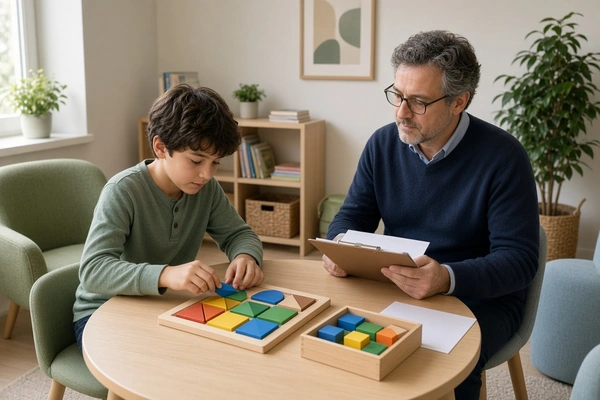
Question 1 covers conditions the task force says to consider first, such as ADHD. Our psychoeducational testing checks attention, memory, language, and reading, writing and math skills, along with executive functions, emotions and behavior. Autism belongs here too, since the task force noted it can be confused with RAD. In April 2026, I completed training in the ADOS-2, a structured autism assessment. ADOS-2 testing is part of my current contracts.
Question 2 is about symptoms a parent can’t always see. A clinical psychological evaluation looks for trauma, depression, anxiety and other mood concerns. The report includes recommendations for treatment and support.
Question 4 applies when a court is involved. Our forensic psychological evaluations cover family-law questions such as time-sharing, parental fitness and reunification. I’m also under contract with Communities Connected for Kids for psychological and parental capacity evaluations. The agency oversees child welfare services in Indian River, Martin, Okeechobee and St. Lucie counties.
Not every family needs every check. The federal factsheet also suggests asking the therapist for an evaluation meeting 6 to 8 weeks after treatment begins.
What Happens in an Attachment and Bonding Assessment?
An attachment and bonding assessment evaluates the pattern of relatedness between a child and caregivers, including who is most central in the child’s life. APSAC’s guidelines say to look at behavior over time and in more than 1 setting.
In plain terms, the guidelines call for:
- Patterns over time, since current behavior can be a reaction to recent stress
- Behavior with teachers, day care staff and peers, as well as with you at home
- No diagnosis built on a parent-child power struggle alone
- Screening checklists only when they have tested measurement properties
- Family and caregiver factors as well as the child’s history
- Cultural norms, especially when the child and parents come from different cultures
In my 2011 to 2012 evaluations, I gathered information from foster parents, caseworkers, attorneys and therapists. I also reviewed past records. Then I combined it all with test results in a final written report.
How Family Therapy Works at FC PsychExperts
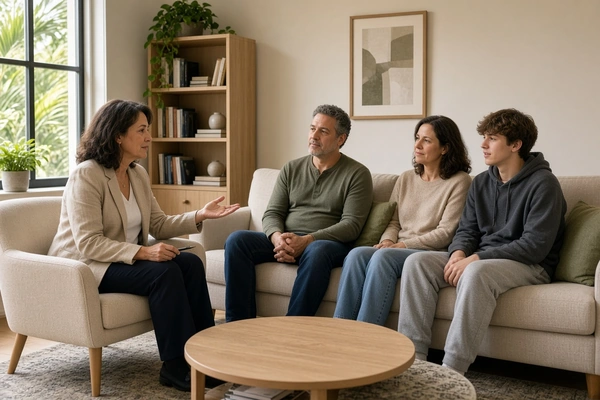
At FC PsychExperts, family therapy brings 2 or more family members together with a licensed clinician. Sessions run 50 to 80 minutes, in our Jupiter office or by secure video anywhere in Florida.
Jessica T. Aloise, LCSW, has more than 20 years in practice and works with parents, teens and whole households. Her family work centers on communication, regulation and repair. I oversee court-referred family cases and the documentation they require. If a court orders custody or psychological evaluations, they’re done in-house.
Sessions use structural, systemic and attachment-based approaches matched to the family. The practice accepts referrals from family-law attorneys, guardians ad litem and the court directly.
The first session follows an 80-minute plan. Everyone answers the same opening question: what would need to be different for you to say this helped? Next, the clinician maps the loop between people. A teen or a co-parent may get 10 minutes alone. The session ends with 1 thing to try before next time.
Our post on the first family therapy session explains how to prepare. That post also covers what the therapist asks about, such as family history, past therapy and each person’s view.
Therapy then moves through 5 stages: joining, assessment, restructuring, consolidation and closure. Focused goals often improve in 8 to 12 sessions. Reunification and high-conflict co-parenting cases take longer. Progress is reviewed with the family at set points.
Co-parenting sessions can run by video, with each parent on their own screen. The federal factsheet notes a trade-off: on video, it can be harder for a therapist to read a young person’s body language.
Expect a rough patch. Children with attachment trauma may respond with inconsistent or chaotic behavior while forming stronger attachments, the factsheet says. A rise in “negative” behavior doesn’t necessarily mean regression.

Therapies Adoptive Parents Should Refuse
Refuse any treatment that restrains, overpowers or humiliates a child.
Federal guidance warns against “holding therapy” and “rebirthing therapy.” It also warns against any treatment that restrains a child or intrudes on their physical space without welcome. Some states have statutes or policies that restrict or prohibit these therapies.
The task force went further. It called these techniques “contraindicated,” meaning they should not be used. The list includes physical coercion, enforced holding, restraint, provoked catharsis, “ventilation of rage,” age regression, humiliation, withholding or forcing food or water, and prolonged isolation. Its report traces the controversy to child deaths, including a 10-year-old who died during a rebirthing session in 2000.
The position still stands. The American Academy of Child and Adolescent Psychiatry first opposed these coercive methods in 2003. It approved its statement again in December 2022. Instead, it calls for a full psychiatric evaluation and a treatment plan built for the child.
These warning signs come from the APSAC report’s advertising guidance and its account of coercive programs. Walk away from any program that:
- Claims its method is the only one that works
- Describes children as manipulative or at risk of becoming psychopaths
- Leans on patient testimonials or unproven online checklists
- Treats your child’s distress as “resistance” to overcome

Finding an Adoption-Competent Therapist
Ask about adoption training and experience directly, and expect the therapist to include you in the work.
Therapists with adoption training are what the factsheet calls adoption-competent. It cites 5 principles from the National Adoption Competency Mental Health Training Initiative (NTI). In short: strengthen attachment, support grief and loss, understand how trauma affects the brain and behavior, build a positive identity, and weigh race, culture and diversity. The factsheet also points to a directory of professionals who have completed NTI training.
When you interview therapists, the factsheet suggests questions like these:
- How many adoptive families have you worked with, and with problems like ours?
- Have you taken any adoption-competency training?
- Do you prefer to work with the entire family or only with children and youth?
- Will you give us regular reports on progress?
- How long do you expect therapy to last?
- Will you work with teachers and other adults in my child’s life?
You can also ask what they’ll rule out before diagnosing, the step APSAC’s guidelines put first. It’s also important, the factsheet adds, to consider a therapist’s racial and cultural background and training. In the 2007 federal survey, 40% of adopted children were of a different race, culture or ethnicity than both adoptive parents.

Paying for Therapy After a Florida Adoption
Check 4 places: your child’s adoption assistance agreement, Medicaid or private insurance, your community-based care agency’s post-adoption staff and the provider’s fee policy.
Florida’s adoption assistance law is section 409.166 of the 2026 Florida Statutes. It covers qualifying children adopted out of the state’s child welfare system. Help can include a monthly payment, called a maintenance subsidy, plus medical and Medicaid assistance. Subject to state funding, the default subsidy is $5,000 a year, paid monthly until the child turns 18. The family and the state can agree on another amount in writing.
Timing matters. The statute lets the state help pay for services tied to a physical or mental condition your child had before the adoption. That help applies when Medicaid and other state programs don’t cover the service. It ends by the 18th birthday.
Florida’s adoption rule, 65C-16.014 of the Florida Administrative Code, adds a deadline. The need has to be shown before placement. The type of service and its estimated cost also have to be written into the first adoption assistance agreement before the adoption is final.
So if you expect your child to need an evaluation or therapy, tell your case manager before placement. Then make sure it’s in the agreement before the adoption is final. I’m a psychologist, so confirm the legal details with your adoption attorney or your agency’s post-adoption staff.
The same rule requires each community-based care agency to keep at least 1 full-time post-adoption staff member. Each agency must also run a monthly support group or newsletter.
Nationally, 78% of children adopted from foster care received an adoption subsidy in the 2007 survey. And 64% had agreements that covered both a subsidy and health insurance. Before a first visit with any provider, ask whether they take your child’s Medicaid plan.
If you’re not sure your child needs help yet, our list of signs a child needs counseling is a good first screen. Call or text 988, or call 911, if your child talks about self-harm or anyone is in danger.
For family therapy for adoptive families in Palm Beach County, or by video anywhere in Florida, book a free 15-minute call with FC PsychExperts at (561) 834-5849. The office will work out who should come to the first session and answer fee and insurance questions. First family sessions are usually available within the same week.
Frequently Asked Questions About Family Therapy for Adoptive Families
Does every adopted child need therapy?
Not necessarily. In the 2007 National Survey of Adoptive Parents, 81% of adopted children had parents who called the relationship “very warm and close,” and most fared well on 6 measures of social and emotional well-being. Families may reach out for help in response to signs of difficulty, the federal Child Welfare Information Gateway notes. An evaluation can show whether a specific concern needs treatment.
How long does family therapy for adoptive families take?
At FC PsychExperts, focused goals often improve in 8 to 12 sessions of 50 to 80 minutes. Reunification and high-conflict co-parenting cases take longer. The federal Child Welfare Information Gateway suggests asking the therapist for an evaluation meeting 6 to 8 weeks after treatment begins.
What’s the difference between an attachment and bonding assessment and family therapy?
An attachment and bonding assessment is an evaluation. It looks at the pattern of relatedness between a child and caregivers, including who is most central in the child’s life. Family therapy is treatment, where 2 or more family members meet with a licensed clinician to change the patterns between them.
Is reactive attachment disorder common in adopted children?
Reactive attachment disorder is a narrow diagnosis. A 2006 APSAC task force noted that the DSM of that time called it “very uncommon.” Still, in the 2007 federal survey, parents of 12% of adopted children said a provider had told them their child had attachment disorder. The task force advised considering more common conditions, such as ADHD, conduct disorder and PTSD, first.
Does Florida adoption assistance pay for therapy?
It can. Section 409.166 of the Florida Statutes allows Medicaid assistance and, subject to state funding, help with a mental condition that existed before the adoption and isn’t covered by Medicaid, until age 18. Florida’s rule says that need must be established before placement and written into the adoption assistance agreement before finalization. Raise it with your case manager early.
Can family therapy for adoptive families be done online in Florida?
Yes. FC PsychExperts offers family therapy in person in Jupiter or by secure video anywhere in Florida. The federal Child Welfare Information Gateway notes that on video, it can be harder for a therapist to read a young person’s body language.

Dr. Cathy Colet, Psy.D., is a Licensed Clinical and Forensic Psychologist and founder of FC PsychExperts in Jupiter, Florida. She provides expert witness testimony across criminal, family, and immigration law, with advanced training in competency evaluations, criminal responsibility, child custody assessments, and VAWA hardship waivers.