
Do You Need A Psychoeducational Evaluation For SAT And ACT Accommodations?
A psychoeducational evaluation is how most students document an SAT and ACT accommodations request, and in Palm Beach County the timeline is tighter than parents expect.
A forensic psychologist explains how malingering is detected, which tests actually work, and why the DSM-5 criteria wrongly flag most people. Read the guide.
Florida custody evaluations explained by forensic psychologists serving the 15th Circuit since 2008. What the tests, timeline, and 61.13 factors mean. Call.
A VAWA psychological evaluation documents extreme cruelty for a Form I-360. See what changed under USCIS’s December 2025 rules and what a strong report needs.
Written By: Michael Vale, Content Writer
Medically Reviewed By: Dr. Cathy Colet, Psy.D., Licensed Psychologist
Last Reviewed: June 16, 2026
Start with this. If your child is refusing reunification therapy, forcing it is the fastest way to make things worse. A 2024 study of adults who did intensive reunification programs as kids found worse relationships with the targeted parent later, not better. Pushing harder hardens the bond.
Reunification therapy is a structured family treatment meant to rebuild trust between a child and a parent they’ve grown distant from, usually after a divorce or custody fight. A trained clinician works with both sides, over several months, at the child’s pace.
This is about what to do when the child says no, not how to win a contempt motion.

Kids refuse for three reasons. Loyalty to the parent they live with, real fear, or dread of the unknown. Which one you’re facing drives your next move.
The field still can’t agree on what reunification therapy even means. A March 2024 Association of Family and Conciliation Courts keynote said as much. So a child resisting a multi-day program that splits them from the parent they trust may have a point.
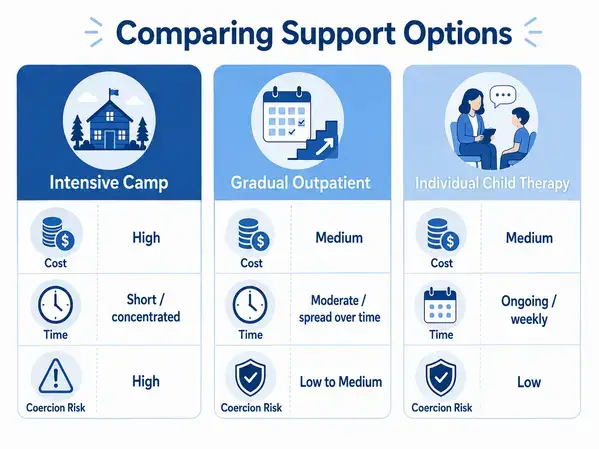
No single script works. The providers worth hiring go slow and never coerce. Compare the main options first.
| Option | Typical cost | Time | Coercion risk | Best fit |
| Intensive residential program | $15,000–$40,000 / 4 days | Days, plus follow-up | High | Rarely; severe court-ordered cases, and contested |
| Gradual outpatient reunification | $175–$200/hr; ~$2,500 retainer | Ongoing, billed hourly | Low | Most families with a resistant child |
| Individual child therapy + co-parenting | Similar per session, fewer joint visits | Variable, often ongoing | Lowest | When safety or trauma comes first |
Outpatient reunification work is private pay, usually $175–$200 an hour, billed against a retainer starting around $2,500. Intensive camps cost far more. ProPublica reported a four-day program at $15,000, and others reach $40,000 or higher. Insurance rarely covers any of it. The priciest option is the riskiest one I’ve seen. A June 2025 Texas law curbed the most coercive programs, with other states following.
Before any therapy, talk to your kid. Not a pitch. A real talk where they name the fear and you don’t argue them out of it. Kids who feel heard show up less defended.
A good clinician starts small: a 20-minute meeting with the child and therapist alone, no estranged parent in the room yet. Trust builds in inches.
For younger kids, often yes. Play lets a child show what they can’t yet say. Hand a guarded seven-year-old a sandtray and the walls drop. Forcing play on a teenager reads as condescending, so match the tool to the age, which good family therapy does anyway.
A kid who says they don’t feel safe isn’t an obstacle. They’re a witness. If a child raises anything like fear of harm, screen for it before pushing reunification, not after. The American Psychological Association puts abuse screening ahead of any alienation theory. A January 2026 Family Court Review piece called the mess of vague court orders a near-lawless space.
The parent the child lives with can make or break this. Treat therapy as punishment and the child reads it instantly. Send the same calm message as the other parent and the child settles. Agree on one thing: the child comes first, the standard behind high-conflict custody cases.

Slow, slower than you want. Progress isn’t a sudden hug, it’s a session that ends without tears. Actually, that’s not quite right. Progress is the child feeling less afraid, whether or not the bond looks repaired. Chasing a tidy reunion by a court deadline is how good cases go sideways.
The right therapist is trained for court work, screens for safety first, and will tell you no when no is the honest answer.
Ask three things before you hire. What method do you use, and what evidence backs it? How do you handle it if my child says they were hurt? What happens if they refuse mid-process? A clinician promising a guaranteed reunion is selling something.
Credentials matter too. Look for training in court-involved therapy and family violence, not a generic counseling license. A practice handling court-ordered therapy and custody work knows the reports a judge needs.
Hold onto one thing. Your child’s refusal is information, not defiance. It tells you what they’re scared of, exactly what reunification therapy must address before it works. Good outcomes come from slowing down, screening for real problems, and hiring an honest clinician, not from pushing hardest. If your child refuses reunification therapy right now, talk to experienced forensic psychologists who do this work locally and will tell you the truth.
What happens if my child refuses to go to reunification therapy?
Courts usually expect the requesting parent to make a good-faith effort to encourage attendance. Persistent refusal can lead to findings of contempt, fines, or changes to custody, though judges weigh an older teen’s wishes more heavily. The stronger move is preparing the child, choosing a non-coercive therapist, and addressing the fear behind the refusal.
Does reunification therapy actually work?
The evidence is mixed and hotly debated. A 2024 study found adults who went through intensive programs as children reported worse long-term relationships with the targeted parent, while gradual, voluntary work tends to show better results. There is no professional consensus on what counts as success.
Can a court force my child into reunification therapy?
In most states, judges have wide discretion to order therapy in custody cases, even over a child’s objection. That is changing in places like Texas, where a 2025 law limits coercive programs and no-contact orders. Objections grounded in documented safety concerns carry more weight than general reluctance.
Is reunification therapy ever harmful?
It can be, especially the intensive, coerced versions. Documented risks include heightened distress, damaged long-term relationships, and retraumatization when abuse allegations are present. This is why the American Psychological Association and family court experts insist on screening for safety before any reunification work begins.
How do I find a good reunification therapist?
Look for training in court-involved work and family violence, not just a standard counseling license, and ask what evidence supports their method. A clinician who guarantees a fixed timeline or a happy reunion is a red flag. Membership in groups like the Association of Family and Conciliation Courts is a good sign.
Written By: Michael Vale, Content Writer
Medically Reviewed By: Dr. Cathy Colet, Psy.D., Licensed Psychologist
Last Reviewed: June 14, 2026
A forensic psychologist’s value comes down to one thing. They give a court better information for a high-stakes decision. They study a person’s mental state, run standardized tests, then explain what the results mean for the legal question at hand. In a custody fight, a competency hearing, or an injury claim, that opinion can shape what a judge decides.


The title by itself tells you almost nothing. A license to practice psychology does not make someone ready for court. The real value sits in the training, the methods, and whether the work survives when an opposing lawyer tries to pull it apart.
A forensic psychologist is a licensed psychologist with extra training in how psychology applies to legal questions. They assess matters like competency to stand trial, mental state, and risk of harm, then present their findings to courts, attorneys, and juries using standardized tests and accepted scientific methods.

They turn a fuzzy question into a documented, testable answer. “Is this person competent?” or “How much did the crash affect her thinking?” becomes something measured, not guessed.
Most of that value lives in objective testing. A skilled evaluator uses standardized tools to measure memory, attention, mood, and effort, then ties the scores back to the legal issue. That gives attorneys far more than an opinion. It gives them data they can defend.
In criminal matters, the work might be a competency opinion or one of the violence risk assessments that help a court weigh release. In civil matters, it might mean showing how an injury changed the way someone thinks and functions. Different questions, same engine: test, document, explain.
No. This is the most common myth about the field, and the popular framing of it gets the answer backward.
A forensic psychologist does not decide who is telling the truth. That call belongs to the judge or the jury. What a good evaluator can do is test for effort and symptom validity. In plain terms, they use measures that flag when results look exaggerated or faked. They report what the data show and stop there. Anyone who promises to “prove” a person is lying is overselling, and the ethics rules in the field warn against that exact move.

The short version: a psychiatrist is a medical doctor, and a psychologist specializes in testing and assessment. Neither one is better. They add value in different ways.
A forensic psychiatrist is a medical doctor, so a forensic psychiatrist’s role centers on diagnosis tied to medication and physical illness. A forensic psychologist’s strength is measurement, using validated tests to map how a mind is working. Many strong cases use both.
| Forensic psychologist | Forensic psychiatrist | |
| Background | Doctoral degree in psychology | Medical degree (MD or DO) |
| Main strength | Psychological and cognitive testing | Medical and medication questions |
| Common tools | Standardized cognitive and personality tests | Clinical exams and medication review |
| Can prescribe medication | No, in most settings | Yes |
| Best fit | Competency, risk, cognitive effects, custody | Diagnosis tied to medication or illness |
Actually, framing it as a contest misses the point. The better question is which type of expertise your specific legal question needs.

Assuming any licensed psychologist can do forensic work. They can’t, at least not well.
Forensic work is its own skill set. It takes training in legal standards, real practice writing reports for court, and experience holding up under cross-examination. A clinician can be wonderful in a therapy room and still hand over a report that gets excluded. That gap is exactly how forensic psychologists differ from general clinicians, and it’s why board certification through the American Board of Forensic Psychology carries weight.
We see the pattern often. An attorney hires a familiar name, the report lacks forensic rigor, the other side moves to strike it, and the case loses ground it can’t win back.
Only if the methods are sound. Florida courts apply a reliability test before an expert can testify, and a polished resume will not rescue weak science.
Under Florida’s evidence rules, an expert opinion is allowed only when three things are true. It rests on enough facts or data. It uses reliable principles and methods. And those methods are applied correctly to the facts of the case. That standard is the real source of a forensic psychologist’s value. When the work is built to pass it, the testimony stands. When it isn’t, a single hearing can throw the whole opinion out.

The bar went up. Florida tightened the rules for court-appointed evaluators, and the change matters for anyone choosing one.
Evaluators who were on the state’s list as of July 2024 must finish annual forensic evaluator training by July 1, 2026, or come off the approved list. The required training now covers competency restoration, evidence-based practice, and least-restrictive treatment options. The need for this expertise is climbing too. Federal labor data projects psychologist jobs to grow 6 percent from 2024 to 2034, faster than the average job, with about 12,900 openings a year. For people picking an expert, the new rule is a quiet win. Ongoing competence is now a floor for court work in the state, not a bonus.
Far more than crime shows suggest. The popular picture treats forensic psychology as a criminal-court job, and that picture is too small.
A large share of the work is civil. These experts evaluate parents in custody and visitation disputes. They measure how an injury affects thinking and memory in personal injury and other medico-legal cases. They assess disability claims and fitness for duty. In South Florida, where many cases involve more than one language, cultural and language fit can decide how accurate an evaluation really is. A practice such as FC Psych Experts works across both criminal and civil matters, which is much closer to what the field looks like day to day.

Start with the question your case turns on, then find the expertise that matches it. Ask about forensic training, not only a license. Ask how many cases like yours the expert has handled. Ask how the opinion will hold up if it gets challenged. That kind of clear, well-researched guidance is what you get when subject knowledge meets an experienced team that understands how people actually search for answers. Match the right specialist to the right question, and a forensic psychologist becomes one of the strongest parts of a case. Skip that step, and the same title can quietly turn into a liability.
What does a forensic psychologist do?
A forensic psychologist applies psychological testing and assessment to legal questions. They evaluate matters like competency to stand trial, mental state, and risk, then explain the findings to courts and attorneys. Their opinions rest on standardized tests and accepted scientific methods, not personal hunches.
What is the difference between a forensic psychologist and a forensic psychiatrist?
A forensic psychiatrist is a medical doctor who can address diagnosis and medication, while a forensic psychologist specializes in psychological and cognitive testing. Neither one is superior. The right choice depends on whether your legal question is mainly medical or mainly about measuring how a person thinks and functions.
Can a forensic psychologist tell if someone is lying?
No. A forensic psychologist does not decide who is telling the truth, since that judgment belongs to the judge or jury. They can test for effort and symptom validity, which flags results that look exaggerated or faked, and then report what the data show.
What qualifications should a forensic psychologist have?
Look for a licensed psychologist with specialized forensic training, court experience, and ideally board certification through the American Board of Forensic Psychology. In Florida, court-appointed evaluators must also complete state-approved initial and annual training, with a July 1, 2026 deadline for existing evaluators to finish their annual update.
Is a forensic psychologist’s testimony admissible in court?
It can be, but it must meet a reliability standard. Under Florida’s evidence code, an expert opinion is admissible only if it is based on sufficient facts or data, uses reliable methods, and applies those methods correctly to the case. Opinions built on weak methods are often challenged and thrown out.
Do forensic psychologists only work on criminal cases?
No. Much of the work is civil, including custody and visitation evaluations, personal injury and medico-legal assessments, disability claims, and fitness-for-duty reviews. Demand across the field is rising, with federal data projecting 6 percent growth in psychologist jobs from 2024 to 2034.
```htmlWritten By: Michael Vale, Content Writer
Medically Reviewed By: Dr. Cathy Colet, Psy.D., Licensed Psychologist
Last Reviewed: June 12, 2026
If your immigration case hinges on hardship, trauma, or fear of returning home, an immigration psychological evaluation can be the evidence that makes an officer take your story seriously. It is a formal assessment by a licensed psychologist that puts your mental health in writing and ties it to the legal question your case turns on. It supports your case; it does not replace your attorney.

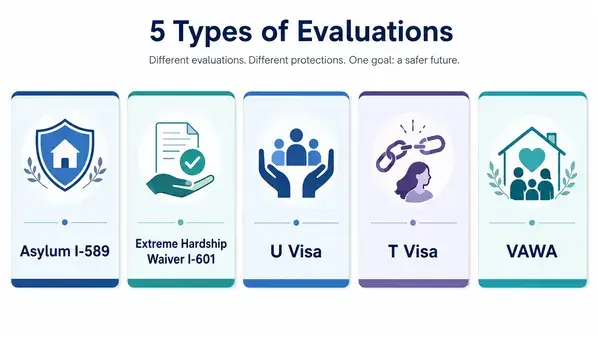
An immigration psychological evaluation is a forensic mental health assessment by a licensed psychologist that documents trauma, symptoms, and functional impairment for an immigration case. It is used in asylum, extreme hardship waivers, VAWA, and U or T visa petitions, and it links the clinical findings to the legal standard the case must meet.
Here is the part people miss. This is not therapy. It is a forensic evaluation with one job, answering a legal question in a report that goes to USCIS or an immigration judge. An evaluator assesses you in a few hours and writes findings the government will read.
A strong evaluation turns a personal story into documented clinical evidence, and in 2026 that counts more than before. The U.S. has 46 million immigrants, about 14% of the population, and many delay mental health care out of fear or cost, so most applicants arrive with real symptoms no one has written down. The report documents the trauma behind an asylum claim or what removal would do to a U.S. citizen spouse or child. Does it guarantee approval? No. One California practice reported an 81.6% grant rate with forensic reports in 2026, but that is a single provider’s number, not controlled data.

Not every case needs the same evaluation. The case type sets the questions the psychologist must answer.
| Case Type | What the Evaluation Documents |
| Asylum (Form I-589) | Trauma from persecution, PTSD or depression, fear of return, and credibility. |
| Extreme Hardship Waiver (I-601 / I-601A) | The harm a U.S. citizen or resident relative faces if you are removed. |
| U Visa | Harm from a serious crime and cooperation with law enforcement. |
| T Visa | Trauma from trafficking and ongoing safety fears. |
| VAWA | Abuse-related trauma and its effect on daily functioning. |
| N-648 (naturalization) | A condition that blocks learning English or civics; needs a physician or psychologist. |
U visas are capped at 10,000 a year, a limit USCIS has hit every year since 2010, so timing your evidence matters.
The hardship waiver is the type we see most, and it surprises people, because it often is not about the immigrant at all. It is about the qualifying relative, the citizen or green card holder left behind or forced to move. Strong reports name specifics, a child’s developmental needs, a spouse’s depression.

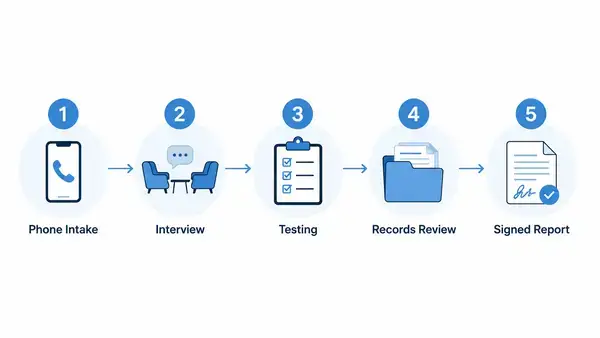
Most evaluations follow the same path from first call to final report.
1. Intake call to map your case, deadline, and legal standard, often with your attorney.
2. Clinical interview, the core. Expect two to four hours, sometimes split over two visits.
3. Psychological testing for trauma, mood, and response style.
4. Records review of medical, mental health, legal, and school documents.
5. Written report tied to the legal standard, then sent to you and your attorney.
Pick the wrong evaluator and a weak report can sink a strong case. The biggest filter is real immigration and forensic experience, not just a therapy license. About 204,300 licensed psychologists work in the U.S., and only a small slice do immigration work, so look for someone who does these often, knows the legal standards, runs testing, and matches your language and culture. The American Psychological Association’s trauma-informed, culturally responsive standards are the bar to expect.
The mistake I see most? People ask their own therapist to write the report because that person knows them best. Don’t. APA ethics warn against one clinician being both your therapist and your evaluator, because it kills the objectivity officers want.

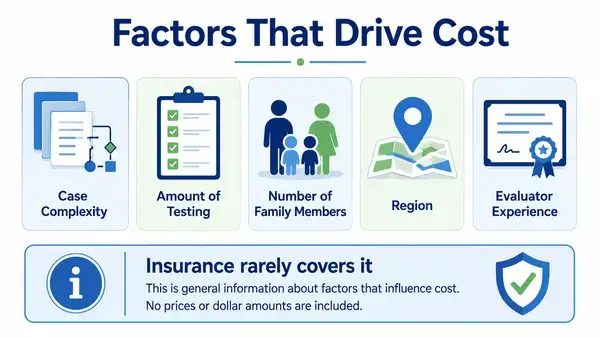
The honest answer is that it depends. Cost moves with case complexity, how much testing is needed, how many family members are involved, your region, and the evaluator’s experience. There is no government or research-backed national figure, so treat any flat price you see quoted online with caution.
One thing stays consistent. Insurance almost never covers it, because it is a legal assessment, not medical treatment. Plan to pay out of pocket, and ask any provider about deposits and payment plans up front.
What you do before the interview shows up in the final report.
1. Schedule early, eight to twelve weeks out. Tighter means a rushed report, so book a consultation well ahead.
2. Gather records: medical and mental health history, prior evaluations, immigration forms, police or school records.
3. Write a timeline of key events and when symptoms started, so the clinician can connect cause and effect.
4. Track symptoms, sleep, mood, and anxiety, for a week or two.
5. Be honest, including the hard parts. Many applicants also see a separate clinician for ongoing trauma therapy.
A strong report is detailed, individualized, and tied to the legal standard. USCIS and the immigration courts have gotten stricter, and short or template reports now work against you. Reviewers now flag hardship reports under roughly eight pages. A report that holds up usually runs eight to ten pages or more, uses DSM-5-TR diagnoses, shows impaired functioning, and ties every finding to the exact legal question. Actually, that isn’t quite right. Length is not the point. A padded ten-page report full of generic language is as weak as a short one. What reviewers want is specifics tied to your life and your case.
An immigration psychological evaluation is one of the few pieces of evidence you control: who does it, how prepared you are. At FC PsychExperts, our licensed psychologists across Florida handle immigration psychological evaluations for asylum, hardship waivers, VAWA, and U and T visa cases, in person and online. If a deadline is coming, start early so there is time to do it right.
Can my own therapist write my immigration psychological evaluation?
It is usually a bad idea. APA ethics caution against the same clinician acting as both your treating therapist and your forensic evaluator, because the dual role undermines objectivity. Reviewing officers and experienced attorneys often give less weight to a report written by your own therapist.
How long does an immigration psychological evaluation take?
The clinical interview usually runs two to four hours and can be split across two visits. After that, most evaluators deliver the written report in about two to four weeks, though rush turnaround is sometimes available for an added fee.
Does insurance cover an immigration psychological evaluation?
Almost never. Because the evaluation is a forensic, legal assessment rather than medical treatment, it is typically paid out of pocket. Ask about payment plans, and expect to leave a deposit before the work begins.
How many pages should the report be?
Strong reports usually run eight to ten pages or more. Since 2025, reviewers have flagged short or template-style reports under about eight pages in hardship cases, so detail and individualized analysis matter more than ever.
Can the evaluation be done online?
Often, yes. Many evaluators offer telehealth interviews, which can widen access to bilingual or specialized clinicians. For complex forensic cases an in-person session is sometimes preferred, and acceptance can vary, so confirm with your evaluator and attorney.
How far in advance should I schedule?
Aim for eight to twelve weeks before your USCIS or court deadline. Four to six weeks is the practical minimum, and tighter timelines usually mean a rushed, weaker report.
Written By: Michael Vale, Content Writer
Medically Reviewed By: Dr. Cathy Colet, Psy.D., Licensed Psychologist
Last Reviewed: June 11, 2026
Hire the wrong forensic psychologist and you can lose a case you should have won. A weak expert misreads the data, misses the legal standard, or falls apart on cross-examination, and the whole opinion goes down with them. I’ve watched one thin report undo months of solid legal work. Custody, freedom, and a person’s reputation often ride on a single evaluation.
A forensic psychologist applies psychological science to legal questions like competency to stand trial, criminal responsibility, child custody, and emotional injury. Unlike a therapist, this expert answers to the court, not a patient. The work demands specialized training, courtroom experience, and strict neutrality, which is exactly what a poorly trained evaluator lacks.
Most people assume any licensed psychologist can do this. That’s where cases quietly fall apart.

The first risk is the obvious one. Wrong conclusions. An evaluator who picks the wrong tools, skips key records, or trusts a gut read over a validated forensic evaluation can hand the court an opinion that isn’t true.
A 2025 review in the Journal of the American Academy of Psychiatry and the Law found that some examiners lack the basic skills the work requires, with documented quality problems in competency and criminal-responsibility reports, mostly among practitioners without board certification.
On the ground, that means a botched competency finding that pushes someone toward the wrong plea, a flawed report that lands a child in the wrong home, or a sloppy neuropsychological evaluation that misreads a brain injury. The opinion looks authoritative on paper, and that’s the trap.
Neutrality is the whole job. An expert who lets a hunch or an attorney’s preferred story steer the findings serves one side instead of the truth.
Bias rarely looks like cheating. It looks like an examiner who locks onto the first theory and reads every fact to fit it. Research on context effects shows that even irrelevant case details can sway a clinician without them noticing. Actually, that’s the part people underestimate. The worst bias is the kind the expert can’t feel.
A trained specialist builds guardrails. Structured tools, documented reasoning, a clear line between the data and what the hiring side wants. A generalist running a clinical psychological evaluation like a therapy intake usually has none.
If your expert can’t speak the court’s language, their opinion may never reach the jury. The law sets the bar for what gets admitted.
In federal court and most states, testimony has to clear the federal standard for expert testimony, where the judge acts as a reliability gatekeeper. A 2023 amendment tightened that screen, and judges enforce it harder now. States like California, New York, New Jersey, and Pennsylvania still use a version of the older Frye test. An expert who doesn’t know which one applies, or who oversteps the limits on “ultimate issue” opinions, gets challenged or thrown out.
National specialty guidelines for forensic psychology, extended through 2026, add an ethics line: practice only within your training. Someone dabbling in emotional injury evaluations without forensic grounding is already across it.
Here’s the part that stings. Even a partly flawed expert is a gift to opposing counsel. They’ll spend cross-examination shredding a thin resume, exposing a sloppy method, or surfacing a bias the evaluator missed. Once credibility cracks, the judge and jury discount everything that person said.
A discredited opinion can taint your whole position, and a verdict built on excluded testimony can be challenged on appeal. I’ve watched a strong case wobble because one expert couldn’t defend their report. The other side won on the weak link, not the facts.

Start before you hire. Confirm the license, check for board certification, dig into forensic-specific experience, and ask how they handle bias. The label “forensic psychologist” is broad, and that’s the problem.
The U.S. The Bureau of Labor Statistics counts more than 200,000 psychologists nationwide, a field projected to grow 6% through 2034. But only about 4% hold any board certification, and in a 2024 survey of forensic practitioners, roughly 30% were board certified. A title alone tells you little.
| What to weigh | Board-certified specialist | Minimally experienced practitioner |
| Report quality | Higher reliability, fewer errors | More variable, more errors |
| Courtroom challenge | Built to withstand scrutiny | Higher risk of exclusion |
| Forensic training | 100+ hours plus a fellowship or 1,000+ supervised hours | A few cases or a workshop |
Board certification through the American Board of Professional Psychology is the strongest signal you’ll find. It calls for a doctoral degree from an accredited program, licensure, at least 100 hours of forensic training, and either a formal fellowship or 1,000 supervised hours over five years, plus a credential review, a written exam, and a three-hour oral exam.
Before you sign, ask:
Location matters too. Certified experts cluster in states like California, New York, Florida, and Texas, and by late 2025 about 40% of the country sat in a mental health professional shortage area, nudging people toward the nearest name over the right one. If you’re a forensic psychologist building a practice, that scrutiny extends to how you present your expertise online, where a marketing partner who understands the legal-services space earns its keep.
The simplest safeguard is a few minutes of verification before you retain anyone, because the wrong forensic psychologist can quietly take the one thing no appeal returns: a fair shot. Work with an experienced forensic psychology practice, confirm the credentials, and make the other side earn every inch.
What does a forensic psychologist do?
A forensic psychologist applies psychological science to legal questions, such as competency to stand trial, criminal responsibility, child custody, and emotional injury. They evaluate people, review records, and often testify in court. Unlike a treating therapist, they answer to the court and are expected to stay neutral.
Can any licensed psychologist perform a forensic evaluation?
Not really. A license permits practice within a psychologist’s competence, but forensic work demands specialized training, knowledge of legal standards, and validated methods. In a 2024 survey of forensic practitioners, only about 30% were board certified, so a general license is no guarantee of forensic skill.
How do I know if a forensic psychologist is qualified?
Check the active license, ask about board certification in forensic psychology, and request a resume that shows forensic-specific training and recent case experience. Only about 4% of licensed psychologists hold any board certification, so it is a strong signal worth confirming. Ask how many cases like yours they have handled in the past five years.
What is the difference between a clinical and a forensic psychologist?
A clinical psychologist diagnoses and treats patients. A forensic psychologist applies psychology to legal questions and serves the court rather than a patient. Many start with clinical training, then add forensic education, supervision, and courtroom experience. The roles carry different duties and ethical obligations.
What happens if an expert’s report is biased or unreliable?
The testimony can be challenged, narrowed, or excluded, and a verdict that relied on it can be questioned on appeal. A 2025 review in the Journal of the American Academy of Psychiatry and the Law documented quality and reliability problems in reports, especially from examiners without board certification. A weak report can damage your entire case.
How long does a forensic evaluation take?
It usually takes weeks to months, depending on the case and the records involved. The process typically includes a records review, clinical interviews, psychological testing, contact with collateral sources, and a detailed written report. It is far more involved than a standard therapy session.
Written By: Michael Vale, Content Writer
Medically Reviewed By: Dr. Cathy Colet, Psy.D., Licensed Psychologist
Last Reviewed: June 9, 2026
A psychological evaluation is a structured way to measure how someone’s mind is working. A trained psychologist uses standardized tests, interviews, and observation to answer a specific question. Is this ADHD or anxiety? Why is my child falling behind in school? What’s behind these memory slips? You leave with a written report and a plan, not a shrug.
Most people picture the wrong thing. They imagine a couch, a few vague questions, and an inkblot. Real testing looks more like a focused set of tasks and questionnaires, scored against thousands of people the same age.
Demand keeps climbing. More than 1 in 5 U.S. adults live with a mental illness in any given year, and only a fraction ever get formally evaluated. Jobs for psychologists are projected to grow about 6% through 2034, faster than most careers.
This guide covers what an evaluation involves, the main types, and why the results are worth having. We’re skipping forensic and court-ordered testing, which plays by its own rules.

A psychological evaluation measures your thinking, emotions, and behavior using tested tools, then explains what the results mean in plain terms.
Put more fully, it’s the process of measuring a person’s mental, cognitive, and emotional functioning through standardized tests, interviews, and observation. A licensed psychologist compares your results to scores from a large group of peers, usually matched by age, to identify conditions, guide treatment, and pinpoint both strengths and trouble spots.
People use “assessment,” “evaluation,” and “testing” like they’re three different things. They mostly aren’t. Or more precisely, testing is one piece, the tasks themselves, and the evaluation is the whole process around it, interview and report included. Clinicians swap the words constantly, so don’t get stuck on them.
What separates this from a free online quiz is standardization. Everyone takes the same tests the same way, and your answers get compared to a normed group. Think of the SAT, but for attention, memory, and mood instead of algebra. Behind the scenes, our team of licensed psychologists follows standards from the American Psychological Association for choosing and reading those tests.

There isn’t one psychological evaluation. The type you need depends on the question you’re trying to answer. Most of them follow the same general arc, though.
The process usually runs like this:
Skip that last step and you’ve wasted the whole thing. I’ve watched people collect a detailed report, never review it with anyone, and file it in a drawer. A report you don’t understand can’t help you.
The four main types compare like this:
| Type | What it measures | Who it’s for | Where it usually happens |
|---|---|---|---|
| Psychoeducational | IQ plus academic skills and learning gaps | Kids or adults struggling in school | Schools or private clinics |
| Emotional & personality | Mood, anxiety, and personality traits | Teens or adults wanting clarity on what they feel | Outpatient clinics |
| Child & adolescent | Behavior, emotions, and development | Children and teenagers | Clinics, sometimes hospitals |
| Neuropsychological | Memory, attention, planning, motor skills | Suspected brain-based conditions | Medical settings and hospitals |

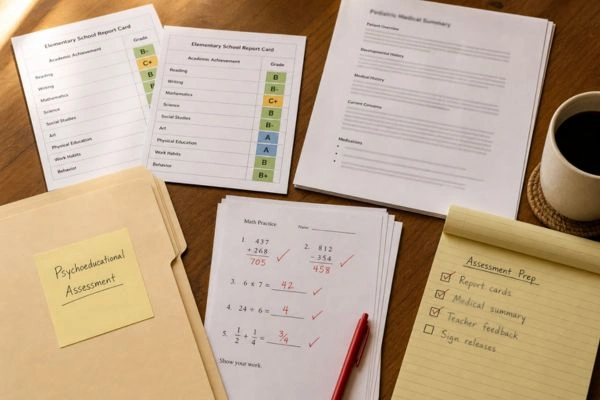
A psychoeducational evaluation tests for learning disorders by comparing how capable someone is with how they perform in school.
The logic is simple. The psychologist measures intellectual ability and academic skills (reading, math, writing), then looks for a gap. When someone’s reading sits far below what their thinking ability predicts, that gap points toward a specific learning disorder.
Schools run these tests when a child falls behind, but you can also get psychoeducational testing privately through a licensed psychologist. Results feed straight into a 504 Plan or an IEP.
I see this constantly: parents assume the free school evaluation and a private one do the same job. They don’t, always. School testing decides whether your child qualifies for services. It isn’t built to hand you a clinical diagnosis, and school psychologists often can’t diagnose conditions like ADHD on their own. For a formal diagnosis, you usually need a private psychologist.
This type looks at mood, anxiety, and personality to figure out what’s driving how someone feels and behaves.
The appeal is speed. A good battery can show a clinician in a few sessions what might otherwise take months of therapy to surface. Results shape real choices: which medication might help, which therapy fits, whether a referral to a psychiatrist or neurologist makes sense. With adults, much of this comes from self-report questionnaires. If you’re trying to understand a long-running pattern, a clinical psychological evaluation beats trial and error.

Kids and teens get evaluated through a mix of direct testing and reports from the adults who know them best.
For a young child, parents fill out questionnaires about what they see day to day. With teenagers, it’s usually both: the teen answers self-report measures, and a parent completes their own. That parent input isn’t a formality. Most young kids, and plenty of teens, can’t describe what’s going on, and parents are often the first to notice something’s off. These evaluations happen in outpatient clinics, and sometimes in hospitals when the situation calls for it.

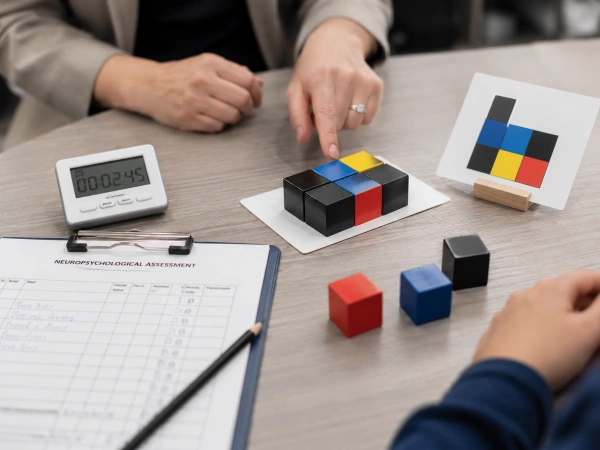
A neuropsychological evaluation digs into specific brain functions like memory, attention, and planning.
It goes deeper than a standard battery. It measures executive functioning (planning, organizing, and putting the brakes on an impulse), attention, learning, memory, even motor coordination. The psychologists who do this work complete extra post-doctoral training first. Referrals usually come from doctors worried about a seizure disorder, head injury, or dementia, or when anxiety or low mood seems to be fogging someone’s thinking. It’s mostly done in medical settings. When a fuller picture is needed, a neuropsychological evaluation can fold into a larger battery covering intelligence, academics, and emotional functioning.
Psychological testing matters because guessing rarely pays off. The right evaluation turns “something feels off” into a named problem with a plan attached.
Start with treatment. About half of adults with a mental illness get no treatment at all, and plenty who do are working from a hunch instead of a diagnosis. Testing replaces the hunch. It pins down the underlying cause instead of chasing symptoms, tracks whether treatment is working, and gives families a shared understanding of what they’re facing. When results point toward something like structured, evidence-based therapy, you start out already knowing the target.
One catch worth planning around: getting in takes time. The national average wait for behavioral health care runs about 48 days, and roughly 40% of Americans live in areas short on providers, per 2025 federal workforce data. Don’t wait for a crisis to start looking.
One last point, and it’s the part people skip. A psychological evaluation isn’t only a hunt for what’s broken. Good testing also shows you what you’re good at, so you can use those strengths to work around the hard parts. That’s the real payoff. It’s not about a label. It’s a clearer picture of how your mind works and what to do next.
What happens during a psychological evaluation, and how long does it take?
A psychological evaluation includes an interview, a set of standardized tests, scoring, a written report, and a feedback session. Face-to-face time is usually a few hours, sometimes split across visits. The full process often takes two to six weeks, partly because scoring and writing one report can take a clinician 8 to 20 hours behind the scenes.
What’s the difference between a psychological evaluation and therapy?
A psychological evaluation is a time-limited process that answers a specific question and ends with a report and recommendations. Therapy is ongoing treatment. An evaluation often leads to therapy, but it isn’t a substitute for it. This matters because about half of adults with a mental illness get no treatment, often because the real problem was never clearly identified.
Can a psychological evaluation be done online?
Some parts can. Updated 2024 telehealth guidance from the American Psychological Association supports remote work for certain evaluations, and online wait times are often shorter. But not every test adapts well to a screen, and some batteries still need to be done in person to stay valid or to be accepted by insurers.
How should I prepare for an evaluation?
Be honest and thorough about your history, symptoms, and any medications. Bring your ID, the referral question, and a list of things you want answered. There’s no need to study or rehearse. Looking up actual test questions ahead of time can invalidate your results.
Can any therapist do a full evaluation?
Not a full one. Many master’s-level clinicians can run brief screenings, but complex testing and interpretation usually require a doctoral-level psychologist with specific training in psychometrics. Matching the provider to your referral question is one of the most overlooked steps in the whole process.
What if I disagree with the results?
You can ask the evaluator to clarify the findings, request a second opinion, or use the results as one input rather than the final word. Test scores are interpreted alongside clinical judgment. They’re a snapshot in time, not a permanent label.
Why is it so hard to get a psychological evaluation appointment?
There’s a national provider shortage. The average wait for behavioral health care is about 48 days, roughly 40% of Americans live in areas with too few mental health providers, and around 6 in 10 psychologists report no openings for new patients, according to 2025 federal data. Booking early helps.
Written By: Michael Vale, Content Writer
Medically Reviewed By: Dr. Cathy Colet, Psy.D., Licensed Psychologist
Last Reviewed: June 7, 2026
If you were hurt in an accident and you’re still not sleeping, still flinching at car horns, still not yourself, a personal injury psychological evaluation is how that damage gets put on the record. It’s an exam by a licensed psychologist that measures the mental and emotional harm tied to your injury, in language courts and insurers take seriously.
Most people think these cases are about broken bones and medical bills. They’re not, or not only. The part that’s hardest to prove is the part you can’t see.
A personal injury psychological evaluation is a structured assessment by a qualified psychologist that documents conditions like PTSD, depression, and anxiety caused by an accident or injury. It combines interviews, standardized tests, and a review of your records to link the harm to the event and explain how it affects your daily life.
We’ll cover what the exam includes, who runs it, what the tests can and can’t catch, and the one mistake that quietly sinks more claims than any other. We won’t talk about fees, and this isn’t legal advice.

It turns invisible harm into evidence. That’s the whole job.
A car wreck leaves a dent the adjuster can photograph. Trauma doesn’t. So the evaluation does three things: it names the condition, ties it to the crash and not to something else, and shows how the symptoms hit your work, sleep, relationships, and daily function.
That third piece matters most, and a diagnosis alone is weak. “This person has anxiety” means little. “This person stopped driving, lost their job, and can’t be alone since the collision” is what moves a number.
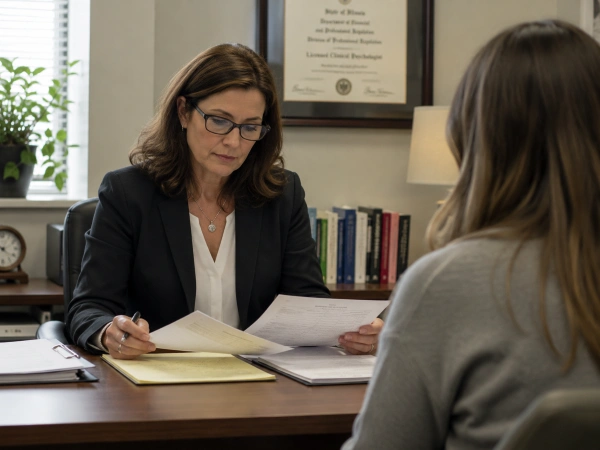
A personal injury psychological evaluation is a forensic mental health exam built for the courtroom, not the therapy room. A licensed psychologist runs it, usually over several sessions, and writes a report that can hold up if a lawyer tries to pick it apart.
That last part is the difference between this and regular therapy. Your therapist’s job is to help you feel better. A forensic evaluator’s job is to answer one question: what’s really going on, and is the injury the cause? Those are different jobs, and courts know it. A good evaluator stays neutral even when you’re the one who hired them.
Most evaluations follow the same path. It usually runs in this order:
Expect several weeks total. A little preparation goes a long way, so it helps to know how to prepare for the assessment before your first session. The four parts below are where the real work happens.
Before you say a word, the psychologist reads your file. That’s deliberate. They want your history, including any anxiety or depression that predates the accident, so the defense can’t ambush them with it later. The first meeting sets the frame. Who they are, who they’re not, and the fact that this exam isn’t a treatment.

In plain language, the tests measure your symptoms and check whether you’re being straight. Common ones include the MMPI-3 and the PAI, both packed with validity scales that flag exaggeration or faking. For suspected memory or attention problems, evaluators add symptom-validity measures like the TOMM. No single score decides anything. A skilled evaluator reads the whole picture, not one number. If a head injury is in play, the work may extend into neuropsychological testing.

This is a long conversation, often hours across more than one session. The evaluator asks about the accident, your symptoms, your sleep, your work, and your life before all of it. They’re also watching how you tell it and whether your account stays consistent. Consistency is everything. People who try to sound worse than they are get caught, and people who downplay real symptoms hurt their own case.
With your permission, the evaluator may call your spouse, a close friend, or your regular doctor. Not to snoop. To corroborate. If your partner describes the same nightmares and short temper you reported, your account gets stronger. If nobody else has noticed any change, that’s a problem the report has to address.

Three conditions show up again and again after a serious injury: PTSD, depression, and anxiety.
PTSD is the big one in accident cases. Flashbacks, nightmares, panic at anything that reminds you of the crash, avoiding the road where it happened. Depression often follows when the injury steals the life you had, your job, your sport, your independence. Anxiety can attach to the injury itself or to the slow grind of the legal process.
There’s overlap with the body, too. Chronic pain feeds depression. A head injury from the same collision can blur the line between emotional symptoms and cognitive ones, which is exactly when a careful evaluation earns its keep.
A solid evaluation can move a case in either direction, which is the part people forget.
Link serious harm to the injury, and the value of the claim goes up, because the law treats emotional damage as real damage. Find little harm, or harm from another cause, and it can shrink the claim or sink it. Both sides use these exams. Yours strengthens your case. The other side is hired to test it.
Yes, sometimes a lot. Documented psychological injury feeds the non-economic part of a claim, the pain-and-suffering side that often dwarfs the medical bills. One 2025 review of more than 5,800 personal injury cases put the average settlement around $55,000, with the high end driven by severe, well-documented harm. No evaluation guarantees a bigger check, and anyone who promises one is selling something. It gives your damages a factual spine instead of a feeling.

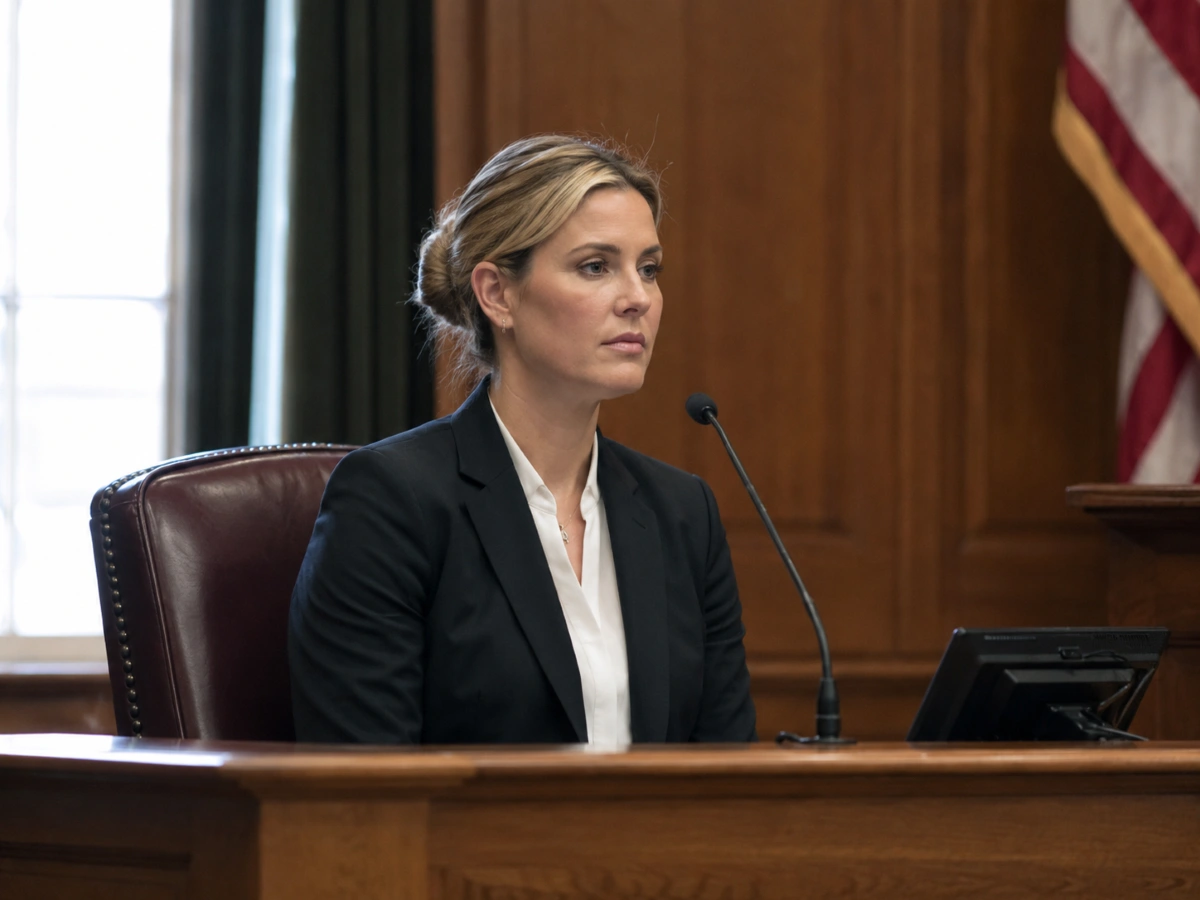
If the case goes far enough, your evaluator may testify, explaining the diagnosis, cause, and impact in plain terms a jury can follow. When both sides bring an expert, you get a battle of the experts. It rarely cancels out. The winner usually has stronger credentials, cleaner methods, and findings that fit the evidence. Board certification helps, and so does an evaluator who has survived cross-examination.
Short answer: no, not the way therapy is. This surprises people, so read it twice.
Treatment is protected. A forensic evaluation is the opposite. It exists to be shared with the attorneys, the court, and the other side. The psychologist’s loyalty isn’t to your comfort. It’s to an honest answer, the kind professional ethics rules require no matter who’s paying. A good evaluator tells you this up front, so nothing you say feels like a trap later. Anyone who frames a litigation exam as private like a counseling session is a red flag.
These exams aren’t perfect, and pretending otherwise helps no one.
Psychological injury is subjective. There’s no X-ray for trauma. That opens two real risks. One is malingering, the clinical word for faking or padding symptoms, which gets tempting when money is on the line. Good tests catch a lot of it, not all. The other risk runs the other way. A thin, sloppy report can get thrown out under the reliability standard judges apply to expert testimony, sometimes called the Daubert standard.
Because the whole report is only as good as the evaluator’s independence. A one-sided exam is worthless the moment it’s challenged.
The industry loves the phrase “neutral and unbiased.” The uncomfortable truth is that complete objectivity is a goal, not a finished state. Even careful, ethical evaluators carry blind spots, a point forensic specialists make in their own peer-reviewed research. The guidelines that govern the field, recently extended through the end of 2026, ask evaluators to aim for fairness, weigh rival explanations, and stay independent precisely because bias is the default, not the exception.
So what protects you? Method. A neutral evaluator runs the same tests, asks the same hard questions, and follows the same logic no matter who signed the check, which is the standard we hold ourselves to at our forensic psychology practice. It’s also why a one-sided hired gun gets shredded on cross, and why an evaluator who works both plaintiff and defense cases carries more weight with a jury.
If your injury came with real psychological harm, the kind you can’t see but live with every day, then yes. Documenting it is how it counts.
Skip it and the most painful part of your injury stays invisible to the people deciding your case. The one mistake I’d warn against is waiting too long, or using someone without forensic training to save a step. A weak evaluation is worse than none, because the other side will use it against you.
Get the right evaluator early, be honest, and let the work speak. A well-run personal injury psychological evaluation won’t promise you an outcome, but it will make sure the harm you carry is on the record, in language the system respects. The strongest practices also stay visible online, so the attorneys and clients who need that work can find it.
What is a personal injury psychological evaluation?
It’s a forensic mental health exam that documents psychological harm, such as PTSD or depression, caused by an accident or injury. A licensed psychologist runs it over several sessions and writes a report built to hold up in court. Unlike therapy, its purpose is to answer a legal question, not to provide treatment.
How long does a personal injury psychological evaluation take?
Most take several weeks from start to finish. The interviews alone can run several hours across two or more sessions, and the psychologist still needs time for testing, records review, and a report that often runs 10 to 20 pages. Complex cases with heavy records take longer.
Is a forensic psychological evaluation confidential?
No, not the way therapy is. A forensic evaluation exists to be shared with the attorneys, the court, and the opposing side. A good evaluator explains this before you start, so nothing you say is mistaken for a private counseling session.
What tests detect faking or exaggerated symptoms?
Forensic psychologists use instruments like the MMPI-3 and the PAI, which include built-in validity scales that flag inconsistent or exaggerated reporting. For memory or attention complaints, they add symptom-validity tests such as the TOMM. No single score is decisive; the evaluator weighs the whole pattern against your records and interview.
Can the defense make me see their own psychologist?
Often, yes. The defense can request an independent medical examination, or IME, with a psychologist of their choosing. That sets up a battle of the experts, where the more credible, better-documented opinion usually carries the most weight.
Is a letter from my treating therapist enough?
Usually not for a contested claim. Treating therapists are valuable, but courts often discount their letters because of the therapeutic alliance and the lack of forensic testing. An independent evaluation built around objective measures and the Daubert reliability standard holds up far better under cross-examination.