

Can A Court Order Therapy In Florida?
Written By: Michael Vale, Content Writer
Medically Reviewed By: Dr. Cathy Colet, Psy.D., Licensed Psychologist
Last Reviewed: October 3, 2026
Yes. A Florida judge can order you into therapy, your child into therapy, or both. It happens in divorce cases, paternity cases, and any fight over a parenting plan.
But the power has edges, and almost nobody explains where they are. A judge can’t order counseling nobody asked for. A judge can’t hand the therapist the job of deciding whether you finished. Reconciliation counseling in a divorce stops at 3 months. And the phrase “the judge ordered therapy” covers 5 different orders that carry 5 different sets of rights.
Our Florida forensic psychology practice evaluates and treats families under these orders. Parents usually arrive knowing what court-ordered therapy is and still not knowing what their own order allows. Here’s what the statutes and rules say.

What Is Court-Ordered Therapy In Florida?
Court-ordered therapy is counseling a judge requires as part of a family law case. Florida has no single statute for it. The authority is split across Chapter 61 of the Florida Statutes and the Florida Family Law Rules of Procedure, and each source has its own trigger, its own time limit, and its own rules about who takes part.

Yes, And Here’s The Law That Lets A Florida Judge Do It
There is no one Florida statute that says “the court may order therapy.” A judge draws on 5 separate sources depending on what’s being ordered and who it’s aimed at.
| What’s ordered | Authority | Time limit | What triggers it |
|---|---|---|---|
| Reconciliation counseling in a divorce | Fla. Stat. 61.052(2) | Continuance not to exceed 3 months | A minor child, or the respondent denies the marriage is irretrievably broken |
| Parent education course | Fla. Stat. 61.21 | Minimum 4 hours, done before final judgment | Automatic in any dissolution with minor children |
| Evaluation of a minor child | Fla. Fam. L. R. P. 12.363 | Report due before the evidentiary hearing | A party’s motion, or the court’s own motion |
| Mental exam of a parent | Fla. Fam. L. R. P. 12.360 | None set by rule | A party’s motion, then a hearing |
| Therapy written into a parenting plan | Fla. Stat. 61.13(2)(b)3. | None set by statute | Whatever the parenting plan says |

Can A Judge Order My Child Into Therapy If I Object?
Usually yes, and often the judge doesn’t have to. Under Fla. Stat. 61.13(2)(b)3., when a court orders shared parental responsibility over health care decisions, the parenting plan must provide that either parent may consent to mental health treatment for the child. One parent can start a child in therapy without the other agreeing.
That provision exists so a child isn’t stuck without care while 2 adults argue. It isn’t a tool for one parent to take over. It doesn’t say one parent picks the therapist, sets the schedule, and controls what the other parent hears.
When the court wants a professional to examine a child rather than treat one, that runs through Florida Family Law Rule of Procedure 12.363. A party moves for it, or the judge orders it on the court’s own motion. The parents can agree on an expert, subject to the judge’s approval. If they can’t agree, the court picks. The appointment order has to state the issues the expert will address.
So a child can end up in front of a mental health professional 2 ways, and they are not the same thing. One is treatment a parent consented to. The other is an examination the court ordered to answer a question. Knowing which one you’re in changes what you should expect from the clinician, and what a child’s stated preference does or doesn’t count for.

Can A Judge Order A Parent Into Therapy?
Yes, but the path is narrower than it is for a child, and it starts with a motion.
A psychological examination of a parent runs under Florida Family Law Rule of Procedure 12.360. A party has to move for it and the court has to hold a hearing. The rule carries a wrinkle worth knowing: the examiner can be called as a witness by any party, but is not identified as appointed by the court.
Counseling aimed at saving the marriage is different. Under Fla. Stat. 61.052(2), if there’s a minor child or the responding party denies the marriage is irretrievably broken, the judge can order the parties to consult with a marriage counselor, psychologist, psychiatrist, minister, priest, rabbi, or any other person the court considers qualified. The statute adds a condition most summaries skip: that person has to be “acceptable to the party or parties ordered to seek consultation.” You get a say in who it is. And the judge can only pause the case up to 3 months for it.
Then there’s the parenting course under Fla. Stat. 61.21, which isn’t optional at all. Every party in a dissolution with minor children, or a paternity action involving parental responsibility, has to complete the Parent Education and Family Stabilization Course before the court enters a final judgment. It runs a minimum of 4 hours. The petitioner has 45 days from filing. Everyone else has 45 days from service. Skip it and the court can hold you in contempt, deny you shared parental responsibility or time-sharing, or sanction you some other way. The judge can also order extra courses for children with special needs or emotional concerns.

What Happens To The Report, And Who Sees It?
Under Rule 12.363, the expert’s written report goes to the parties and any guardian ad litem. It does not go to the judge unless the parties and their attorneys agree in writing that the court will consider it.
That surprises most parents. The report isn’t automatically filed. Somebody has to put it in front of the judge, and in an evaluation of a minor child that takes written agreement from both sides.
There’s one more line in that rule almost nobody quotes. The committee note says the rule “is not intended to prevent a mental health professional who has engaged in long-term treatment of the child from testifying about the minor child.” Your child’s regular therapist is not automatically shielded from the witness stand. Long-term treatment doesn’t buy immunity from being called.
Which raises the bigger question of what stays private through any of this. That answer turns on Florida’s evidence code and on which kind of order you have, and we’ve covered it separately.
The 4 Limits On A Florida Therapy Order In 2026
1. It has to be asked for. A judge can’t order counseling that nobody pleaded for. Relief outside the pleadings is relief the court didn’t have in front of it. If an order appeared that neither side requested, raise it with your attorney.
2. The judge decides whether you finished, not the therapist. In Malley v. Malley, No. 4D2023-0332 (Fla. 4th DCA, June 20, 2024), a trial court made the father submit proof of treatment to a court-appointed doctor, who would assess whether it was enough before he could petition for modification. The Fourth District reversed that piece. A court may condition increased time-sharing on completing parenting courses and therapy, but as the opinion put it, “Courts may not delegate their statutory authority to determine visitation to GALs, attorneys, or experts.” Your clinician reports what happened. The judge rules on what it means.
That distinction isn’t a technicality. It decides who you’re talking to when you sit down. A clinician who believes they hold your time-sharing in their hands behaves differently from one who knows they’re a witness to facts. So does the parent across from them.
3. Reconciliation counseling stops at 3 months. Fla. Stat. 61.052(2) lets the judge continue the proceeding for that purpose, not to exceed 3 months. That cap applies to reconciliation counseling and nothing else. It does not cap therapy written into a parenting plan, which is where most long-running orders live. If you miss sessions or stop going, the consequences track the order you’re under, not the statute.
4. The order has to define the job. Under Rule 12.363, an appointment order states the issues the expert will address. An order with no scope and no end point is an order nobody can comply with cleanly, and it’s the kind that produces a clinician doing work the court never asked for.
Malley is a June 2024 Fourth District decision, not a ruling of the Supreme Court of Florida. Ask your attorney how courts in your circuit are applying it.
Court-Ordered Therapy Or Court-Ordered Evaluation: What Changes
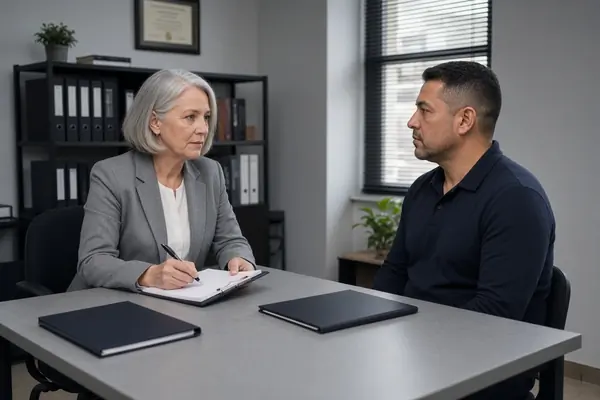
These 2 get used as if they mean the same thing. They don’t, and the difference changes almost everything about the room you walk into. If your case involves a custody evaluation, you are not in a therapy process at all.
| Court-ordered therapy | Court-ordered evaluation | |
|---|---|---|
| Goal | Help the family function | Answer a question the judge asked |
| Who the clinician serves | The patient | The court’s question |
| What you get | Sessions over time | A written report |
| How it reaches the judge | Through testimony or agreement | Under Rule 12.363, only if the parties agree in writing |
| What ends it | The order’s terms are met | The report is delivered |
| Who the clinician can be | Your ongoing provider | Someone with no prior role in the family |
Our forensic evaluations follow a fixed sequence: clinical interview, mental status exam, collateral interviews, record review, psychological testing, scoring and interpretation, then the written report. That’s roughly 10 hours of work per evaluation. Therapy has no such sequence, because it isn’t trying to answer anything for a court. Which evaluation a judge orders depends on the question in front of the court.
If your order uses the word evaluation, examination, or assessment, you’re in the right-hand column. Read it before your first appointment.

Why We Won’t Be Your Therapist And Your Evaluator
When a family we’ve been treating later needs a forensic opinion, we hand the evaluation to someone else. Every time.
The reason is in the table above. A treating clinician works for the patient’s improvement and owes that patient loyalty. A forensic evaluator works for the question in the court order and owes it objectivity. One person cannot hold both jobs without damaging both. An opinion written by someone who has sat in the therapy room with your family is an opinion the other side will attack, and they’ll usually be right to.
It starts before we take the case. When someone calls, we talk through the scope first and tell them whether we can provide an objective evaluation or whether we have to decline. Declining is common. It’s better than an opinion that falls apart at deposition.
Our doctors have testified in the 1st, 2nd, 15th, 17th, 19th, and 20th Judicial Circuits, covering Palm Beach, Broward, Martin, St. Lucie, Indian River, Okeechobee, Escambia, Okaloosa, Santa Rosa, Walton, Leon, Gadsden, Franklin, Jefferson, Liberty, Wakulla, Charlotte, Collier, Glades, and Hendry Counties. Dr. Christopher J. Beltran has been licensed in Florida since 2007, Dr. Matthew J. Jalazo since 2008, Dr. R. Lauren Miller since 2013, and Dr. Cathy Colet since 2014. We’re typically booked about 3 weeks out, which matters when your order carries a deadline.
What Florida Hasn’t Copied From California
On paper, a Florida judge’s therapy order is less bounded than a California one.
California caps court-ordered counseling at 1 year under Family Code 3190. In 2023, SB 331 went further and barred California courts from ordering family reunification treatment premised on cutting a child off from, or restricting contact with, the primary custodial parent, absent abuse or neglect. It also made judges state their reasons and the evidence they relied on.
Florida has no equivalent. Our only hard time cap is the 3-month continuance in 61.052(2), and that one is for reconciliation counseling, not for therapy in a parenting plan. In reunification cases specifically, that gap is the whole argument. The real limits on a Florida order come from appellate decisions like Malley, not from the statute book.
That’s a description of the law as it stands, not a complaint about it and not advice about your case. If you think an order in your case reaches too far, that’s a conversation for your attorney.

What Should You Do Before Your First Session?
Get a copy of the actual order and read what it names. Therapy or evaluation. Who is required to attend. How long it runs. What question, if any, the clinician is being asked to answer.
Then pick a provider who will tell you which role they’re in before the first appointment, in plain words. Ask directly: are you treating my family, or evaluating us for the court? A provider who won’t answer that cleanly has told you something.
Frequently Asked Questions
Can a court order therapy in Florida?
Yes. A Florida court can order a parent, a child, or both into counseling as part of a family law case. The authority comes from Chapter 61 and the Florida Family Law Rules of Procedure rather than a single therapy statute. Different orders carry different time limits, and a reconciliation counseling continuance under Fla. Stat. 61.052(2) cannot exceed 3 months.
Can a judge order my child to attend therapy if I disagree?
Often the judge doesn’t need to. Fla. Stat. 61.13(2)(b)3. requires that when shared parental responsibility over health care is ordered, the parenting plan let either parent consent to mental health treatment for the child. For an examination rather than treatment, Rule 12.363 requires a party’s motion or the court’s own motion, and an order stating the issues the expert will address.
Can my child’s therapist testify in my custody case?
Yes. The committee note to Rule 12.363 states the rule “is not intended to prevent a mental health professional who has engaged in long-term treatment of the child from testifying about the minor child.” A treating therapist is not automatically shielded from the witness stand.
How long can court-ordered therapy last in Florida?
There is no general statutory cap. The 3-month limit in Fla. Stat. 61.052(2) applies only to a continuance for reconciliation counseling. Therapy written into a parenting plan runs for whatever term the order sets, and how long these orders usually run varies by circuit. Florida has no 1-year ceiling like California Family Code 3190.
Can a Florida judge make my therapist decide whether I get more time-sharing?
No. In Malley v. Malley, No. 4D2023-0332 (Fla. 4th DCA, June 20, 2024), the Fourth District held that courts “may not delegate their statutory authority to determine visitation to GALs, attorneys, or experts.” A judge may condition increased time-sharing on completing therapy, but the judge decides whether the condition was met.
Is the mandatory parenting class the same as court-ordered therapy?
No. The Parent Education and Family Stabilization Course under Fla. Stat. 61.21 is a minimum 4-hour class required in every dissolution with minor children. The petitioner has 45 days from filing and other parties have 45 days from service. Missing it can bring contempt or a denial of shared parental responsibility or time-sharing.
What is the difference between court-ordered therapy and a court-ordered evaluation?
Therapy is treatment aimed at helping the family function, delivered over a series of sessions. An evaluation answers a specific question the judge asked and produces a written report. Under Rule 12.363, an evaluation report of a minor child reaches the judge only if the parties and their attorneys agree in writing.

Dr. Cathy Colet, Psy.D., is a Licensed Clinical and Forensic Psychologist and founder of FC PsychExperts in Jupiter, Florida. She provides expert witness testimony across criminal, family, and immigration law, with advanced training in competency evaluations, criminal responsibility, child custody assessments, and VAWA hardship waivers.