

Family Therapy For Adult Children And Parents In 2026
Written By: Michael Vale, Content Writer
Medically Reviewed By: Dr. Cathy Colet, Psy.D., Licensed Psychologist
Last Reviewed: November 6, 2026
Family therapy for adult children and parents works when every adult in the room wants the relationship to change, even if they disagree on how. It can repair old hurts and stop a fight that keeps repeating. It can also help siblings agree on care for an aging parent. What it can’t do is tell a family who’s right. It also shouldn’t be where anyone decides whether a parent can still manage their own affairs.
At FC PsychExperts, we work on both sides of that line. We provide family therapy, and we’ve written evaluations for Florida courts since 2008. Our psychologists are court-qualified expert witnesses in Florida’s 1st, 15th, 17th, 19th, and 20th Judicial Circuits. That’s why this guide spends as much time on where family therapy stops as on what it does.
What Is Family Therapy for Adult Children and Parents?
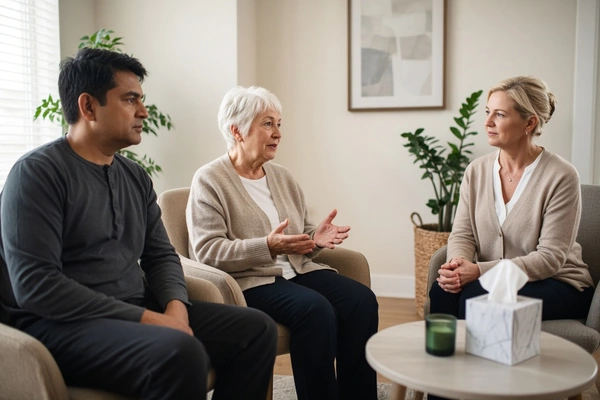
Family therapy for adult children and parents is talk therapy in which a grown child and 1 or both parents meet with a licensed therapist. Siblings or spouses can join. The therapist treats the pattern between people, not 1 person, and helps the family agree on what repair, or a workable distance, looks like.
It runs differently from family therapy with young kids. Every adult has an equal vote, and nobody’s parent can make them come. Who attends depends on the goal, and the mix can change from session to session. Adult children and aging parents are one of the 6 situations we list for family therapy in Jupiter. A teenager who has gone quiet and co-parenting after separation are 2 others.

The 2026 Pressures That Bring Adult Families In
Caregiving and estrangement are both common in American families, and both put grown children and parents at odds.
AARP and the National Alliance for Caregiving reported in 2025 that 63 million Americans gave ongoing care in the past year. Each cared for an adult or a child with a complex medical condition or a disability. That’s nearly 1 in 4 adults. Of those, 59 million were caring for someone over 18. We see that strain in our office. It shows up as caregiving decisions, old conflicts resurfacing, and siblings who can’t agree on what a parent needs.
Estrangement is the other pressure. Researchers at Ohio State University and the University of Alabama at Birmingham followed 8,495 mother-child and 8,119 father-child relationships from 1994 to 2018. They found that 26% of adult children reported a period of estrangement from their fathers, compared with 6% from their mothers. The same study, published in the Journal of Marriage and Family, found that most of those breaks ended: 81% with mothers and 69% with fathers.
Distance is common, and it usually isn’t permanent. A structured conversation can help a family find its way back.

What Can Family Therapy Fix for Adult Families?
It fixes patterns, like the fight that keeps replaying or the roles nobody updated when the kids grew up. In a first session here, the clinician maps the loop: who reacts to whom, what happens next, and where it ends. Families are usually surprised that the fight has a shape, and that shape is what therapy works on.
- An adult child wants a parent to hear what childhood felt like, and the parent hears an accusation. A therapist slows that exchange down so each person finishes a sentence before the other answers.
- Roles get stuck. A parent still gives orders to a grown child, who still answers like a teenager. Sessions let both practice talking as 2 adults.
- Siblings can sort out who handles which part of a parent’s care, and who gets a vote when they disagree.
- A new partner, or a widowed parent who starts dating, can unsettle a family that seemed fine.
- After a cutoff, sessions help a family decide whether to reconnect and on what terms. Some settle on limited contact that holds.

Where Family Therapy Stops
A family therapist shouldn’t decide who’s right or judge a parent’s capacity. Those are evaluation jobs, and they belong to someone who isn’t treating your family.
Families often hope the therapist will settle the argument. Kim Scott, a licensed marriage and family therapist, wrote about it in a 2025 article for therapists. It ran in the newsletter of LA-CAMFT, the Los Angeles chapter of the California Association of Marriage and Family Therapists. Families new to therapy, she wrote, might mistakenly expect the therapist to act as an arbitrator or judge. Don’t ask for that, and be cautious with a therapist who agrees to it.
Our profession’s own standards back this up. The American Psychological Association publishes Specialty Guidelines for Forensic Psychology. They say that treating and evaluating the same person, or closely related people, may impair objectivity. The guidelines encourage psychologists to explain that risk and refer the second job to another qualified provider.
Florida’s guardianship law draws a similar line, in section 744.331 of the Florida Statutes. Within 5 days after someone files a petition to determine incapacity, the court appoints a 3-member examining committee. The person’s attending or family physician can’t serve on it unless the court finds good cause.
We hold ourselves to the same rule. If we evaluate you, we won’t be the ones who treat you. If we treat you, we shouldn’t be the ones who evaluate you. Sometimes that means turning down an evaluation because we couldn’t be objective in it.
A therapist can still confirm attendance and progress if a court asks. That’s a record of treatment. An expert opinion on capacity comes from a forensic psychological evaluation. Ours cover the capacity to make a will or sign a power of attorney, plus evaluations that support guardianship petitions under chapter 744.
Therapy or a Forensic Evaluation: How They Differ
Therapy works for the family. An evaluation works for the court or the attorney who asked for it, and what you say can end up in a written report.
| Family therapy | Forensic evaluation | |
|---|---|---|
| Who it works for | The family and the goals it sets | The court or the attorney who requested it |
| The professional’s role | Helps the relationship and takes no side | Owes the court impartiality and gives an expert opinion |
| What happens to what you say | Stays in treatment, within Florida’s privilege law | Goes into a report the court or attorney reads |
| Time at our practice | Focused goals often improve in 8 to 12 sessions of 50 to 80 minutes | Standard reports are delivered within 30 days of the final assessment session |
| Questions it answers | How do we stop having this fight? | Did a parent have the capacity to make a will or sign a power of attorney? |
| Does it decide a legal issue? | No | No. It informs the judge, who decides |

Is What You Say in Family Therapy Confidential in Florida?
Mostly, yes. Florida’s privilege law protects therapy conversations, with 3 written exceptions.
Section 90.503 of the Florida Evidence Code lets a patient refuse to disclose, and stop others from disclosing, what was said in therapy. It covers psychologists, psychiatrists, and Florida-licensed clinical social workers, marriage and family therapists, and mental health counselors. A conversation can still count as confidential with other people in the room. They need to be there to further the patient’s interest or be taking part in treatment under the therapist’s direction.
The statute lists 3 exceptions:
- Proceedings to hospitalize a patient for mental illness, when the therapist has reasonable cause to believe the patient needs it.
- Court-ordered exams of the patient’s mental or emotional condition.
- Cases where the patient relies on their own mental or emotional condition as part of a claim or defense. After the patient dies, this applies when any party relies on that condition.
The third exception catches families off guard. After a parent dies, a will contest can turn on the parent’s mental condition. Then the parent’s therapy communications about that condition can come into the case.
Florida’s licensing laws add a rule for families. When more than 1 family member is in therapy, a waiver of confidentiality needs each member’s written agreement. That rule is in sections 490.0147 and 491.0147 of the Florida Statutes. At our practice, the limits of Florida law are explained in writing at intake. Family work also has its own confidentiality agreement, set before the first session. If someone gets time alone with the clinician, what’s shared back with the family is agreed in advance.
Talk to a Florida attorney before you count on any of this. This guide isn’t legal advice, and we’ve covered how the privilege works during a court case in more detail.
The Repair-or-Ruling Test
Before you book, answer 4 questions. They tell you whether your family needs a therapist, an evaluator, or both, and in what order.
- Does anyone want a judge to decide something? Guardianship, a will contest, or a fight over a parent’s power of attorney all count. If yes, you need a ruling, and an evaluation comes before therapy.
- Is someone’s memory or judgment in question? Start with a neuropsychological evaluation. Dr. Lauren Miller, Psy.D., J.D., our clinical and forensic neuropsychologist, tests memory, attention, language, processing speed, and executive function. Her evaluations also cover dementia, guardianship, and competency questions.
- Is anyone afraid of someone in the family? Violence, threats, or money disappearing from a parent’s account can make joint sessions less safe for the person who’s scared. In Florida, anyone who suspects a vulnerable adult is being abused, neglected, or exploited must report it to the Florida Abuse Hotline at 1-800-962-2873. Call 911 if someone is in immediate danger.
- Does every adult want the relationship to work, even if they disagree on how? If yes, and your first 3 answers were no, you have a repair job. Book family therapy.
A yes to question 1 or 2 often means you need both. Get the evaluation for the legal or medical question first, then therapy for the relationship, with a different clinician in each role.

How Long Family Therapy Takes
Focused goals often improve in 8 to 12 sessions. At our practice, family sessions run 50 to 80 minutes, and reunification after time apart usually takes longer.
That lines up with national data. The American Association for Marriage and Family Therapy puts the average family therapy case at 9 sessions. Individual treatment averages 13.
Your first family therapy session runs 80 minutes here. Everyone answers the same opening question: what would need to be different for you to say this helped? Nobody is interrupted, and the clinician watches how the family handles turns. You leave with 1 small thing to try before the next session.

What If Your Parent or Adult Child Won’t Come?
Start without them. When 1 person changes their part of a family pattern, the pattern can’t play out the same way.
Individual therapy gives you a place to plan what you’ll say and how you’ll answer when the old fight starts. When the same argument repeats no matter who’s across from you, the work is individual. Sessions here run 50 minutes. Some reluctant parents join later, once the invitation feels less like an ambush. Bring it up on a calm day, never in the middle of an argument.

Online Sessions When Family Lives in Another State
Video works for family members anywhere in Florida. A relative who joins from another state is a different case, because the therapist’s license may not cover them.
Sessions run in person in Jupiter or by secure video. Kim Scott’s LA-CAMFT article tells therapists to check whether every family member lives in the state where the therapist is licensed. If not, she suggests extended sessions when everyone is in town for a holiday or family event. Ask before you book, and plan around the visits already on your calendar.
Getting Started in Jupiter
Call 561-870-0411, weekdays from 7:30 AM to 4:30 PM. The first call is a free 15-minute conversation about who should come to the first session, fees, and insurance. First sessions are usually available within the same week.
Everyone should know what family therapy for adult children and parents is for before the first session. If your family needs repair, our Jupiter office at 210 Jupiter Lakes Blvd can set up a first session in person or by video. If the real question is a parent’s capacity, a will, or a court date, say so on the call. The office can then match you with the right service first.
Frequently Asked Questions
Is family therapy for adult children and parents worth it?
It’s worth it when every adult wants the relationship to work, even if they disagree on how. Estrangement is common but often temporary. A study published in the Journal of Marriage and Family found that 81% of estrangements from mothers and 69% from fathers ended. Sessions give that reconnection a structure, with a neutral professional in the room.
How long does family therapy for adult children and parents take?
At FC PsychExperts, focused goals often improve in 8 to 12 sessions of 50 to 80 minutes each. Nationally, the American Association for Marriage and Family Therapy reports an average of 9 sessions for family therapy cases. Reunification after time apart usually takes longer.
Can a family therapist decide whether my parent is competent?
No. Capacity calls for a forensic or neuropsychological evaluation. In a Florida guardianship case, the court appoints a 3-member examining committee to examine the person. Forensic guidelines from the American Psychological Association also caution against 1 psychologist treating and evaluating the same person or close relatives.
Is family therapy confidential in Florida?
Mostly. Section 90.503 of the Florida Evidence Code protects therapy communications, with 3 exceptions: hospitalization proceedings, court-ordered exams, and cases where the patient relies on their own mental condition. After the patient’s death, that third exception reaches any party who relies on the condition. Ask a Florida attorney how it applies to your family.
What if my parent refuses to go to family therapy?
Start with individual therapy on your own. Individual sessions at FC PsychExperts run 50 minutes. If you change your part of a family pattern, the pattern can’t play out the same way, and some parents agree to join later.
Can family therapy be done online if siblings live in other states?
FC PsychExperts offers secure video sessions for families anywhere in Florida. A therapist’s license may not cover a family member who joins from another state. Ask before you book, or plan a longer session for a time when everyone is in town.

Dr. Cathy Colet, Psy.D., is a Licensed Clinical and Forensic Psychologist and founder of FC PsychExperts in Jupiter, Florida. She provides expert witness testimony across criminal, family, and immigration law, with advanced training in competency evaluations, criminal responsibility, child custody assessments, and VAWA hardship waivers.