

Long Covid Brain Fog Disability Claim: What Actually Wins
Written By: Michael Vale, Content Writer
Medically Reviewed By: Dr. Cathy Colet, Psy.D., Licensed Psychologist
Last Reviewed: August 27, 2026
In March 2026, a nurse lost her long COVID disability appeal partly because her own psychiatric provider agreed she was not prevented from working from a cognitive standpoint. The Second Circuit affirmed the denial. Her complaints, the panel wrote, were “largely subjective and not supported by objective evidence demonstrating functional impairment.”
She never had formal cognitive testing.
Every long COVID brain fog disability claim turns on the same question: can you show, with standardized findings from a medical source, that the cognitive problem blocks specific work tasks? A symptom report does not answer that. Neither does a diagnosis. Social Security’s own rulebook says so in one line: “Objective medical evidence does not include symptoms, diagnoses, or medical opinions.”
That sentence has cost more claims than any insurer ever has.

What A Long COVID Brain Fog Disability Claim Actually Is
A long COVID brain fog disability claim is a request for benefits based on thinking problems that persist after a COVID-19 infection, most often memory lapses, slowed processing speed, and trouble holding attention. Insurers, Social Security, and courts decide it on functional evidence rather than on diagnosis. Standardized neuropsychological testing, with documented validity measures, is the usual proof.
What The Research Actually Shows About Long Covid And Thinking
The cognitive effect is real, measurable, and small in most people. That combination is exactly what makes these claims hard.
The largest study to date measured it. In a sample of 112,964 English adults who completed online cognitive testing, people whose COVID symptoms had not resolved after 12 weeks scored 0.42 standard deviations below people who never had COVID (95% CI, -0.53 to -0.31). Hampshire and colleagues published that in the New England Journal of Medicine in 2024. People treated in an ICU scored 0.63 SD lower, which the authors describe as roughly 9 IQ points. For everyone else the gap runs closer to 3 points.
Three points is not nothing. It is also not something a treating physician can see across a desk, and it is not something a normal brain MRI will ever show.
The risk does persist. Taquet and colleagues followed 1,284,437 matched patients in Lancet Psychiatry and found the hazard of a cognitive deficit diagnosis stayed above baseline for the full two years in adults aged 18 to 64 (HR 1.35) and in adults 65 and over (HR 1.41). Mood and anxiety disorders returned to baseline within two months. Brain fog did not.
Two 2026 findings sharpen the picture in opposite directions. Frontera and colleagues, publishing in Alzheimer’s and Dementia, followed 260 people for 4.4 years and found mild cognitive impairment in 27 percent of the long COVID group against 5 percent of the recovered group and 1 percent of those never infected. Small sample, wide confidence interval (HR 3.93, 95% CI 1.86 to 8.31), but the direction is hard to dismiss. Pulling the other way, a June 2026 preprint from a VA group tested 86 adults and found no difference in objective cognitive performance between people reporting post-COVID cognitive changes and controls, despite large differences in depression and anxiety scores. That one has not been peer reviewed, and it reports no validity testing at all, which matters for reasons that come up below.
Treatment has been the disappointment. The NIH RECOVER-NEURO trial randomized 328 people across 22 sites to online cognitive training, structured cognitive rehabilitation, or transcranial direct current stimulation. Published in JAMA Neurology in November 2025, it found no differential benefit from any of the three.
Why “My Doctor Says I Have Brain Fog” Loses
Because a diagnosis is not a functional finding, and every decision-maker in this space is trained to know the difference.
The Second Circuit case is the cleanest example. In Alexander v. Unum Life Insurance Company of America, No. 25-974 (2d Cir. Mar. 17, 2026), the panel conceded that fatigue and brain fog resist easy measurement. Then it held that the functional limits “could be objectively measured,” and that “the absence of testing, clinical findings, or other evidence demonstrating work-preclusive limitations was therefore a permissible basis” for discounting what the claimant said about herself. General diagnoses, the court wrote, “do not answer the more granular question about her ability to work during the period in question.”
It is a summary order, so it binds nobody. Read the reasoning anyway, because carriers are.
Social Security says the same thing in gentler language. Its 2023 guide for health professionals on long COVID evidence states that “symptoms alone cannot be the basis for a finding of disability,” and asks providers to submit clinical and laboratory findings, positive and negative. That document never once names neuropsychological testing as an evidence type. The silence is not a rule against it. It is a gap a well-built report fills.
On the employment side the answer is friendlier but still conditional. The July 2021 joint guidance from HHS and the Department of Justice holds that long COVID can be a disability under the ADA “if it substantially limits one or more major life activities,” and it names brain fog directly: a person with memory lapses and brain fog “is substantially limited in brain function, concentrating, and/or thinking.” The guidance also insists on an individualized assessment, which is the polite way of saying the diagnosis alone gets you nowhere.
Can Testing Hurt My Claim?
Yes, and pretending otherwise does claimants no favors. Neuropsychological testing is a measuring instrument, not an advocacy tool, and it returns whatever the person’s performance returns.
Mendoza v. First Unum Life Insurance Company, No. 3:24-cv-00834 (S.D. Cal. May 5, 2025), is the case nobody in this field writes about. The claimant did get tested. The results “did not substantiate claims of significant cognitive dysfunction.” Scores landed within normal limits or mildly impaired, mental status exams were largely normal, and his reported extreme fatigue sat badly next to documented international travel. Testing was the thing that closed the file.
Then there is the case that runs the other way. In Abrams v. Unum Life Insurance Company of America, No. C21-0980 TSZ (W.D. Wash. Dec. 27, 2022), the neuropsychologist found no cognitive impairment, found above-average cognitive ability, and found no malingering. The claimant won anyway. He won on daily temperature recordings backed by video, on corroboration from family, physicians, and colleagues who all described the same functional change, and on the specific cognitive load of trial work. As the court put it, “the accuracy of Plaintiff’s diagnoses is not, however, the question before the Court.”
Normal scores did not defeat that claim, because the disability theory was never built on scores.
A fourth case is worth one line for the opposite reason. In Baltes v. Metropolitan Life Insurance Company, No. 2:23-cv-07404 (C.D. Cal. Nov. 12, 2025), the claimant won and the court faulted MetLife’s consultant for demanding cognitive testing the plan never required. The supporting evaluation there leaned on SPECT neuroimaging offered as proof the brain was injured. SPECT is not accepted mainstream practice for attributing cognitive impairment to a cause, and a defense expert who knows that has an easy afternoon. Winning on a method that will not survive the next challenge is a temporary win.
Four cases, four different roles for testing. That is the honest picture, and it is why the choice of evaluator matters more than the choice of test. The mechanics of the evaluation itself, how to prepare and what happens when an insurer orders its own, are covered in our guide to what a neuropsychological evaluation involves in a disability claim.

What Is Performance Validity Testing, And Why Does It Help You?
Performance validity tests, or PVTs, measure whether someone is putting forth full effort on cognitive testing. They look like memory tasks and are scored against a floor that almost everyone with genuine impairment clears. Symptom validity tests do the parallel job for self-reported symptoms. Together they answer the question every carrier’s file reviewer is already asking silently.
Most claimants and a surprising number of attorneys assume validity testing is something done to them. It is closer to the opposite. A cognitive result with no validity data attached is a number a reviewing psychologist can discount for free, and they will, because they have no way to weigh it. A result carrying four passed PVTs is a number they have to argue with.
Our own writeup on detecting malingering in forensic evaluations walks through the specific instruments and why no single test carries a conclusion on its own.
Do Long COVID Claimants Actually Fail Validity Testing?
Less often than the general clinical population, based on the only two published samples that measured it. This is the finding that should change how these claims are argued, and as of today I have not seen it in a single article aimed at claimants or attorneys.
Whiteside and colleagues tested 247 consecutive long COVID patients on four PVTs and published the results in the Journal of Clinical and Experimental Neuropsychology in 2024. Results: 8.9 percent failed two or more, 6.4 percent failed one, and 85 percent passed cleanly. The groups that passed “showed no evidence for significant cognitive deficits.” The authors’ recommendation was that PVTs be administered routinely in long COVID cases.
Clark and colleagues, in Archives of Clinical Neuropsychology in 2025, tested 323 long COVID clinic patients and found 6.3 percent failed both embedded PVTs. Failure was unrelated to how severe the person’s COVID had been, and unrelated to how many cognitive complaints they reported.
Set those against the background rates:
| Population | Measure | Rate |
|---|---|---|
| Long COVID clinic patients (Whiteside 2024, n=247) | Failed 2 or more PVTs | 8.9% |
| Long COVID clinic patients (Clark 2025, n=323) | Failed both PVTs | 6.3% |
| Clinical populations pooled (Roor 2024, 47 studies) | PVT failure | 16% |
| Clinical, no external gain incentive (Roor 2024) | PVT failure | 10% |
| Disability referrals (Mittenberg 2002, clinician estimate) | Probable malingering or exaggeration | 30% |
| Personal injury referrals (Mittenberg 2002) | Probable malingering or exaggeration | 29% |
The comparison is not clean and I will not pretend it is. The long COVID samples are clinic patients rather than litigants, and Mittenberg’s figures are clinician judgment rather than measured test failure. But the direction is consistent across both long COVID studies, and it points the opposite way from the assumption that runs underneath most claim denials.
One caution belongs next to it. Within the Whiteside sample, an external incentive was present in 54.5 percent of the people who failed, against 22.1 percent of those who passed. Incentive is not proof of anything about any individual. It is a reason the testing has to happen, not a reason to skip it.
Put plainly: on the published numbers, validity testing is the credible long COVID claimant’s asset. The claimant whose evaluator never ran PVTs handed the carrier a free argument. The claimant who passed four of them bought something the carrier has to answer.
What Belongs In A Long COVID Evaluation
Four things, and most reports I review as a claims consultant are missing at least two of them.
One: validity data, reported openly. Multiple PVTs plus symptom validity measures, with the actual results in the report rather than a sentence saying effort was adequate. A report that buries this reads as though it has something to bury.
Two: findings tied to named job tasks. Not “impaired executive function.” Something closer to “cannot sustain divided attention past 20 minutes, which is the length of the shortest scheduled patient handoff.” Alexander turned on exactly this gap, and the Baltes court faulted a reviewer for never reading the job description.
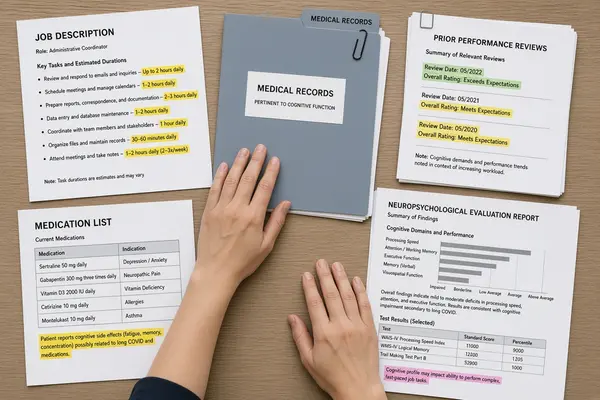
Three: a pre-illness baseline, reconstructed from records. Academic transcripts, prior testing, licensure exam scores, performance reviews. Long COVID deficits are small in absolute terms. Against a documented high baseline, a score at the 40th percentile means something. Without one, it is just a score.
Four: a stated position on alternative explanations. Depression, anxiety, sleep disruption, medication effects, and deconditioning all produce the same profile. A report that never mentions them will be told about them by the other side. The Frontera group’s own data on depression and anxiety scores in post-COVID samples is not an argument against the claim. It is a set of questions the report should answer before it is asked.
That fourth item is where I spend most of my time when analyzing an opposing expert’s work and drafting deposition questions. A report that has already handled the alternative explanations is difficult to cross-examine. A report that has not is a gift.

Five Forums, Five Different Evidence Standards
They are not the same, and claimants routinely prepare for the wrong one. Here is what each forum actually requires.
| Forum | Who decides | Evidence standard | Where cognitive testing lands |
|---|---|---|---|
| Social Security (SSDI/SSI) | SSA, then ALJ | Signs or laboratory findings from a medical source. Symptoms and diagnoses excluded by rule (POMS DI 24503.010) | Standardized test findings qualify as signs. SSA’s own long COVID guide never names them, so the report has to make the connection |
| Private LTD under ERISA | Plan administrator, then federal court on the administrative record | Whatever the policy says. Many require objective evidence of functional impairment; some require nothing | Often decisive. Alexander lost for its absence, Mendoza lost because of its content |
| Florida workers’ compensation | Judge of Compensation Claims | Clear and convincing medical evidence from a licensed psychiatrist, plus an accompanying physical injury (Fla. Stat. 440.093) | Structurally limited. See the next section |
| Personal injury (Florida civil) | Jury, with the expert screened under Fla. Stat. 90.702 | Preponderance, but the expert must clear Daubert first | Admissibility is the fight, not weight |
| ADA accommodation | Employer, then EEOC or court | Substantially limits a major life activity, assessed individually | Supports the limitation, usually without litigation |
One policy trap sits underneath the ERISA row. Most long-term disability policies change definition at 24 months, from “cannot perform your own occupation” to “cannot perform any occupation.” Claims paid without objection for two years get re-reviewed against a harder standard, and cognitive claims that rested on self-report tend not to survive it. If a claim is approaching month 20, that is when testing is worth the most, not after the denial arrives.

How Is A Florida Claim Different?
In workers’ compensation, considerably, and not in the claimant’s favor.
Florida Statute 440.093 requires that mental or nervous injuries be “demonstrated by clear and convincing medical evidence by a licensed psychiatrist.” Not a psychologist. It also bars benefits for a mental or nervous injury “without an accompanying physical injury requiring medical treatment,” and requires that the physical injury be and remain at least 50 percent responsible for the mental condition compared to all other causes combined. Temporary benefits cap at six months past maximum medical improvement for the physical injury.
For a long COVID cognitive claim in Florida comp, that stacks three hurdles before anyone opens a test protocol. A psychologist’s role there is to supply the testing and the functional analysis that a psychiatrist’s opinion rests on, not to be the opining source. Getting that division wrong wastes the evaluation.
Civil cases run on different rails. Florida has been a Daubert state since the legislature enacted the standard in 2013 and the Florida Supreme Court adopted it as a procedural rule in 2019, in In re Amendments to the Florida Evidence Code, 278 So. 3d 551 (Fla. 2019). As of this writing I have found no published Florida or federal decision ruling on a Daubert challenge to expert testimony about long COVID cognitive impairment. That fight has not happened yet. When it does, the method used will matter more than the conclusion reached, which is one more reason to keep SPECT and similar approaches out of the report.

What To Send An Evaluator
Send the records before the appointment, not after. The reconstruction of a pre-illness baseline is the slowest part of the work and the part that most often changes the conclusion.
The list that earns its keep: the policy or plan document with the definition of disability and the change-of-definition date; the job description with actual task durations; performance reviews from before and after the infection; the full medical record including the acute COVID episode; any prior cognitive or psychoeducational testing; medication lists with start dates; and the denial letter with the reviewer’s report, if there is one. That last document tells the evaluator exactly which questions the report has to answer.
Attorneys handling personal injury matters where cognitive damages are in play, or building a record where a traumatic brain injury has to be proven, face the same evidentiary structure with a different burden attached.
FC PsychExperts has evaluated for Florida courts since 2008, with clinicians court-qualified in the 1st, 15th, 17th, 19th, and 20th Judicial Circuits, taking referrals from plaintiff and defense counsel alike. If you are weighing whether a long COVID cognitive claim can be documented well enough to hold, call 561-870-0411 and we will tell you before you commit a client’s money to it. Our forensic evaluation service page covers scope and scheduling, and the timeline for a psychological evaluation is set out separately.
If you are the claimant rather than the attorney, the decision usually belongs to your lawyer, and the question worth asking them is whether your file contains any objective evidence of functional impairment at all. A long COVID brain fog disability claim without it is not a hard case. It is arithmetic.
Frequently Asked Questions
Is long COVID brain fog a disability under the ADA?
It can be. The July 2021 joint guidance from HHS and the Department of Justice states that long COVID is a disability if it substantially limits one or more major life activities, and names brain fog as an example of substantial limitation in brain function, concentrating, or thinking. The guidance requires an individualized assessment, so the diagnosis alone does not establish it.
What counts as objective evidence in a long COVID brain fog disability claim?
Social Security defines objective medical evidence as “signs, laboratory findings, or both, from a medical source,” and excludes symptoms, diagnoses, and medical opinions by rule. Standardized neuropsychological test findings qualify as signs. A physician’s letter describing your symptoms does not.
Can I have real cognitive impairment with normal test scores?
Yes, and courts have accepted it. In Abrams v. Unum (W.D. Wash. 2022) the neuropsychologist found no cognitive impairment and above-average ability, and the claimant still won on documented physical signs and corroboration from family, physicians, and colleagues. The effect sizes in long COVID are small, around 3 IQ points for most people, which is real but often within the normal range.
What percentage of long COVID patients fail validity testing?
In the two published samples, 8.9 percent of 247 patients failed two or more performance validity tests (Whiteside 2024) and 6.3 percent of 323 patients failed both embedded measures (Clark 2025). Both figures sit below the 16 percent pooled failure rate across clinical populations generally.
Will a normal brain MRI sink my long COVID claim?
It should not, and a reviewer who says otherwise is misreading the evidence. Structural imaging in long COVID shows group-level differences too small to diagnose an individual. Cognitive function is measured by performance testing, not by scans.
Should I get tested before or after my claim is denied?
Before, and ideally before the 24-month change-of-definition date in a long-term disability policy. Claims paid for two years on self-report get re-reviewed against a harder standard, and testing obtained after a denial enters an administrative record that may already be closed.

Dr. Cathy Colet, Psy.D., is a Licensed Clinical and Forensic Psychologist and founder of FC PsychExperts in Jupiter, Florida. She provides expert witness testimony across criminal, family, and immigration law, with advanced training in competency evaluations, criminal responsibility, child custody assessments, and VAWA hardship waivers.