
Coconut Creek falls under Broward County’s 17th Judicial Circuit. FC PsychExperts conducts court-ready forensic psychological evaluations for that circuit from our Fort Lauderdale office on West Cypress Creek Road, about 20 minutes from Coconut Creek. Four licensed Florida psychologists handle competency, sanity, custody, risk, personal injury, and immigration evaluations, and have testified thousands of times, for both sides, in courthouses, jails, and detention facilities across the state.
Most pages that rank for this search are directory profiles. They give you a name, a number, and a license. This page gives you what those listings leave out: what an evaluation costs, how to confirm an evaluator is currently approved for court work in 2026, how the process runs, and which courthouse actually serves Coconut Creek.

At a Glance
- Four licensed Florida psychologists (PY9058, PY8992, PY7803, PY6432)
- Testimony in Broward’s 17th Circuit and five other Florida circuits
- Thousands of evaluations and testimony appearances, for both sides
- About 75% forensic focus since 2008
- Typically booked about three weeks out, with limited rush capacity
What a Forensic Psychological Evaluation Costs in Broward
Private forensic work in South Florida may be billed hourly, through a flat fee based on the evaluation type, or with an initial retainer. The total fee depends on the legal question, the complexity of the case, the amount of testing and record review required, the number of people involved, and whether testimony is needed.
Court-appointed criminal evaluations follow court-established compensation schedules, which differ from private-retention arrangements. Health insurance generally does not cover forensic evaluations because they address legal questions rather than treatment needs.
After a brief scope call, we provide the applicable flat fee or retainer before any work begins. Deposition and trial testimony are billed separately from the evaluation itself.
How to Confirm a Court-Appointed Evaluator in 2026
Ask for current standing on Florida’s Department of Children and Families forensic evaluator list, not an old training certificate. This changed recently, and most directory pages have not caught up.
A 2025 amendment to Chapter 916, Florida Statutes (Chapter 2025-143) requires court-appointed evaluators to complete annual update training from DCF, not only the original University of South Florida forensic examiner course. Evaluators already on the list must finish the annual training by July 1, 2026 or be removed. DCF sends each circuit a refreshed list once a year. So a certificate from a training taken years ago no longer tells you whether someone is eligible for court-appointed work today.
Before you retain or request a court-appointed evaluator anywhere in Florida, confirm they hold an active Florida license through the Florida Board of Psychology and that their name is on the current DCF forensic evaluator list for the year. Ask the question directly. A current evaluator will answer it without hesitation.
How our Evaluations Work, start to finish
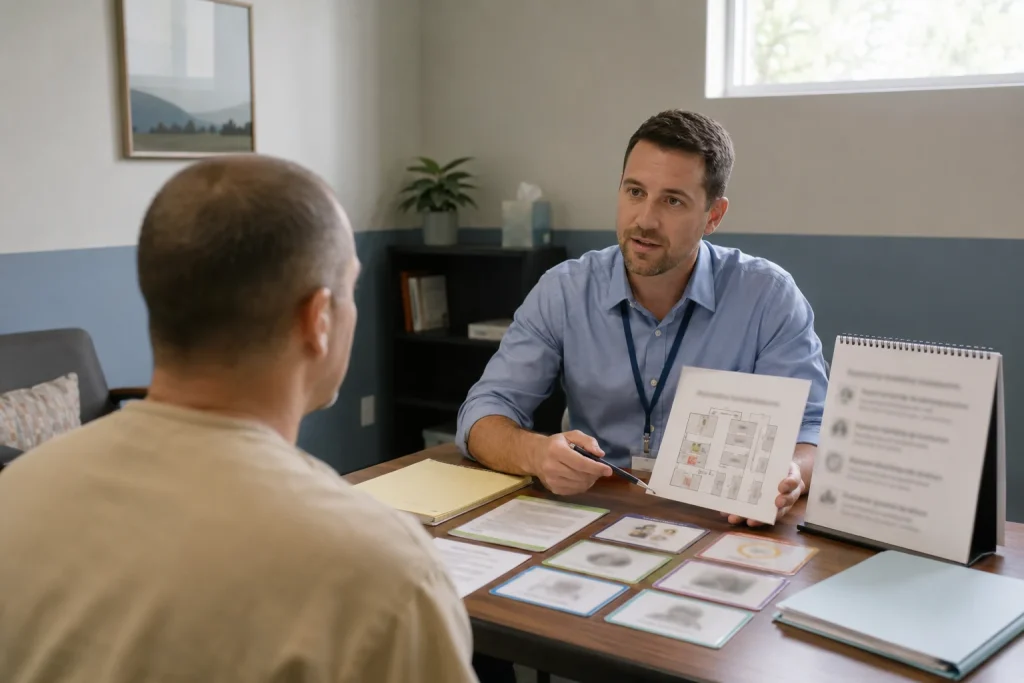
Every forensic evaluation follows the same defensible sequence: records review, a clinical interview, a mental status exam, collateral interviews, standardized psychological testing with scored interpretation, and a written report. A typical evaluation runs about 10 hours of professional time. We are usually booked about three weeks out, and we hold limited rush capacity for cases against a filing deadline.
Testing is matched to the referral question, not applied from a fixed checklist. Competency questions typically use structured tools such as the ECST-R or MacCAT-CA. Violence risk uses the HCR-20. Sexual-offense risk uses the Static-99R. Personality and response validity use the MMPI-2-RF or PAI. Cognitive questions use the WAIS. The report states the question we were asked, the data we reviewed, the methods we used, and the opinion we reached, with the reasoning laid out so it holds up under cross-examination.
Evaluations we Provide
We complete the full range of forensic evaluations for criminal, family, civil, and immigration matters. On the criminal side: competency to proceed for adults and juveniles, sanity and criminal responsibility, sentencing mitigation, competence to waive Miranda rights, violence risk, and sexual-offender risk. On the family and civil side: custody and time-sharing evaluations, parenting-capacity assessments, attachment and bonding evaluations, and clinical psychological evaluations that document emotional injury in personal-injury and employment cases. We also conduct immigration evaluations for asylum, hardship, and trauma claims. See the full list of forensic evaluations we offer.
Reports built for Florida’s Daubert standard
Florida admits expert testimony under the Daubert standard, set out in section 90.702, Florida Statutes. That means an opinion has to rest on sufficient facts, reliable methods, and a sound application of those methods to the case. We write to that bar: validated instruments, documented data sources, and reasoning a judge can follow and an opposing expert can test. Reports that skip those steps get challenged, and challenged reports cost your case time it may not have.
The forensic team
FC PsychExperts is a four-doctor practice, which lets us cover criminal, civil, family, and immigration questions and assign the right evaluator to your case.
- Dr. Cathy Colet, Psy.D. – Founder. Licensed clinical and forensic psychologist, Florida license PY9058, licensed since 2014. Trains doctoral-level students in forensic assessment.
- Dr. R. Lauren Miller, Psy.D., J.D., ABAP – Board-certified neuropsychologist and licensed psychologist, Florida license PY8992, licensed since 2013. Also trains doctoral-level students.
- Dr. Matthew J. Jalazo, Psy.D. – Licensed psychologist specializing in forensic psychology, Florida license PY7803, first licensed in 2008.
- Dr. Christopher J. Beltran, Psy.D. – Licensed psychologist specializing in forensic psychology, Florida license PY6432, first licensed in 2007.
Our senior evaluators bring 18 to 19 years of forensic practice. The team holds memberships in the American Psychological Association, the Association of Family and Conciliation Courts, the Association for the Treatment of Sexual Abusers, the American Professional Society on the Abuse of Children, and Physicians for Human Rights. You can verify any Florida license through the Florida Board of Psychology, and read more about our practice.
Who Retains Us
Criminal defense attorneys, prosecutors, family-law attorneys, plaintiff and defense civil attorneys, and immigration attorneys retain us. So do courts directly, child-welfare agencies such as ChildNet and Community Connected for Kids, and private clients. Our experts have been accepted by both sides, prosecution and defense, plaintiff and defense, and have conducted evaluations at courthouses, jails, juvenile detention centers, correctional facilities, and federal and ICE detention facilities across Florida.
Serving Coconut Creek and the 17th Judicial Circuit
We work Coconut Creek from our Fort Lauderdale office at 1451 W. Cypress Creek Road, Suite 300, Fort Lauderdale, FL 33309, roughly a 20-minute drive from the city. We also keep an office in Jupiter, and we accept cases across Florida.
Coconut Creek matters are heard in Broward’s 17th Judicial Circuit. Depending on the division, that usually means the North Regional Courthouse at 1600 W. Hillsboro Boulevard in Deerfield Beach or the Central Courthouse at 201 SE 6th Street in Fort Lauderdale. We conduct evaluations at our office and, when a case calls for it, at courthouses and secure facilities. Forensic specialists serving Coconut Creek are almost all based elsewhere in Broward and travel in, so treat this as a circuit-wide market and choose on qualifications, not a Coconut Creek mailing address. We also serve nearby Coral Springs, Parkland, and North Lauderdale.
Office hours are Monday through Friday, 7:30 AM to 4:30 PM, and Saturday 9:00 AM to 4:00 PM. Our practice serves clients without judgment based on age, race, gender, religion, or sexual preference.
Common Questions about Forensic Psychology in Coconut Creek
How do I confirm an evaluator is currently court-approved in Florida?
Check two things: an active license with the Florida Board of Psychology, and current standing on the DCF forensic evaluator list for the year. Since a 2025 change to Chapter 916, court-appointed evaluators must complete annual DCF update training, and those who do not finish it by July 1, 2026 come off the list. An old training certificate is not proof of current eligibility.
Is there a free or lower-cost option for custody evaluations?
Sometimes. Under section 61.20, Florida Statutes, a judge can order a social investigation into time-sharing. In most cases the parents pay for it, taxed as a cost of the case, unless the court uses its own staff or a parent is found indigent. It is not automatically free, and it is not the same as a private custody evaluation. Ask the court whether a court-conducted investigation is available in your matter.
How long does an evaluation take, and how far out are you booked?
A typical evaluation involves about 10 hours of professional time across interviews, testing, records review, and report writing. We are usually booked about three weeks out and hold limited rush capacity for deadline-driven cases.
Do you come to Coconut Creek, or do I come to you?
Most evaluations happen at our Fort Lauderdale office, about 20 minutes from Coconut Creek. When a case requires it, we conduct evaluations at courthouses and secure facilities, and we work across the 17th Circuit and statewide.
Can the same psychologist evaluate my client and then treat them?
No. Ethics rules bar the evaluating forensic psychologist from also providing therapy to the same person, because it compromises objectivity. A separate clinician who had no part in the evaluation can provide treatment.
What is the difference between a clinical and a forensic psychologist?
A clinical psychologist treats mental-health conditions. A forensic psychologist answers a legal question for a court, stays objective rather than therapeutic, and writes to a standard that survives legal challenge.
Request a Consultation
Tell us the legal question, the deadline, and the venue, and we will tell you whether we can provide an objective evaluation and what it will cost. If the case is outside what we can answer objectively, we will say so. To start, we generally need the records, the court order if there is one, and signed releases.