

When To Stop Therapy: A Psychologist’s 3 Checks
Written By: Michael Vale, Health Content Writer
Medically Reviewed By: Dr. Cathy Colet, Psy.D., Licensed Psychologist
Last Reviewed: October 19, 2026
When to stop therapy depends on 3 checks. You’ve met the goals you set at the start. Your scores on a standard symptom questionnaire are back in the low range. And your gains hold up once sessions get spaced out. All 3 passing means it’s time to plan a final session with your therapist. With only 1 or 2, taper instead of quitting, as long as your scores are under 10. A score of 10 or higher means keep working, whatever the other checks say. If nothing has moved after a fair trial, review the plan or the fit with your therapist.
I’m Dr. Cathy Colet, a clinical and forensic psychologist in Jupiter, Florida. I founded FC PsychExperts in 2008, and I direct clinical care for our therapy services in Palm Beach County and Fort Lauderdale. After 18 years of forensic practice, I think in measurements: symptoms, daily function, risk. That’s why I push back on a piece of advice you’ll see on other sites: trust your gut.
Early exits are common. In 2012, psychologists Joshua Swift and Roger Greenberg pooled 669 studies covering 83,834 adults. They found that 19.7% of clients drop out of therapy early, or about 1 in 5. A planned ending is the opposite of a dropout, and planning starts with knowing what done looks like.

When Should You Stop Therapy?
You should stop therapy when 3 checks pass at the same time. The goals you set at intake are met. A standard questionnaire, like the PHQ-9 for depression or the GAD-7 for anxiety, puts you back in the low range. And your gains hold after sessions move to every other week or monthly.
That bar is higher than having a good week, since good weeks happen in the middle of treatment, too. You’re looking for change that shows up on paper, in your daily life and without your therapist in the room.
Why Gut Feel Isn’t Enough
Gut calls miss change, even for trained therapists. Psychologist Michael Lambert described a 2005 study by Hannan and colleagues in the APA journal Psychotherapy in 2015. In it, 40 therapists predicted which of their 550 clients would leave treatment worse off. They picked 3, and only 1 of those 3 got worse. In fact, 40 clients got worse. A statistical method applied to data from the same period flagged 36 of those 40.
Experienced therapists did no better than trainees.
That study tested therapists’ judgment. In my view, the lesson carries over to clients: measured data catches what a feeling can miss. Feelings drift with sleep, stress and whatever happened that morning. A questionnaire asks the same questions the same way every time.
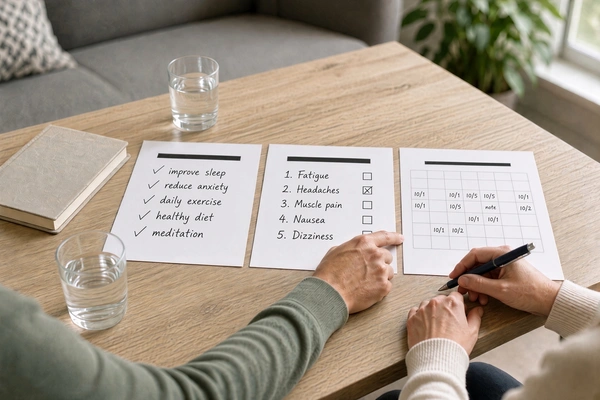
The 3-Check Test for Ending Therapy
Run all 3 checks before you set an end date, since each one covers a blind spot the others miss. Goals tell you whether you got what you came for, and scores tell you whether your symptoms agree. The solo test is the easiest one to skip, and it’s the one that shows whether the change lasts.
Check 1: your goals
Pull out the goals you and your therapist set at the start. Vague goals, like “feel better,” can’t be checked. Rewrite them as things you can see, such as sleeping through the night or driving on the highway again.
In our individual therapy, you and your therapist decide in the first session what you want to change. Our family therapists write goals in the family’s own words and review progress at set points. Set goals now if you never did, because ending therapy without them is guesswork.
Check 2: your scores
Ask for the same questionnaire you took at intake, or for a first one if you never took one. The 2 I’d start with are short. The PHQ-9 has 9 questions about depression, and the GAD-7 has 7 about anxiety.
Both have simple score lines. The original PHQ-9 study tested about 6,000 patients. Kurt Kroenke and colleagues found that scores of 5, 10, 15 and 20 marked mild, moderate, moderately severe and severe depression. In 2006, Robert Spitzer’s team suggested GAD-7 lines at 5, 10 and 15 for mild, moderate and severe anxiety.
Those lines measure severity. They weren’t designed as rules for ending therapy, so treat my reading below as a starting point to go over with your therapist.
For this decision, I read the scores like this:
- Under 5 on both: the symptom side passes.
- 5 to 9: you’re in the mild range. Taper and test again.
- 10 or higher: keep working, whatever your goals look like. That line matters: in the PHQ-9 study, a score of 10 or more caught 88% of patients who had major depression.
A single rule overrides the total. Question 9 on the PHQ-9 asks about thoughts that you’d be better off dead or of hurting yourself. Any answer other than “not at all” means you tell your therapist that day. If you’re in crisis, call or text 988. If you’re in immediate danger, call 911.
For scale, a full psychological exam at our practice takes 3 to 4 hours of interview plus 3 to 4 hours of testing. You don’t need that to decide whether to end therapy, and 16 questions are a fair start. When your scores and your sense of things don’t line up, a clinical assessment can go further.
Check 3: the solo test
Therapy is practice for life without therapy, so test that. Move to every other week, then monthly, and watch what happens when a hard week hits.
Our own plans work the same way. Individual therapy runs weekly, then spaces out.
Check 3 passes when you use your skills without being prompted. It fails when every problem gets saved for the next session.

How Many Sessions Does Therapy Usually Take?
First gains can come early, and recovery takes longer. In a classic study cited by the American Psychological Association, half of patients improved by session 8 and 75% by 6 months. Recovery is a higher bar. An APA patient page on treatment length, published with its PTSD guideline, puts recovery for half of patients at 15 to 20 sessions on average. That figure comes from patients’ own symptom reports.
| Milestone | Typical range |
|---|---|
| Some people start to feel better | About 6 to 12 sessions |
| Half of patients improved (1 study) | By session 8 |
| 75% of patients improved (same study) | By 6 months |
| Half of patients recovered | 15 to 20 sessions, on average |
| Clinically significant improvement in a specific treatment | For example, 12 to 16 weekly sessions |
| Fuller remission and keeping gains, when patient and therapist choose longer treatment | For example, 20 to 30 sessions over 6 months |
| Co-occurring conditions or personality difficulties | May need longer, for example 12 to 18 months |
Our therapy service pages list these typical ranges at FC PsychExperts.
| Service | Typical range | Session length |
|---|---|---|
| Individual therapy | 6 to 12 sessions for a focused concern; longer for deeper or trauma-related work | 50 minutes |
| Family therapy | 8 to 12 sessions, longer for reunification | 50 to 80 minutes |
| Couples therapy | 8 to 20 sessions | 50 to 80 minutes |
| Co-parenting therapy | 6 to 10 sessions, longer for high conflict | 50 to 80 minutes |
| Court-ordered therapy | Set by the order | 50 minutes |
Treat these as ranges, since nobody can promise a number. But if you’re past session 12 and your scores haven’t moved, say so. That’s a cue to review the plan with your therapist, which might mean a different approach or more support. APA notes that some people start to feel better within about 6 to 12 sessions.
Signs It’s Time to Stop Therapy in 2026
The clearest signs show up outside the therapy room. You have less to bring to sessions, and the people around you notice the change.
- You arrive with less to talk about, week after week.
- Old patterns still show up, but you catch them in the moment.
- A rough week no longer waits for your next appointment. You handle it.
- Your partner, kids or coworkers comment on the change.
- Your sessions are more about plans than problems.
Treat any one of these as a cue to run the 3 checks, since no single sign settles it.

When to Stop Therapy, Taper, Switch or Pause
Stop when all 3 checks pass, and taper while 1 or 2 are still shaky and your scores are under 10. Scores of 10 or higher mean keep going. A poor fit calls for a different therapist, and a schedule crunch or a move can call for a pause with a date to come back.
| Your situation | Best move | First step |
|---|---|---|
| All 3 checks pass | Stop | Book a final session to review what changed and your warning signs |
| Goals mostly met, scores 5 to 9 | Taper | Move to every other week, then monthly |
| Scores of 10 or higher, any thoughts of self-harm, or you want out because sessions got hard | Keep going and say so | Raise it at your next session |
| No change in your scores by about session 12 | Review the plan | Ask about the approach, the level of care or the fit |
| You feel judged, unheard or unsafe | Switch | Ask for referrals. Psychologists are expected to suggest other providers when appropriate |
| A schedule change or a move, with scores under 10 | Pause | Ask about video sessions or a referral first. Then set a check-in date and keep your last scores |
Switching therapists doesn’t mean therapy failed you. A therapist with a different method or training may get you unstuck. To sort out what type of professional you need, start with the difference between a counselor or a psychologist.
Some reasons to leave don’t need a final session. If a therapist crosses a personal line or makes you feel unsafe, you can end right away.
Is the Urge to Quit a Sign You’re Avoiding Something?
Sometimes it is. When therapy reaches painful material, sessions can feel worse before they feel better, and the urge to quit can spike right then.
Swift and Greenberg’s review found higher dropout among younger clients, people with personality or eating disorder diagnoses, and clients seeing therapists still in training. If you fit one of those groups, the urge to leave deserves a conversation before a decision.
Say it out loud in session. “I want to quit, and I’m not sure why” is a fine opening line. Your therapist can help you sort avoidance from readiness, and your scores will help too.

How Do You Tell Your Therapist You Want to Stop?
Say it in session, plainly, and early enough to plan a real ending. Ending is part of the work, and a good therapist will want to plan it with you.
These openers work if you’re not sure how to start:
- “I think I’m close to done. Can we look at my goals and scores and pick an end date?”
- “This isn’t working for me. Can you refer me to someone with a different approach?”
- “I need to pause for a while. Can we set a date to check in?”
Use the last session to name what changed, list your early warning signs and agree on what would bring you back. Ask for a copy of your final scores.
Feeling sad or uneasy about ending is common, even when it’s the right call. Say so in that last session, since it’s part of finishing well.
An email or text is fine when talking feels too hard. Disappearing means you miss the referrals and the relapse plan.
Can Your Therapist End Therapy?
Yes. The American Psychological Association’s ethics code for psychologists covers it. Therapy should end when it’s reasonably clear you no longer need it, aren’t likely to benefit, or are being harmed by it.
The same standard lets a psychologist end treatment if they’re threatened or endangered. Before ending, they should give you time to talk it through and suggest other providers when appropriate. The exception is when your own actions or your insurer make that impossible. If your therapist raises ending first, ask which reason applies. Sometimes it’s the best one: you’re done.

What If a Court Ordered Your Therapy?
Then the order sets the finish line, and feeling ready doesn’t change it. Don’t stop early on your own, and talk to your attorney first.
Orders differ. Some set a fixed count of sessions or weeks. Others say therapy continues until it’s successfully completed, and then your clinician judges when you’ve met that and puts it in writing. Case type is one of the factors that set the time frame, which is why court-ordered therapy length varies so much.
In our court-ordered therapy program, your clinician logs, dates and signs attendance after every session. Progress summaries go to your attorney, probation officer or the court when they ask. When you meet the requirement, you get a completion letter that states the requirement, the dates and that it was met. Documents go only where you authorize, and sessions stay confidential within legal guidelines.
Some orders require in-person sessions and others allow video, so we confirm before your first session. Meeting the order doesn’t mean you have to stop, either. We encourage clients to keep going when the work is helping.
Ending Couples, Family or Co-Parenting Therapy
Ideally, everyone in the room agrees on the ending, and the goals that count are the shared ones. If one partner wants out and the other doesn’t, that disagreement is the next session’s topic. Anyone who feels unsafe in joint sessions can stop attending them and talk with the therapist alone.
Our family therapy runs in 5 stages. As progress builds, sessions spread out on purpose while the family practices new patterns at home. The final stage is where everyone names what changed and plans for setbacks, and the door stays open after that.
Co-parenting therapy usually takes 6 to 10 sessions to build a working communication system, and longer for high-conflict cases. Before you stop, check whether a parenting plan or court order covers it.

Coming Back After You Stop
Going back later is a normal part of a good plan. Decide in your last session what would bring you back, and pick concrete triggers. A PHQ-9 or GAD-7 score back at 5 or higher is one. An old pattern that returns and sticks is another, and so is a big life change on the way. Thoughts of self-harm are always a reason to call right away.
Keep your last scores so you have something to compare against. If you take medication for depression or anxiety, ending therapy is a separate decision, so don’t change your medication without talking to your prescriber.
If you’re torn on when to stop therapy, ask your therapist for your scores before you decide. Our therapists see clients in Jupiter, in Fort Lauderdale and by secure video across Florida for individual, family, couples, co-parenting and court-ordered therapy. To book a time, contact our office in Jupiter or Fort Lauderdale, or call 561-870-0411.
Frequently Asked Questions
How do you know when to stop therapy?
You know when to stop therapy when 3 checks pass: your intake goals are met, your PHQ-9 or GAD-7 scores are under 5, and your gains hold as sessions space out to monthly. With 1 or 2 passing and scores under 10, taper instead. A score of 10 or higher, or any thoughts of self-harm, means keep working with your therapist.
Should I stop therapy once I feel better?
Not right away. APA notes that some people feel better within about 6 to 12 sessions, but an APA patient page reports that it takes 15 to 20 sessions, on average, for half of patients to recover. Use that first good stretch as a cue to run the 3 checks.
Is 6 months of therapy enough?
It can be. In a classic study cited by the American Psychological Association, 75% of patients had improved by 6 months. Some patients and therapists choose longer treatment, for example 20 to 30 sessions over 6 months, to reach fuller remission and keep gains, and co-occurring conditions or personality difficulties may need 12 to 18 months.
Is it OK to stop therapy without telling your therapist?
You can. About 1 in 5 adult clients drop out early, according to a 2012 review of 669 studies. A short email or a final session gets you referrals, a relapse plan and a copy of your scores.
Who decides when to stop therapy if a court ordered it?
The order sets the bar. Some orders set a fixed count of sessions or weeks, and for open-ended orders, your clinician judges when you’ve met the requirement and documents it for the court. Talk to your attorney before you stop.
Can I go back to therapy after I stop?
Yes, and it’s smart to plan for it. Pick your triggers in your last session, such as a PHQ-9 or GAD-7 score back at 5 or higher. Thoughts of self-harm mean calling your therapist that day or 988, and 911 in an emergency. At FC PsychExperts, you can book a session by secure video from anywhere in Florida.

Dr. Cathy Colet, Psy.D., is a Licensed Clinical and Forensic Psychologist and founder of FC PsychExperts in Jupiter, Florida. She provides expert witness testimony across criminal, family, and immigration law, with advanced training in competency evaluations, criminal responsibility, child custody assessments, and VAWA hardship waivers.